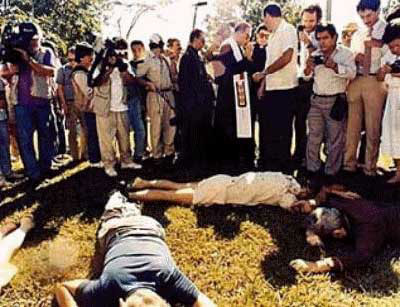
Twenty Five years ago, on November 16, 1989, Ignacio Ellacuría, S.J., Ignacio Martín-Baró, S.J., Segundo Montes, S.J., Juan Ramón Moreno, S.J., Joaquín López y López, S.J., Amando López, S.J. and their housekeeper Elba Ramos, and her 15 year-old daughter Celina Ramos, were murdered at the University of Central America in San Salvador, El Salvador.
The murder of the six Jesuits, their house keeper and her daughter, was at the hands of the Salvadoran military. There is clear evidence, based on declassified documents that the order to kill the Jesuits came from the highest levels of the Salvadoran military. In fact, some of the Salvadoran soldiers involved in the 1989 massacre, were also graduates of the notorious US Army School of the Americas.
The Jesuits were targeted, in part, because they were seen as the “intellectual authors” of the Salvadoran left. While there is no clear connection between the Jesuits and the armed insurgents of the 1980s (FMLN), the priests were known for their sharp and ongoing critique of the Salvadoran elite. Here is a video report done by the BBC on the murder of the 6 Jesuit priests, their cook and her daughter in El Salvador in 1989.
Grand Rapids Responds
As soon as word got out to the international community about this most recent atrocity in El Salvador, those involved in the Grand Rapids Central American Solidarity movement mobilized.
About 100 people blocked traffic on Michigan Avenue in front of the Federal building in Grand Rapids. The road blockade consisted of people using two long banners that people held up, with one banner stating, “End US Military Aid to El Salvador.”
After protestors blocked traffic for 30 minutes, the Grand Rapids police came and threatened to arrest people if they did not move. Most of those blocking the trafficking decided to leave the road rather than get arrested. Shortly afterwards another contingent of people went into Congressman Paul Henry’s office and attempted to make a citizen’s arrest against the Congressman and his staff.
Several people held signs about the most recent massacre in El Salvador, while others read the Congressman’s staff their rights. Another protestor leaned over the counter in the congressional office and picked up the phone to call the GRPD, making the claim that there were “violent crimes being committed at 110 Michigan.”
Eventually, the federal building security showed up and demanded that people leave. One by one the security guards dragged people out and the doors to the federal building were locked so no one could get back in.
Another action was organized a week later, where those resisting US policy in El Salvador built coffins and made cardboard tombstones to draw attention to the US financed murders. One protestor began to dig a grave in the federal building lawn, but before they could did a large enough hole to bury the coffin, federal building security came out a took the shovel away. Those protesting US policy were still able to bury half of the coffin and place the cardboard tombstone next to it, while others held signs by Michigan Avenue.
These actions that took place 25 years ago, were in larger part, due to the nearly decade long Central American Solidarity movement that existed in Grand Rapids.
 Grand Rapids People's History Project
Pingback: Campaign to Boycott Salvadoran Coffee was part of the Grand Rapids Central American Solidarity Movement in the early 1990s | Grand Rapids People's History Project
Pingback: We don’t need no stinking permits to protest: 100 years of dissent and disruption in Grand Rapids | Grand Rapids Institute for Information Democracy