Calvin College took a stand against South African Apartheid by Divesting

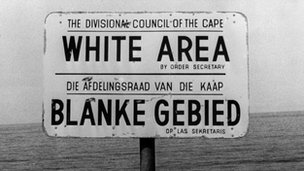
_62537028_getty_apartheidnotice_capetown

Last week we posted a piece about the early efforts at organizing in Grand Rapids around defeating South African Apartheid.  Numerous community groups and organizations pushed the Grand Rapids City Council to adopt a resolution against having any investments in companies or financial institutions doing business in South Africa.

Besides the work done to pressure the City of grand Rapids, other efforts were taking place in Grand Rapids that were part of the larger Anti-Apartheid Movement targeting South Africa. Calvin College was one of those entities that participated in this movement.

Beginning in the early 1980s, students and faculty members began investigating the issue, especially since the Christian Reformed Church was directly involved in the historical dynamics that contributed to Apartheid policies in South Africa.

One thing that made the Anti-Apartheid campaign get off the ground was the presence of Allan Boesak, a member of the Dutch Reformed Church and one of the leading Anti-Apartheid activists from South Africa. Boesak not only spoke at Calvin College in 1983, he was invite to be a visiting professor.Screen Shot 2014-12-11 at 3.02.30 AM
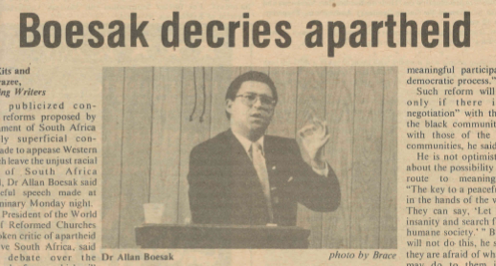
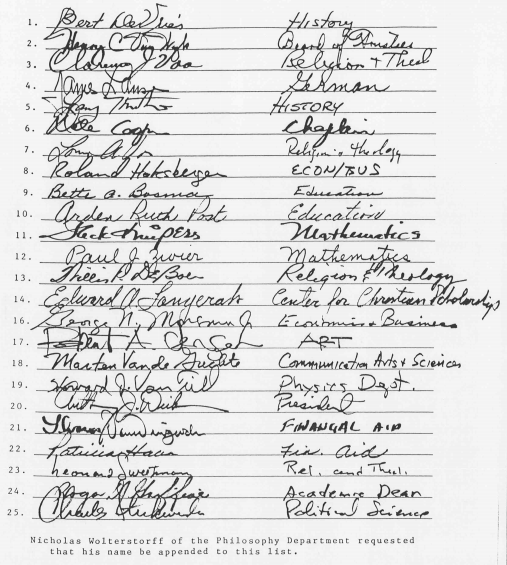
This relationship with Boesak was important for the longevity of the Anti-Apartheid Movement on Calvin’s campus, because now students and faculty had a relationship with someone who was the target of South African government harassment. Evidence of how the Calvin community was engaged around this personal relationship with Boesak is evidenced by a letter sent and signed by dozens of Calvin faculty (pages 1 – 10), which was addressed to then South African President Botha. The letter, like so many others from that movement put pressure on the South African government to end their abuse of those involved in the Anti-Apartheid Movement.Screen Shot 2014-12-11 at 3.38.01 AM
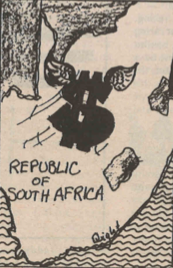
Coverage of the Anti-Apartheid efforts at Calvin can be found in the student newspaper, The Chimes, over a several year period.  One can see that there were ongoing efforts to educate the campus community on the issues centered around South African Apartheid, but most of the coverage was about the actual campaign of divestment.Screen Shot 2014-12-11 at 3.02.12 AM
Students and faculty had begun a campaign to get Calvin College to divest from any company profiting off of racist Apartheid policies. The Student Senate had done the research looking into how much money Calvin College had invested in companies doing business in South Africa and in a letter to the college president in October of 1985, they provide a breakdown of this money. (page 13) Screen Shot 2014-12-11 at 3.26.27 AM
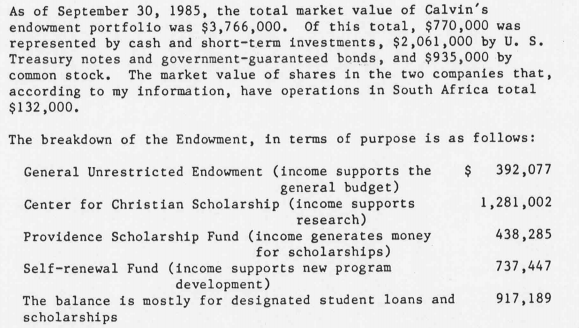
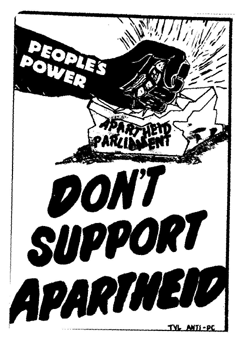
One can see that the amount was not very large, especially when compared to larger colleges and universities across the country, but the amount was not relevant to the students organizing around the campaign. in fact, the students deeply involved in the campaign had very well thought out arguments in response to those who questioned the efficacy of divestment (pages 16 – 21) anti-apartheid-poster
This well organized campaign paid off, when the finance committee of the Board of Trustees decided to divest Calvin College funds from two companies in November of 1986. The Chimes article (page 9) on this action states,  According to President DeWit, “These two companies were right on the verge of the legitimate classification in the Sullivan system. It was proper, rather than to press the point, to sell them.” 

It was the efforts of people at institutions such as Calvin College, using the tactic of divestment, which eventually dismantled the Apartheid policies of South Africa.
Posted in Anti-Apartheid Movement | Tagged , , , | 2 Comments

An obligation to not participate in racist activities: The South African Anti-Apartheid Movement in Grand Rapids

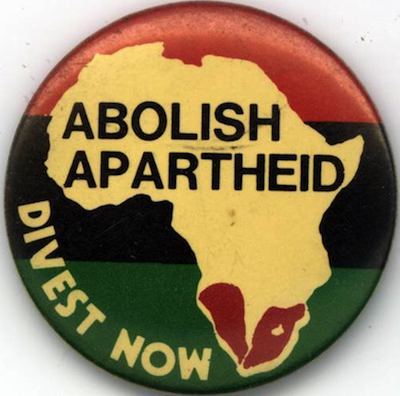
(This is the first is a series of articles that deals with the South African Anti-Apartheid Movement that was active in Grand Rapids.)Abolish_Apartheid

The international Anti-Apartheid Movement for justice in South Africa is an interesting case study and an example of how economic boycotts, economic sanctions and economic divestments can be effective tools to fight against racism and White Supremacy.

The Anti-Apartheid Movement was born out of the struggle of Black South Africans demanding political and legal equality. After decades of political struggle by groups like the African National Congress (ANC) and events such as the Soweto Massacre of 1976 and the murder of Steve Biko in 1977, a call for a Boycott, Divestment and Sanctions (BDS) Campaign was issued.

Dozens of States around the world and millions of people actively participated in the Anti-Apartheid campaign and particularly the BDS Campaign. Pressure was put on the diamond industry that profited from South African Apartheid and many other corporations that did business in South Africa, such as Coca Cola, GM, IMB, Motorola and Caterpillar.

Universities, religious institutions, unions and municipalities also participated in the South African Anti-Apartheid movement by divesting funds from banks and other financial institutions profiting from Apartheid.anti-apartheid

The Divestment efforts were well organized across the country and in Grand Rapids. Numerous organizations and religious institutions took a public stand against South African Apartheid by holding forums, educating the public and initiating a divestment campaign in Grand Rapids in 1982.

The City of Grand Rapids adopted a resolution put forth by the Community Relations Commission in 1982, which was the result of a grassroots effort by dozens of organizations and countless individuals who were organizing against South African Apartheid. 

The language of the resolution reads in part:

Screen Shot 2014-12-02 at 12.43.34 PM

Such a resolution was only possible because so many people were involved and pressured the City of Grand Rapids to take such a stance. Organizations such as the Grand Rapids NAACP, the Grand Rapids Urban League, the YWCA, the Hispanic Center, the Grand Rapids Inter-Tribal Council and the Institute for Global Education, along with religious groups such as Temple Emmanuel, Plymouth Congregational Church, the Afro-America Lay Catholic Caucus of Grand Rapids and the Christian Reformed Church in North America all sent letters in support of the resolution, demonstrating such an effort was initiated and endorsed by the community. 

The letter from the Grand Rapids Urban League in part reads:

The current racial policy of Apartheid, practiced by South Africa is an insult and an injustice to the people of color in South African, as well as a violation of universally excepted human rights.

The City of Grand Rapids has a moral obligation to sever all economic ties to South Africa whether they are direct or indirect.

The Grand Rapids Chapter of the NAACP also used strong words to push for the resolution. Their statement in part reads:

Most often, the policy of Apartheid sustains its existence on the monies of people and companies who knowingly or unknowingly do business with businesses which contribute directly to the South African government.

The City of Grand Rapids has an obligation to this city and its citizens to not participate in racist activities of any kind.

The City of Grand Rapids eventually divested its funds from any financial institution or business that was profiting off of South African Apartheid. The Boycott, Divestment and Sanctions campaign organized in Grand Rapids was another example of the power of movement fighting for against oppression and for justice.

Posted in Anti-Apartheid Movement | Tagged , , | 10 Comments

Fighting for the Rights of Animals has a long history in Grand Rapids

This is the first posting in a series of articles and interviews that deals with the organizing around animal rights and animal liberation in West Michigan.1782096_10152245889634430_1830757221_n

There has been some new attention given to Animal Rights in Grand Rapids, with the efforts by numerous people to get the City of Grand Rapids to take a position on allowing the circus to preform in town.

The group Grand Rapids for Animals encouraged people to use this online letter to pressure city officials to ban the use of wild animals in entertainment. 

Grand Rapids for Animals has been active for years, but is not the first group to organize around animal rights and animal liberation.

Beginning in the 1980s, the group known as West Michigan for Animals, organized around a whole array of animal rights campaigns, like a lot of their contemporaries across the country.

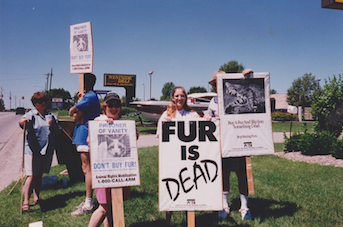
West Michigan for Animals organized protests against the murder of animals for food, with protests at Fast Food Restaurants and slaughterhouses, like the one pictured here.

WM for Animals 2

In addition, West Michigan for Animals organized a large protest outside the Amway Grand Plaza in 1994, during the US Cattlemen’s Association Conference. The local media attempted to marginalize the group by asking the question of whether or not the the Cattlemen’s Association was the same as mass murderer Jeffrey Dahmer. Organizers of the protest responded by saying, “If the systemic slaughter of millions of cows a year for profit is not mass murder, then what do you call it?”

West Michigan for Animals also took on a local rodeo that was held in Sparta for years, as well as anytime the Circus came to Grand Rapids.

WM for Animals 3

Another major area of protest was around the fur industry. West Michigan for Animals protested at a store that sold animal furs, located near the Gaslight Village, in East Grand Rapids. Besides leafletting against the business, the group would sometimes organize street theater and hold a mock fur event, where those protesting would splash red paint on fake fur coats to dramatize the brutality done to animals.

In the early 1990s the group organized protests at “fur shows” in the old Grand Center, located on Monroe, where the new convention center exists.

WM for Animals

These are just a sampling of the kinds of actions that people engaged in around animal rights and animal liberation. It is important to note that the current effort to get the city to ban the use of animals at the circus, is built on decades of activism around the rights of animals.

Posted in Animal Rights/Animal Liberation | Tagged , , , , | 1 Comment

Twenty Five Years Ago Grand Rapids Responded to the Murder of Priests in El Salvador

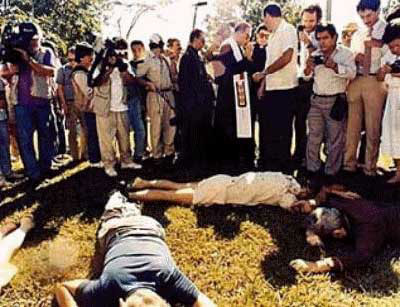
Twenty Five years ago, on November 16, 1989, Ignacio Ellacuría, S.J., Ignacio Martín-Baró, S.J., Segundo Montes, S.J., Juan Ramón Moreno, S.J., Joaquín López y López, S.J., Amando López, S.J. and their housekeeper Elba Ramos, and her 15 year-old daughter Celina Ramos, were murdered at the University of Central America in San Salvador, El Salvador.dead-jesuits1

The murder of the six Jesuits, their house keeper and her daughter, was at the hands of the Salvadoran military. There is clear evidence, based on declassified documents that the order to kill the Jesuits came from the highest levels of the Salvadoran military. In fact, some of the Salvadoran soldiers involved in the 1989 massacre, were also graduates of the notorious US Army School of the Americas

The Jesuits were targeted, in part, because they were seen as the “intellectual authors” of the Salvadoran left. While there is no clear connection between the Jesuits and the armed insurgents of the 1980s (FMLN), the priests were known for their sharp and ongoing critique of the Salvadoran elite. Here is a video report done by the BBC on the murder of the 6 Jesuit priests, their cook and her daughter in El Salvador in 1989.

Grand Rapids Responds

As soon as word got out to the international community about this most recent atrocity in El Salvador, those involved in the Grand Rapids Central American Solidarity movement mobilized.

About 100 people blocked traffic on Michigan Avenue in front of the Federal building in Grand Rapids. The road blockade consisted of people using two long banners that people held up, with one banner stating, “End US Military Aid to El Salvador.” 

After protestors blocked traffic for 30 minutes, the Grand Rapids police came and threatened to arrest people if they did not move. Most of those blocking the trafficking decided to leave the road rather than get arrested. Shortly afterwards another contingent of people went into Congressman Paul Henry’s office and attempted to make a citizen’s arrest against the Congressman and his staff.

Several people held signs about the most recent massacre in El Salvador, while others read the Congressman’s staff their rights. Another protestor leaned over the counter in the congressional office and picked up the phone to call the GRPD, making the claim that there were “violent crimes being committed at 110 Michigan.”

Eventually, the federal building security showed up and demanded that people leave. One by one the security guards dragged people out and the doors to the federal building were locked so no one could get back in.

Another action was organized a week later, where those resisting US policy in El Salvador built coffins and made cardboard tombstones to draw attention to the US financed murders. One protestor began to dig a grave in the federal building lawn, but before they could did a large enough hole to bury the coffin, federal building security came out a took the shovel away. Those protesting US policy were still able to bury half of the coffin and place the cardboard tombstone next to it, while others held signs by Michigan Avenue.

These actions that took place 25 years ago, were in larger part, due to the nearly decade long Central American Solidarity movement that existed in Grand Rapids.

ucamartyrs2

Posted in Central American Solidarity Movement | Tagged , , , , | 2 Comments

There are Robber Barons in every generation in Grand Rapids

When reading radical historian Howard Zinn’s, A People’s History of the United States, it becomes clear early on that one can not talk about social movements without talking about the power structures that those movements fought against.

Whether it was slave owning class, robber barons, war profiteers, White Supremacist power structures or other sectors of power, Zinn makes it clear that every major social movement experienced push back from these structures of power.Screen Shot 2014-11-12 at 2.23.23 PM

Grand Rapids has its own history of robber barons, right from the start. City fathers such as Lucius Lyons and Louis Campau were some of the earliest robber barons, buying up land that had belonged to the local Native community. These men are seen as in competition with each other, but it is also clear that they were both beneficiaries of White Settler Colonialism that was moving westward after the founding of the United States.

Like much of the mid-west, Grand Rapids had its own industrialists, particularly in the furniture industry. Men like Henry Widdicomb (pictured here), were not only the beneficiaries of massive deforestation in the Great Lakes, they also made their wealth by paying workers low wages. Widdicomb, according to Jeffrey Kleiman, author of Strike: How the Furniture Workers Strike of 1911 Changed Grand Rapids, was one of the most vicious in attacking workers during the 1911 strike. Widdicomb also led the charge to bring in scab workers and hire thugs to break the strike.

In more recent decades the robber barons have names like Van Andel, DeVos, Seechia, Kennedy, Frey, Jandernoa, Hunting & Wege, just to name a few. All of these families made their wealth through the labor of working class people and by accessing public funds for private gain. The graph here demonstrations how many of them are part of the same power structures in Grand Rapids.

Screen Shot 2014-11-12 at 4.04.02 PM

Probably the most notable contemporary robber baron family is the DeVos family. Co-founders of Amway, the now three generations of DeVos family members have inserted themselves into a great deal of local state and national politics. The DeVos family has been buying elections and influencing policy by spending millions on political campaigns and lobbying. They own a tremendous amount of property in downtown Grand Rapids, most of the hotels and through their involvement in Grand Action, have re-directed millions in public funds (Van Andel Arena, DeVos Convention Center and the Downtown Market) to benefit themselves and the other members of the capitalist class in Grand Rapids.

The DeVos family is so wealthy that they used to own their own island. For years the family owned Peter Island, part of the British Virgin Islands, but more recently have invested heavily in The Cape Eleuthera resort and real estate project, according to an online source

This should not be a surprise for those who have followed the DeVos family, their excessive wealth and how they flaunt it. The DeVos Family owns one of the world’s largest yachts, which they have so arrogantly named Freedom. Below is a picture of the yacht, accompanied by an interior photo. More recently, the family has acquired the yacht know as Seaquest, which is 130 foot long. 

Frederick Douglass’ point about power conceding nothing without a demand is still relevant today. Indeed, with a growing gap between those with wealth and those in poverty, it is clear that those with wealth will not willingly give it up. As with all generations of social movements, we need to know who the opposition is and be prepared to fight against them, because they sure as hell will not ignore social movements that want substantive social justice.

Screen Shot 2014-11-13 at 9.12.35 AM

Posted in Anti-Capitalism/Labor | Tagged , , , | Leave a comment

The Nuclear Freeze Movement inspired many in Grand Rapids

Beginning in the late 1970s, many people in the US began to learn about the dangers of nuclear weapons and possibility of nuclear war.

The US and there former Soviet Union were engaged in a nuclear arms race, with both countries increasing their nuclear weapons stockpiles and placing these weapons of mass destruction all across the planet.Nuclear Freeze Campaign Group

A movement to challenge the proliferation of nuclear weapons was born and involved not only seasoned activists, but included physicians, social workers, scientists and teachers. Groups like Physicians for Social Responsibility help push an anti-nuclear agenda that focused on getting the US to sign on to an arms reduction treaty as the beginning stages of a total nuclear disarmament campaign.

In Grand Rapids, a local chapter of Physicians for Social Responsibility, the Institute for Global Education (IGE) and various faith-based groups formed a coalition to educate the community and organize for nuclear disarmament. The group pictured above, were some of the main organizers of the Grand Rapids campaign. This picture was taken in front of the YWCA building on Sheldon SE, where IGE had an office in the early 80s.Screen Shot 2014-11-07 at 1.06.18 PM

The educational campaign focused on hosting forums, creating and distributing literature, screening films like If You Love This Planet and holding regular demonstrations in public spaces in order to engage the community. One tactic was to get communities, organizations or congregations to declare themselves Nuclear Free Zones, as is pictured here. The Nuclear Free Zones were part of the Ground Zero Campaign, to help people understand what would happen to communities hit by a nuclear bomb.

Another tactic used to draw attention to the harsh realities of a nuclear attack was to hold a Die-In on the First Friday of the month in downtown Grand Rapids. At noon, a siren goes off as a test, but it is the same siren that would be used if an impending disaster would happen, such as a nuclear attack. People involved in the Freeze Campaign would be on the old Monroe Mall downtown and when the siren went off they would scream and fall to the ground. Other members of the Freeze Campaign would hand out flyers to people walking by to let them know what would actually happen if a nuclear bomb fell on Grand Rapids.

Over time, some of these same activists would use the old weather ball (formerly located on top of the Michigan National building) as a way to draw attention to nuclear war and nuclear winter by saying, WEATHER BALL BLACK, NUCLEAR ATTACK.Anti-Nuke arrests in UP

However, the organizing against nuclear war and nuclear proliferation by people in Grand Rapids involved taking action outside of West MI. Several campaigns involved people confronting nuclear madness where the bombs were deployed and where the bombs were made.

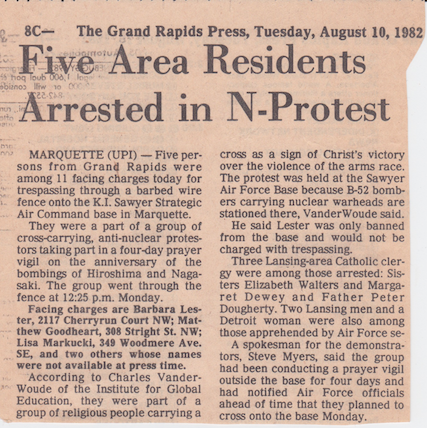
In August of 1982, several people were arrested at the K.I. Sawyer Air Force Base, which was a Strategic Air Command base in the UP. Barb Lester, Matt Goodheart and Lisa Markucki, all from Grand Rapids, were arrested for trespassing at the military base.

Other campaigns targeted weapons manufacturers, such as Williams International in Walled Lake, MI and Lear Siegler, located in the southeastern part of Grand Rapids. Numerous people were involved in campaigns to shut down production of nuclear weapons at both of these factories, using educational campaigns, vigils and direct action to stop the manufacturing of weapons of mass destruction.Screen Shot 2014-11-07 at 12.56.28 PM

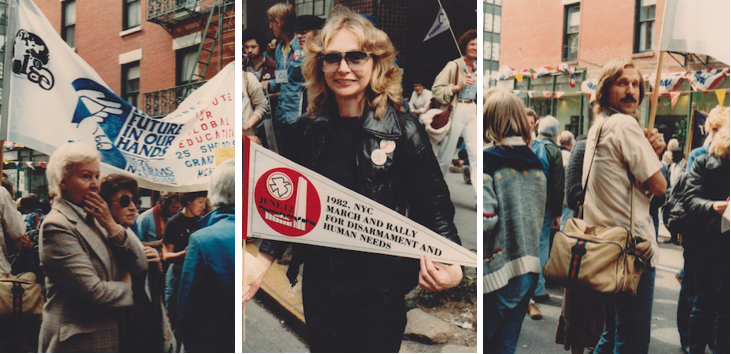
The Freeze Campaign hit its peak however, in 1982, with the mobilization of over 1 million people in New York City during a United Nations gathering. Several people from Grand Rapids participated in that march, with high visibility from the Institute for Global Education, as seen in the pictures below. There were also 2 women from Grand Rapids who were arrested at the massive Nuclear Freeze march in New York, Lori and Beth Smalligan.

While the Nuclear Freeze Movement did not stop the proliferation of nuclear weapons by the US, it did create a new generation of activists who went on to be involved in the Central American Solidarity and the Anti-Apartheid movements of the 1980s.

Screen Shot 2014-11-07 at 1.13.56 PM

Screen Shot 2014-11-07 at 1.15.05 PM

Posted in Anti-Nuclear Movement | Tagged , , , | 2 Comments

Street Theater was a common tactic in the Grand Rapids Central America Solidarity Movement

TO Fist Logo 3

Street Theater has been a tactic used by social movements for decades as a means to dramatize the message of a particular campaign.

Much of the modern day street theater can be linked to the work of Brazilian artist Augusto Boal, credited with starting the famous Theater of the Oppressed. 

One example of using street theater in Grand Rapids occurred in 1984, the day after Ronald Reagan was re-elected as President of the United States.

The Stop the Invasion Campaign (STIC), organized an intense form of street theater in Grand Rapids as a way to draw attention to the kind of brutal policies that the US government was supporting in Central America.

The Stop the Invasion Campaign staged a series of mock kidnappings throughout Grand Rapids, where hooded men would drag off someone, throw them in a van and drive off. People who witnessed the mock kidnappings were not sure what was actually taking place, but moments later other STIC members handed out information sheets explaining that what people just witnessed was a dramatization of what death-squads do in Guatemala and El Salvador everyday.STIC Street Theater

The mock kidnapping began on Monroe Avenue, right in front of the Amway Grand Plaza Hotel cafe, where a van pulled up to a screeching halt and hooded men jumped out and grab a woman. The staged kidnappings then moved to the old Monroe Mall, where Father Paul Milanowski was taken. Milanowski was part of a regular Wednesday vigil that took place on the old Monore Mall against US policies in Central America.

After the priest was kidnapped, STIC members then went into the GRCC cafeteria and took a student, climbing over tables to grab her (pictured here). The next stop was in front of a Meijer store on Kalamazoo & 28th street, where someone in a wheelchair was dragged into the van, with his wheelchair left behind and witnesses left in shock.

STIC PosterThe last mock kidnapping took place at the County building, where Kent County Commissioner Liz Oppewal was taken during a County Commission meeting.

These actions all began at noon and the STIC members and supporters ended up in front of the Federal building for a protest that included about 40 people.

The street theater was an effective tool to get both the general public and other activists thinking about the daily violence in Central America that was being paid for by our tax dollars. The timing of the event was also part of a larger STIC strategy to resist US policies in Central America, which included the ongoing threat of a direct US military invasion of Nicaragua.

Posted in Central American Solidarity Movement | Tagged , , , , | 1 Comment

Calvin Student Newspaper Coverage of Vietnam War Resistance

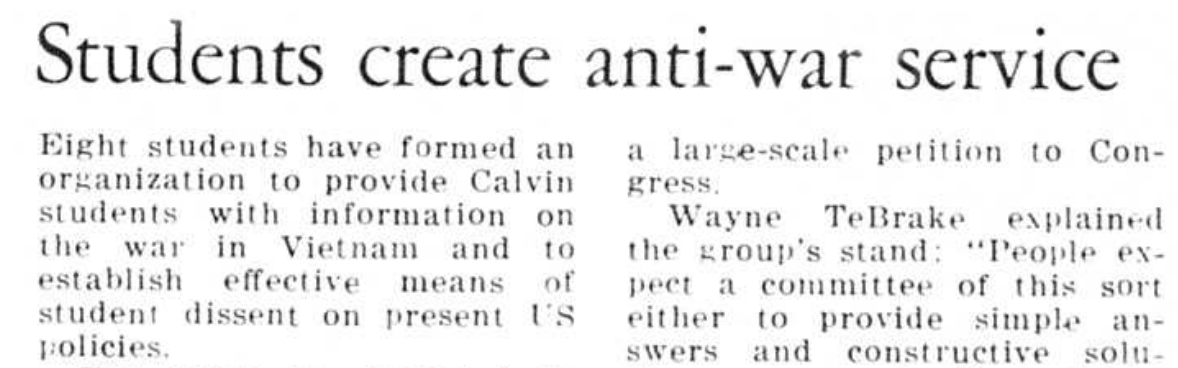
Last month we posted a piece on the diversity of tactics being used in Grand Rapids to resist the US war in Vietnam. Screen Shot 2014-10-27 at 2.19.23 PM

Some of that resistance came from Calvin College, with both students and faculty being involved in the opposition to the war.

We just uploaded the complete coverage from the Calvin student newspaper of all their articles on opposition to the Vietnam war, resistance that began to be reported on in 1967 and lasted until 1973. 

The evolution of the reporting is interesting, but tends to reflect the national movement’s opposition timeline, with many people not getting involved until 1967 and most of the opposition dying off after 1973, even though the US occupation of Vietnam continued until 1975.

Some of the articles dealt with the ongoing debate around US involvement in the Vietnam war, with articles on debates pages 4, 26 and 30. There is also an interesting article (page 11), which was responding to a pro-war diatribe appearing in the Christian Reform Church’s national publication, The Banner.

The Banner article referred to any anti-war position as “treasonable propaganda” and thought the US role in Vietnam was akin to a holy crusade against any “Christless” ideology around the world.Screen Shot 2014-10-27 at 2.18.35 PM

Not surprising the Calvin student newspaper published several articles over the years looking at Christian responses to the war, with an interesting piece (page 27) about both Phil and Dan Berrigan, the brothers who were involved in the Catonsville 9 protest, where they broke into a government office and stole draft files and burn them in public using homemade napalm.Screen Shot 2014-10-27 at 2.24.04 PM

However, most of the articles in the student newspaper dealt with organizing efforts on campus with both students and faculty members who opposed the war. Some of these articles dealt with the opposition to the draft, how to be a conscientious objector, a student run anti-war information service, forums, rallies and Calvin student involvement in national marches in Washington and Chicago in 1967, 1969 and 1971.

There was also some reporting on the anti-war organizing happening off campus throughout Grand Rapids, with a piece about Julian Bond speaking at Aquinas College (page 21), Jane Fonda and Tom Hayden at Fountain St. Church (page 34) and an article about the Kent County Peace Council (page 35).

As someone who was connected to the antiwar movement opposing the US occupation of Iraq, the level of anti-war activity seems to be more diverse and involved many more students and faculty during the Vietnam. This was most likely due to the impact of the Draft, which forced more men to come to terms with the morality of the war in Vietnam, but it is also a reflection of the larger counter-cultural dynamic that existed around the country in the late 1960s and early 1970s.

Screen Shot 2014-10-27 at 2.21.18 PM

Posted in Vietnam War Resistance | Tagged , , | Leave a comment

Music was a tool in the Grand Rapids Central America Solidarity Movement

Last week we posted a piece about how political cartoons were used as a means to raise Amandlaawareness about the struggle for justice in Central America in the 1980s & 90s. 

This week we draw attention to how music played a role in the same struggle.

Music has always been part of freedom movements, whether it was the spirituals that slaves sang to give them hope, the folk music of Joe Hill that mobilized workers or the role that music played in the anti-Apartheid struggle in South Africa that is so vividly depicted in the documentary film, Amandla: A Revolution in Four-Part Harmony.

The Central American Solidarity Movement was no different, with music that emanated from Central America that inspired the solidarity movement in the US or the music of local artists that wanted to contribute to movement in every community.

In Grand Rapids, there were numerous occasions where music was a major mechanism for creating solidarity with the struggles for justice in El Salvador, Nicaragua and Guatemala. Often music was woven into an educational event or religious ceremony honoring the people of Central America.

However, music was also used as a fundraising tool, to financially support various organizations and political movements in Central America.

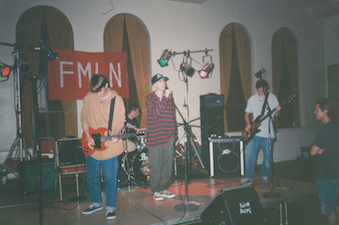
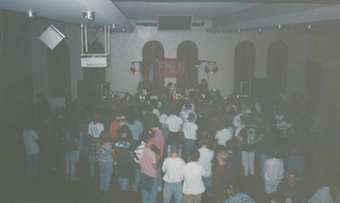
In 1991, just months before the January 1992 ceasefire that ended a decade-long counterinsurgency war in Central America, people involved in the Central America Solidarity movement organized a concert at Fountain Street Church in order to raise money for the insurgent movement in El Salvador known as the FMLN.

FMLN Concert

The FMLN (Farabundo Martí National Liberation Front) was the political and military framework for the democratic resistance movement in El Salvador, since the late 1970s. The FMLN had developed a sophisticated insurgency strategy that allowed the to control many parts of the country by the late 1980s. The FMLN was such a formidable movement that the US-financed Salvadoran Army could not defeat them.

The fundraising concert you can see in the pictures in this posting featured a Grand Rapids band called Friends of Durruti. (Durruti was a Spanish Anarchist) The concert not only provided a forum for people to donate to the cause, it provided a great opportunity to educate people about the freedom struggle in El Salvador.

Some of the people involved in organizing the concert went to El Salvador and just happened to be there during the cease-fire agreement. Within days, hundreds of thousands of Salvadorans poured into the streets for a day-long celebration, which featured musicians from all over Latin America. People danced and wept together until the sun came up and the people from Grand Rapids who were in attendance saw just how powerful music and solidarity can be in the struggle for justice.

FMLN Concert 1

Posted in Central American Solidarity Movement | Tagged , , , | 2 Comments

Political Cartoons were also part of the Grand Rapids Central America Solidarity Movement

(This article is part of two separate projects – The Central American Solidarity Movement and the Indy Media Movement in Grand Rapids)Screen Shot 2014-10-08 at 5.09.01 PM

There were all types of resistance to US policy in Central America in the 1980s. As we have already noted, people engaged in various forms of resistance and direct action against the US funding and training of the Contra forces in Nicaragua and the Death Squad Armies in El Salvador and Guatemala. 

There were also artists who lent their talents to critiquing and satirizing of US policy in the 1980s. These are the days before the Internet and print media was the main form of communication for most grassroots groups.

In the 1980s in Grand Rapids, one political cartoonist created dozens of pieces to reflect both the absurdity of US policy and the harsh reality of torture, disappearance and murder that was being done with US funding and weapons.

Jim Jirous, created some very poignant pieces for the Central American Solidarity Movement, along with the Central American Sanctuary Movement. The re-design State of Liberty shown here is one example that reflected the US government’s selective treatment of political refugees. The blatant denial by the Reagan administration of the brutal repression in Guatemala & El Salvador is what fueled the US Sanctuary Movement.

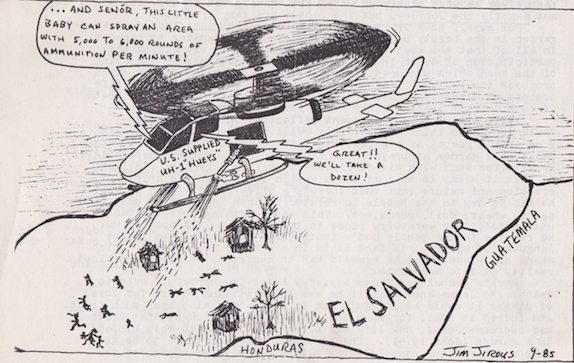
Another cartoon by Jirous uses less satire, but reflects the direct connection between US weapons sales and political repression in El Salvador. During the 1980s, the Chicago Central America Task Force estimated that the US was provided $1.5 Million a day to El Salvador, which used that funded to murder an estimated 75,000 of its own citizens, according to the United Nation Truth Commission in El Salvador.

This cartoon by Jirous appeared in several local newsletters and his work inspired many on the realities of US Policy in Central America, along with the human cost of those counter-insurgency wars.

Screen Shot 2014-10-08 at 5.08.33 PM

Posted in Central American Solidarity Movement | Tagged , , , , | 3 Comments