Part I of Interview with Mark Kane on the West Michigan Nuclear Freeze Campaign in the early 1980s

This is Part I of a two part interview with former director of the Institute for Global Education Mark Kane.fallout shelter

In the United States, awareness about nuclear weapons was relatively marginal, until people like Dr. Helen Caldicott and Jonathan Schell began writing, speaking and producing films about the dangers involved in nuclear proliferation.

In many ways the nuclear disarmament/nuclear freeze movements were an outgrowth of the anti-Vietnam War movement. The resistance to the US war in Vietnam involved community-based investigation into weapons production and the growing US nuclear arsenal.

People began to question the very existence of nuclear weapons and the fallacies that came with so-called nuclear fallout shelters. Nuclear Weapons proliferation was spreading across the globe and more and more people were being concerned about the arms race between the US and the Soviet Union.Freeze petition

Various forms of organizing and actions took place around challenging nuclear weapons in West Michigan, as we have noted in a previous posting, The Nuclear Freeze Movement inspired many in Grand Rapids

In Part I of our interview with Mark Kane, he discusses the evolution of the nuclear disarmament/nuclear freeze movement in the US and West Michigan, along with some tactics and strategies used with the freeze campaign. A big part of the freeze campaign, which is also explained in this 1982 IGE article, was putting a freeze on nuclear weapons on the ballot. You can see from the graphic here, an example of what the petition looked like that people were circulating in West Michigan.

Mark also talks a bit about the Grand Rapids contingent that participated in the massive anti-nuclear rally in New York in 1982, where roughly 1 million people from all over the world converged on New York City to so no to nuclear weapons.

Part II of this interview will discuss more details of the anti-nuclear organizing in West Michigan, lessons learned from that campaign and why it is important for people to know this history.

Posted in Anti-Nuclear Movement | Tagged , , | 1 Comment

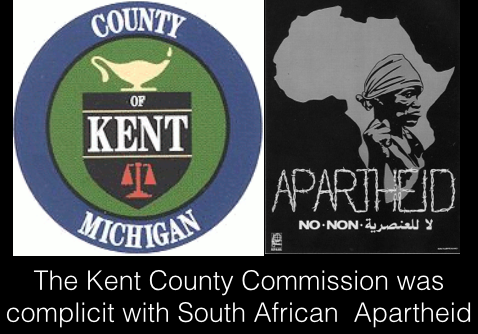
The Kent County Commission was complicit in South African Apartheid

Last week we posted a piece on the campaign to get the Grand Rapids Public School Board to take a stand against South African Apartheid in 1985.  The School Board, in this instance, voted 7 – 2 in favor of divesting from corporations or financial institutions that were profiting off of the Apartheid system in South Africa.Screen Shot 2015-04-21 at 12.38.43 PM

We have also documented in a previous posting that the City of Grand Rapids passed a resolution in 1982 in favor of divesting from South Africa  and within a few years took action to formally divest.

The Grand Rapids Anti-Apartheid Movement was also attempting to getting the Kent County Commission to take a similar stance, by adopting a resolution and divesting from all corporations and financial institutions economically benefiting from South African Apartheid.

Doug Van Doren, who was a member of the South Africa Working Group of IGE, had sent two letters in July and August of 1985 The letters were a follow up to when members of the South Africa Working Group spoke before the County Commissioners asking them to follow the City Commission and take a stand against the racist Apartheid regime in South Africa.

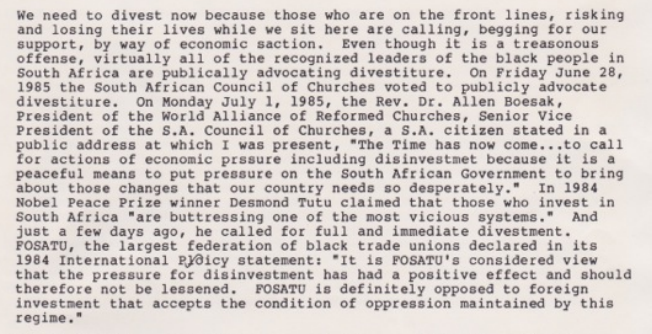
Van Doren provides in his letters insight into how the Grand Rapids Anti-Apartheid Movement was organizing at the time and what arguments and talking points they were using. One of those arguments was to simply list which organizations in South Africa were endorsing the divestiture campaign. Here is a paragraph, which speaks to this point from Van Doren’s August 27, 1985 letter:

Screen Shot 2015-04-21 at 12.06.31 PM

In the letter that Van Doren had sent in August, he also points out the significance of people in Grand Rapids taking action on South Africa:

You need to be aware that action taken in the West Michigan area has an impact out of proportion to our size. This is due to the strong religious and ethnic ties people of this area have to the present South African government. The only city of a smaller size and the only mid-west city visited when the Eloff Commission from South Africa came to the US, to see if they could get away with action against Bishop Tutu, was Grand Rapids. Smash Apartheid button badge c. 1970

Grand Rapids was definitely on the radar for the South African government, mostly because of the strong Dutch and Christian Reformed Church presence in West Michigan. Van Doren was correct in making that point as he urged the county commission to divest. Van Doren further cements the importance of the Kent County Commissioners in taking a stance by stating:

To withdraw support from a racist, violent and repressive regime is the right and moral thing to do. I am certain that you and the citizens of Kent County do not one penny of our money to support, directly or indirectly, physically or psychologically, a regime that discriminately governs the life of its citizens solely by the color of their skin. In addition, divestiture makes a statement that the Kent County Board of Commissioners is against racist behavior wherever it may be found.

The County Commission did not support divestment in South Africa, therefore demonstrating their complicity in the racist Apartheid government in South Africa.

Posted in Anti-Apartheid Movement | Tagged , , | 2 Comments

Grand Rapids Public School Board took a stand against Apartheid in 1985

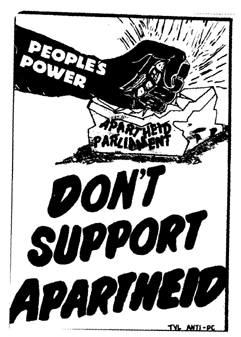
As our research moves forward on the history of the Grand Rapids movement against South African Apartheid, we continue to find important outcomes of the grassroots organizing that took place in the 1970s and 80s.images

Recently, we posted the second part of a two-part article on the Roots of the South African Anti-Apartheid Campaign in Grand Rapids  and last week we posted an interview with Rev. Doug Van Doren, someone who was deeply involved in the effort to get the City of Grand Rapids to pass a resolution in support of Divestment from companies doing business in South Africa in the 1980s. 

The City of Grand Rapids eventually did divest funds from institutions doing business in South Africa, making Grand Rapids one of the first cities in Michigan to take such action. In the interview with Rev. Van Doren, we also discovered that the Grand Rapids Public School Board was approached by those involved in the Anti-Apartheid Movement.

The campaign to get the GRPS Board to take a stand against Apartheid was undertaken in 1985. You can read a letter (pages 1 – 2) that Rev. Van Doren had sent to the Finance Committee of the GRPS Board in late August of 1985 , which was in response to a meeting the South African Working Group had with GRPS. The letter concludes by saying:poster

Finally, let me say that I am very impressed with the seriousness and sense of responsibility Mr. Nienhuis and the Committee has brought to this task. My hope, of course, is that you will recommend to the School Board a resolution for full divestiture. I think it is both the morally and fiscally responsible thing to do. I respect the fact that you are looking at it thoroughly and seriously. That seriousness will be reflected in whatever comments I make about your recommendations, whatever you decide to do.”

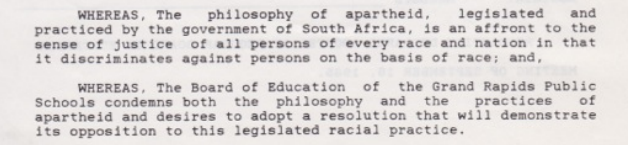
The efforts of the local anti-Apartheid group certainly paid off, since the Grand Rapids Public School Board voted 7 – 2 in favor of condemning South African Apartheid. Here is part of that resolution, which emphatically condemns racial apartheid.

Screen Shot 2015-04-14 at 8.01.41 AM

The entire resolution can be read here (pages 4 – 5), which includes the names of Board members who voted for the resolution and those who did not. The resolution’s position on divestment, was to take a stand against any new investments in South Africa and that they would not do business with corporations also involved in South Africa.

This action, like the one that organizers got the City of Grand Rapids to take, demonstrates once again that it is possible to get make global justice connections on a local level and that local institutions can be held accountable if there is organized opposition to institutional violence, as in the case of South African Apartheid.

Posted in Anti-Apartheid Movement | Tagged , , , | 3 Comments

Doug Van Doren on the Grand Rapids Anti-Apartheid Movement

This interview is with Rev. Doug Van Doren, pastor at Plymouth United Church of Christ in Grand Rapids. The interview is 17 minutes and 30 seconds in length.

Doug talks about his own beginnings in the South African Anti-Apartheid Movement, his involvement with the South African Working Group (part of the Institute for Global Education IGE) and his role in pushing for the City of Grand Rapids to pass a divestment resolution, which ultimately led to the City divesting funds.

In addition, Doug talks about the efforts to get the Grand Rapids School Board to take a position on divestment and an action he and others participated in to disrupt a public sale of South African krugerrands.

Lastly, Doug addresses the significance of the Anti-Apartheid Movement in Grand Rapids. With West Michigan being a major Dutch religious stronghold, the South African government send a delegate to the US to respond to the Anti-Apartheid Movement, making stops in Washington and Grand Rapids.

Posted in Anti-Apartheid Movement | Tagged , , , | 2 Comments

Archival Anti-Apartheid Flyer from early 1980s Michigan

Recently, we have posted an archival poster that was used in West Michigan by the South African Anti-Apartheid Movement and the second part of a two-part article on the Roots of the Roots of the South African Anti-Apartheid Campaign in Grand Rapids.

Screen Shot 2015-04-01 at 1.07.38 PM

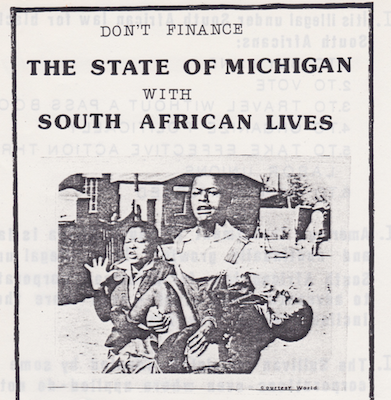
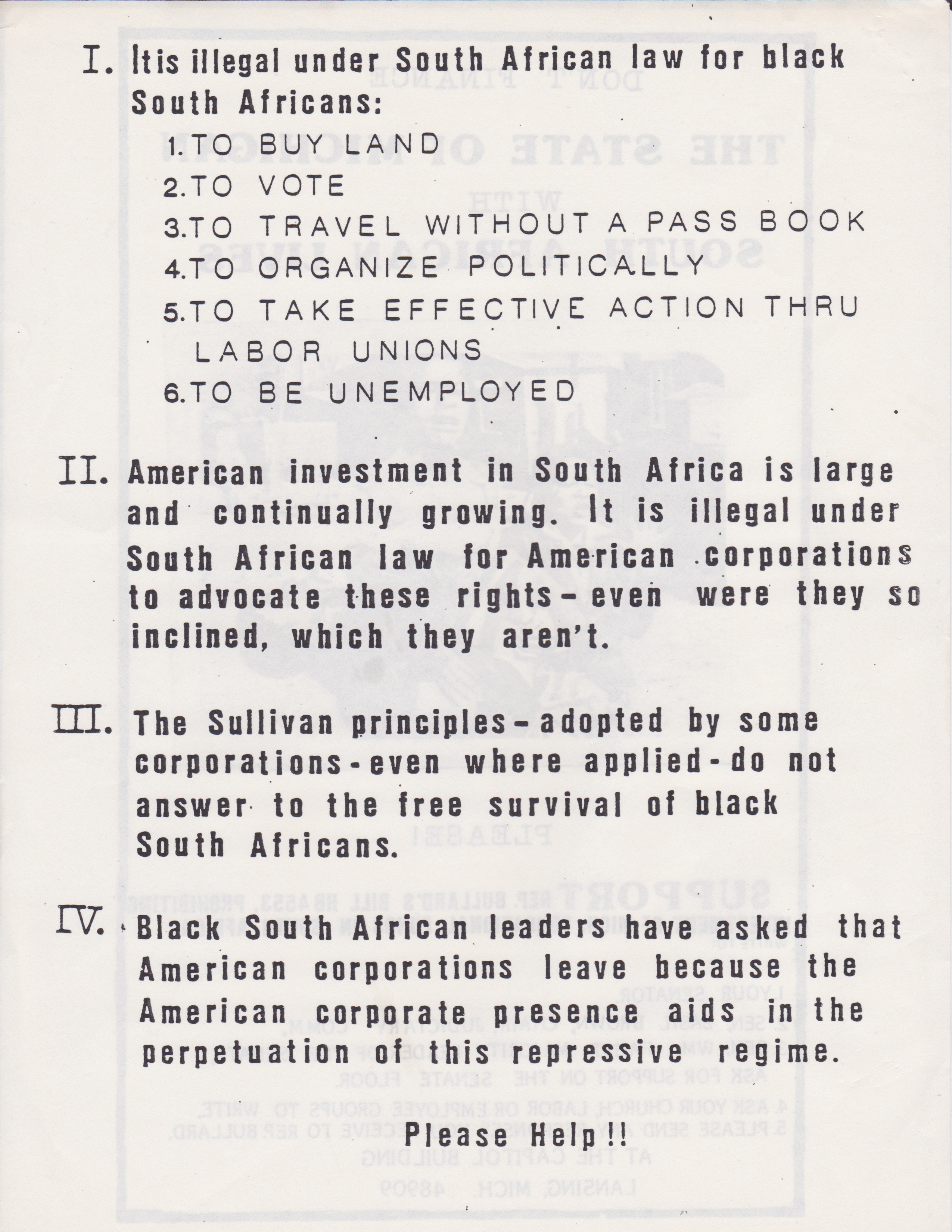
A few days ago we came across an archival flyer used in the early 1980s by the Anti-Apartheid Movement across Michigan, including Grand Rapids. The two-sided flyer has information about legislation that would prohibit investment of Michigan Educational funds in South Africa on the front side, with the back side with the realities for Black South Africans and why people should support the campaign to get US corporations out of South Africa.

Scan 1


Posted in Anti-Apartheid Movement | Tagged , , | Leave a comment

The Roots of the South African Anti-Apartheid Campaign in Grand Rapids – Part II

Screen Shot 2015-03-25 at 12.40.48 PM

Last month we posted the first part of a two part series on the roots of the South African Anti-Apartheid Movement in Grand Rapids.  Here is part two, which looks at the work done that led to the City of Grand Rapids adopting a resolution on divesting from companies doing business in South Africa to an eventual divestment action.

As noted in Part 1 of this two-part article, the American Friends Service Committee (AFSC) office in Grand Rapids was instrumental in facilitating the bulk of the Anti-Apartheid organizing in the 1970s. We recently found new documentation to further demonstrate the kind of work that the AFSC office in Grand Rapids around South Africa.

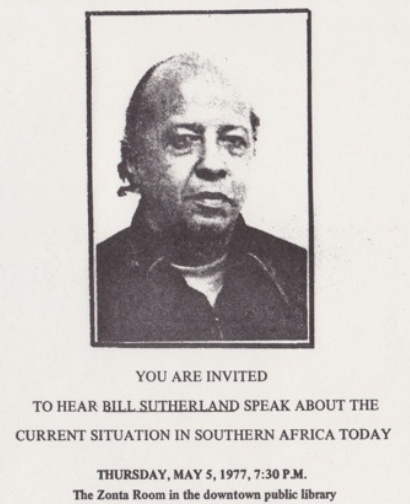
Screen Shot 2015-03-25 at 11.48.44 AMWe found a copy of a flyer for an educational forum on South Africa, with AFSC liaison Bill Sutherland speaking (page 13 of source document) after returning from a fact finding trip to South Africa in 1977. The Grand Rapids Press wrote up a story (page 14 of source document) about Sutherland’s talk, where the Anti-Apartheid activist noted that much of the US Press has distorted what was happening on South Africa and other liberation movements throughout the continent. 

Another archival set of archival documents shows that a Grand Rapids Task Force on South Africa(page 16 of source document) was being formed through the Grand Rapids Area Center for Ecumenism (GRACE) and that area churches were being organized to respond to the Apartheid policies of the South African government. 

Indeed, there were numerous churches becoming involved in the Anti-Apartheid movement beginning in the late 1970s in Grand Rapids. We found a hand written document from the AFSC office in Grand Rapids, noting the the United Church of Christ Board of World Missions(page 25 of source document) had adopted a policy to divest from companies doing business in South Africa in 1978.  

The West Michigan Reformed Church in America (RCA) was also in communication with the AFSC in the late 70s, based on a letter sent from the Grand Rapids office (page 26 of source document) and an additional document (page 27 of source document) shows that the Reformed Church in America had already been working to adopt a divest position in regards to South African Apartheid.

One of the resources that the AFSC was using with West Michigan churches, was a brief Action Guide on South Africa (pages 28 – 32 of the source document), which consisted of concrete information on major companies doing business in South Africa that the AFSC was encouraging organizations to boycott and divest from. 

Screen Shot 2015-03-22 at 7.10.59 PM

Unfortunately for the movement, the AFSC closed its office in West Michigan by the end of 1979, but many involved in the group locally decided to form a new organization to continue the work begun by the AFSC. The Institute for Global Education (IGE) came into being in 1980 and according to their very first newsletter, South Africa was part of their educational and organizing efforts. The IGE newsletter provides an overview of some of the organizing happening in West Michigan, where schools and churches were targeting Michigan-based companies(page 18 of source document) that were profiting from South African Apartheid, such as UpJohn and Kellogg.  The 1980 IGE newsletter also included a powerful poem by South African dissent and writer Dennis Brutus. (page 19 of source document)

IGE continued working on the South African Anti-Apartheid Campaign until the City of Grand Rapids and individual organizations began adopting divestment policies that were a large part of the eventual dismantling of the racist Apartheid regime in South Africa. You can read in the 1983 IGE newsletter the efforts of the South African Working Group (page 24 of source document) and the ongoing educational efforts like a 1983 interview with exiled South African Maurice Ngakane (pages 20 – 23 of source document).

All of this archival information underscores the level of involvement in the Anti-Apartheid Movement and the amount of organizing necessary for such a movement to be successful.

Posted in Anti-Apartheid Movement | Tagged , , , | 3 Comments

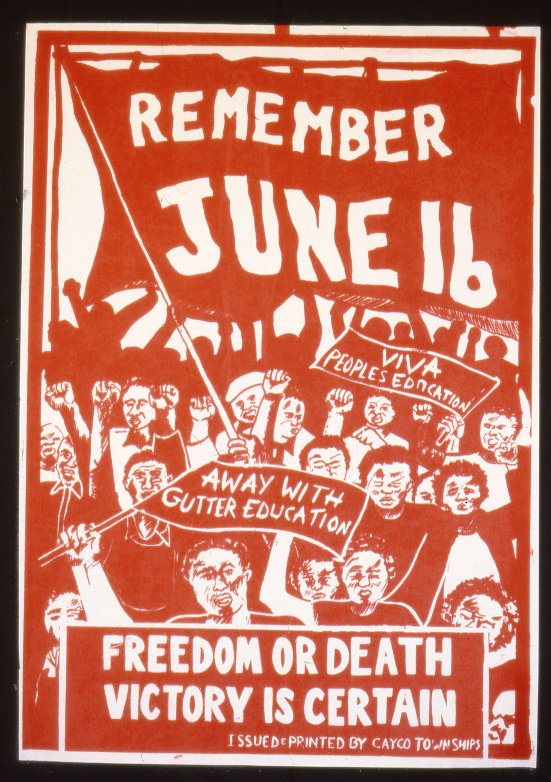
Archival poster from the Anti-Apartheid Movement in the 1970s

The poster here was recently discovered in the South African Anti-Apartheid archives held by Mark Kane. Mark was involved in the Anti-Apartheid Movement first through his work with the American Friends Service Committee in West Michigan and later with the Institute for Global Education.

What is instructive about the poster is that it addresses the larger African Freedom struggle, which was not limited to South Africa.

IMG_8364

Posted in Anti-Apartheid Movement | Tagged , | 1 Comment

The Roots of the South African Anti-Apartheid Campaign in Grand Rapids – Part 1

anti-apartheid-movement-in-britain-348-168In the past month, we have posted a few stories on the South African Anti-Apartheid movement in Grand Rapids. One posting dealt with the campaign to pressure the City to divest from a bank, which had holding in South African, while the other posting was about the anti-apartheid organizing at Calvin College.

The organizing around fighting South African Apartheid took place in Grand Rapids primarily in the 1980s. However, there was a great deal of organizing in the 1970s that laid the groundwork for the movement to grow and be part of a powerful international movement for justice.

In many ways, one cannot ignore the fact that much of the energy and analysis around South Africa, was an extension of the growing anti-colonialist movement that was sweeping the world in the 1950s and 60s. The anti-colonialist movement was widespread throughout Africa, with South Africa struggling for freedom, along with Angola, Mozambique, Zaire and Algeria.

This growing anti-colonialist awareness in the US was directly connected to the insurgent movements happening in communities of color, like the Black Freedom Movement, the American Indian Movement and the Chicano Movement. These movements were in many ways modeling themselves on the international struggles for liberation and using very similar analysis for fighting oppression here in the US.AL2446_2567

Lastly, it is important to acknowledge that another factor in putting South African Apartheid on the radar for US grassroots groups, was the struggle in South Africa itself. The work of the African National Congress (ANC), the imprisonment of Nelson Mandela and the ongoing brutality of the White South African Government all contributed to people being engaged in this issue. One incident that was a catalyst for action was the Soweto uprising. In 1976, thousands of Black South African high school students took to the streets to protest the brutality of Apartheid. This uprising was met with harsh government repression on June 16, 1976, where hundreds of students were killed by South African police.

It is in this context that organizing around South African Apartheid began in Grand Rapids.

According to some recently acquired documents, people from Grand Rapids were attending meetings in Detroit and Lansing around South African Apartheid as early as 1976. Mark Kane, who was at the time working with the Quaker organization, the American Friends Service Committee (AFSC), was one of those in attendance at these meetings. Another Grand Rapids-based organizer was Jaffray Cuyler, also with AFSC.

The American Friends Service Committee had an office in Grand Rapids in the late 1970s, located at 28 1/2 Jefferson SE, which later moved to 25 Sheldon SE. The work that Mark Jaffray and others were doing in conjunction with groups in Detroit, Ann Arbor, Kalamazoo and Lansing, are reflected in this 1979 document, which were minutes from a statewide meeting of the AFSC Southern African Task Force. This task force was developing a campaign, which consisted of numerous actions and strategies.antiapartheid
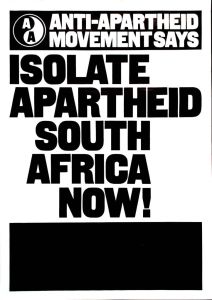
The growing anti-apartheid coalition wanted to do significant outreach and education around the issue of South African Apartheid. The organizers were using an array of educational forums that included speakers, Teach-Ins and pamphlets, like this one that was developed by a group in Dayton. This pamphlet provides basic background information on South African Apartheid, but it also has a list of additional information resources and ways to be involved in the campaign. Another powerful educational tool was the smuggled documentary film, the LAST GRAVE AT DIMBAZA.

In addition to the education efforts, the task force also was working on building a larger coalition, doing media work, identifying corporations invested in South Africa and challenging US policy that was deeply in support of the racist White South African Apartheid government at the time. Here is a document from 1977, that lays out the broader strategy of the task force.

One can see from the documents that the Grand Rapids office of the American Friends Service Committee was deeply connected to the statewide organizing at the time. In our next posting we will look at how their organizing impacted organizing locally and which groups were involved in the campaign.
Posted in Anti-Apartheid Movement | Tagged , , , | 2 Comments

There was a whole community behind them: Public support for the Grand Rapids Central American Sanctuary

As was mentioned in a previous posting, the Grand Rapids Central American Sanctuary House was part of a national movement in the 1980s to provide safe housing and solidarity to Guatemalans and Salvadorans fleeing political violence. Screen Shot 2015-01-08 at 10.46.51 AM

The Koinonia House declared itself a Sanctuary in 1986 and in the spring of 1987 opened their doors to the first group of Guatemalans seeking a safe place to live and the opportunity to tell their stories.

In preparation for becoming a sanctuary for Central American refugees, members of the Koinonia House sought support from the larger community in a variety of forms. Some people offered to provide material assistance, while others provided legal or medical help. However, there was the kind of assistance that was also symbolic and made a statement, especially since the Sanctuary Movement was being targeted by the Federal Government.

Before the Guatemalans even arrived in Grand Rapids, numerous organizations and individuals sent letters of endorsement to the Koinonia House. It was a way of saying that not only were they doing the right thing, but that the community had their back.

Many of the supporters were faith-based, such as Holy Trinity Episcopal Church, which wrote:

We feel strongly this is the loving and compassionate response which the church should and must take in this situation, and sanctuary has long been established within the history and tradition of the church. So we support your compassionate and courageous stand, and are ready to support you in whatever way is possible.

There were several individuals who also supported the Grand Rapids Central American Sanctuary. Two Dominican Sisters wrote, “It is with great pride and feelings of solidarity that we encourage and support your courageous witness of sanctuary with the suffering refugees of Central America.”

One letter of support came from a Grand Rapids couple, Tim and Deb Pieri. Their letter spoke not only of their deep understanding of the causes of the political violence in Central America, but reflected a deep sense of solidarity.

Tim

You can read all 23 letters of support and see for yourself that the Grand Rapids Sanctuary House had tremendous support, a support that was necessary to take such a stand as they did.

Posted in Central American Sanctuary Movement | Tagged , , , | Leave a comment

Grand Rapids Cartoonist Created Anti-Nuclear Characters in 1980s

As we have mentioned in a previous posting, political cartoons were part of the organized resistance against US policy in Central America in the 1980s. no-nukes

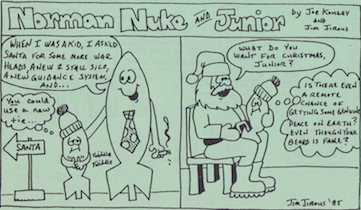
The same cartoonist, Jim Jirous, also created political cartoons that critiqued US nuclear policy. His cartoon characters, Norman Nuke and Jr., used satire as a primary means of communicating anti-nuclear sentiment during the height of the Reagan years, where the threat of nuclear war was always part of the US administration’s rhetoric.

Norman Nuke and Jr. was cartoon that Jirous created as a counter to the nuclear proliferation by the US government in the 1980s. In the cartoon featured here, we see Norman Nuke and Jr. getting ready to celebrate the holiday season. As always, Jr. does not embrace his father’s worldview by resisting his own identity and calling for disarmament as a wish when visiting Santa Claus.

The text reads:

Norman – When I was a kid, I asked Santa for some more war heads, a new 2 stall silo, and a new guidance system, and……

Jr. – You could use a new tie…….

Santa – What do you want for Christmas, Junior?

Jr. – Is there even a remote chance of getting some genuine peace on earth? even though your beard is fake?

Norman Nuke

Jirous created 8 different cartoons featuring Norman Nuke and Jr. in 1985 – 1986.

Posted in Anti-Nuclear Movement | Tagged , , | 1 Comment