Senator Arthur Vandenberg: The Grand Rapids Bi-Partisan Statesman for US Imperialism

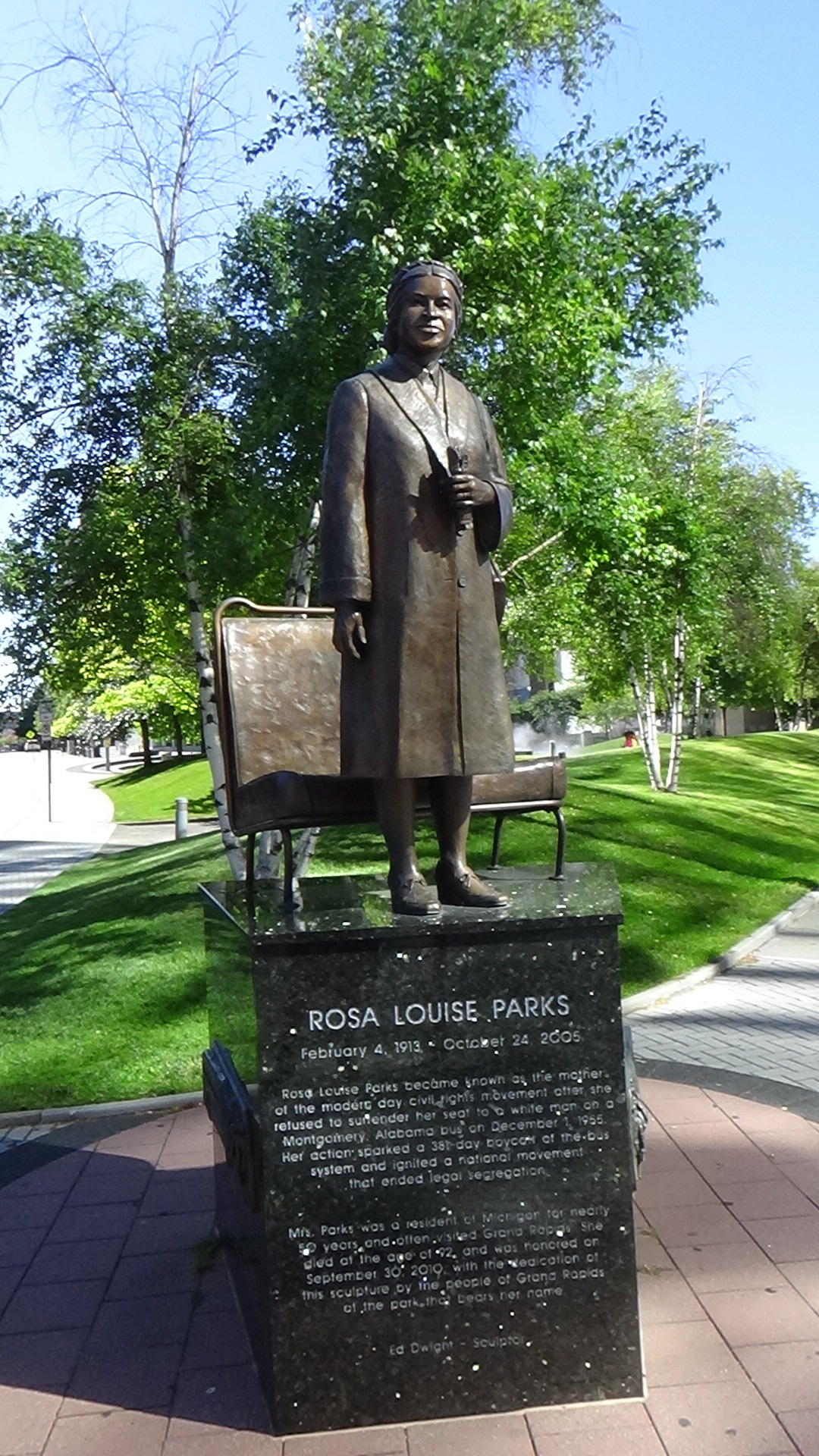
As part of our series that looks at statues, monuments and other historic markers in Grand Rapids, we look at Senator Arthur Vandenberg, who’s statue sits across from the Rosa Parks statue near the entrance to Rosa Parks circle. 

Arthur Vandenberg, who grew up in Grand Rapids, was the editor of the Grand Rapids Herald from 1906 – 1928. Like his boss at the newspaper, William Alden Smith, Vandenberg got involved in politics and was elected Senator in 1928.
DSC00015

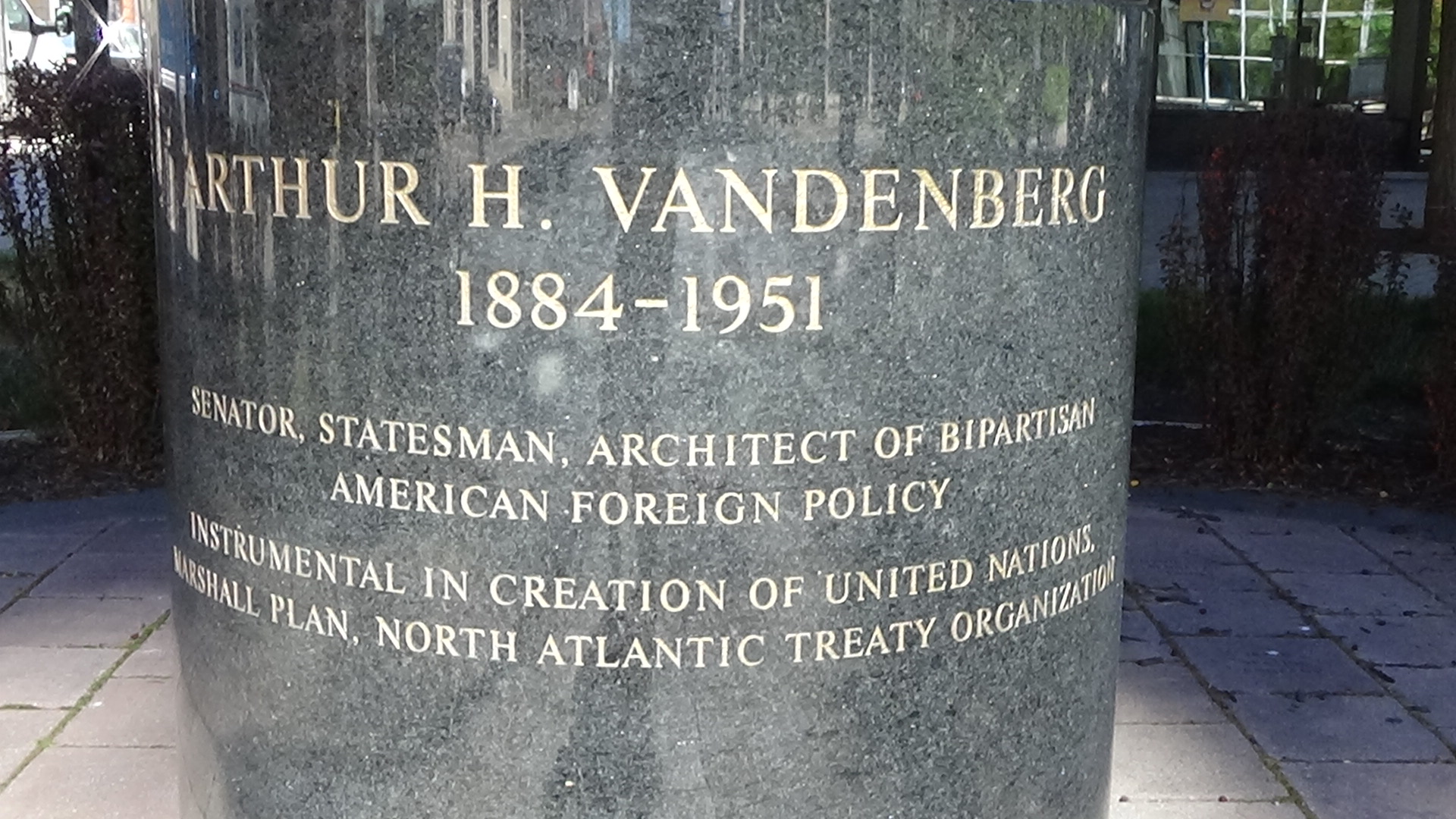
The statue near Rosa Parks Circle in Grand Rapids is inscribed with these words under Vandenberg’s name, Architect of Bi-Partisan American Foreign Policy. Such words are not only instructive, they are reflective of the dominant narrative about US foreign policy that students learn about in civics class, a narrative that is generally mimicked in commercial media.

Often referred to as an isolationist in the early part of his political career, Vandenberg was one of the few members of Congress to ask questions about the role of US weapons manufacturing and sales. Beginning in 1934, the Nye Committee, headed by Senator Gerald Nye, was calling for more accountability for US companies profiting from war, particularly Du Pont. A Washington Post headline from December of 1934 reflected the work of Senator Nye and Senator Vandenberg by stating, “800% War Profit Total at Inquiry: Du Pont Deal Up.”

The Nye Committee published several reports, like this one released in February of 1936.  Senator Nye, along with other members of the committee were calling for government ownership of weapons manufacturing, while Senator Vandenberg was calling for more oversight of the war industry. The following month a Gallup Poll was conducted asking Americans, “Should the manufacture and sale of war munitions for private profit be prohibited?” 83% of those polled said yes. Ironically, days later Eleanor Roosevelt was in Grand Rapids and called for, “taking all profits out of the munitions industry.” (The Untold History of the US, Stone & Kuznick)

However, once the US declared war on Japan after the bombing of Pearl Harbor, Vandenberg’s isolationist views began to dissipate.

As a member of the US Foreign Relations Committee, one of the most influential committees in Congress, Vandenberg began to call for the US to take an assertive role in the matters of foreign policy. Vandenberg did not live that many years after World War II (succumbing to cancer in 1951, but long enough to be part of three policy decisions that continue to dominate US foreign policy ever since.united-nation-security-council-unsc-22867436
The three major policy decisions are also inscribed on the statue of Senator Vandenberg in downtown Grand Rapids. Those policy decisions were: to support the creation of the United Nations, the Marshall Plan and the North Atlantic Treaty Organization (NATO).

The United Nations as an extension of US Foreign Policy

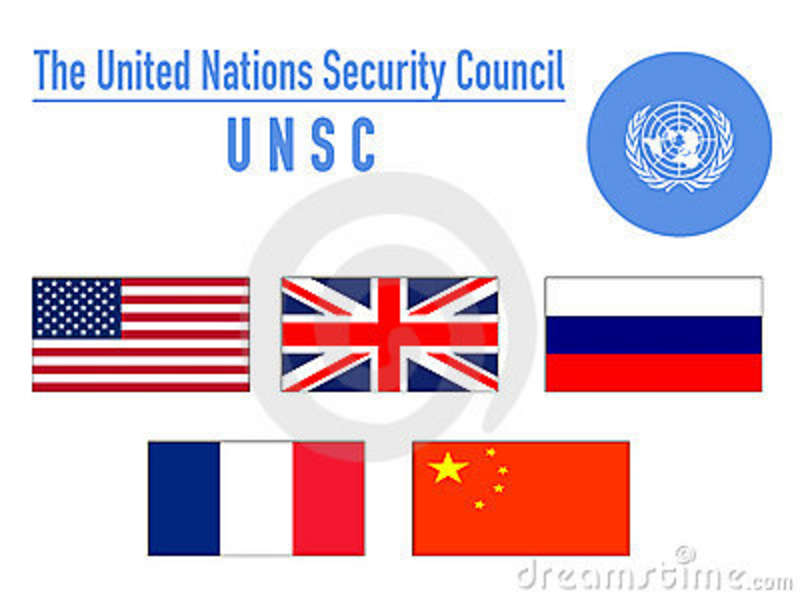
Senator Vandenberg became a champion of the creation of the United Nations and submitted the UN charter for Senate approval in June of 1945. Earlier that year, Senator Vandenberg was a US delegate at a conference in San Francisco to discuss the formation of the United Nations. In Phyllis Bennis’s book, Calling the Shots: How Washington Dominates Today’s UN, the author makes clear that the US was not going to be part of a process that created a level playing field at the international level. US policy makers saw the creation of the United Nations as a mechanism to insert US dominance at the international level after WWII. This was exactly why the UN Charter included a Security Council, with the US being one of the permanent members and giving the country veto power. The UN Security Council was not only decided upon by the US, but other powerful nations, which also had a stake in global politics after WWII. However, the US came out as the dominant power after WWII, both economically and from a geo-political stance. Thus the notion that Senator Vandenberg was in support of global peace is a bit of a stretch, since the creation of the United Nations was fundamentally a mechanism for US hegemony.

The Marshall Plan – Subsidizing US corporate power in Europe

The Marshall Plan in generally communicated in popular culture as the United States commitment to helping rebuild Europe after WWII, sort of a form of US benevolence. However, what was really behind the Marshall Plan was not some great humanitarian endeavor, rather a way to solidify US economic dominance at the beginning of the Cold War.

The $13 billion price tag attached to the Marshall Plan was essentially US taxpayers funding US based corporation who would “re-build” Europe, thus further solidifying US corporate control by opening up new markets throughout Europe. One example that Noam Chomsky discusses is that the Marshall Plan got Europe and Japan to shift from a coal-based energy system to an oil-based energy system. What this means is that roughly $2 billion from the Marshall Plan went straight to US-based oil companies after WWII. 

Another major motivating factor in the Marshall Plan was to suppress any left political movements in Europe. This is an important point since many of the anti-fascist forces organizing in Europe during WWII were either communist, socialist or anarchist. The US did not want to see any of these left political movements take root in Europe and used the Marshall Plan to help finance projects that would undermine such movements. Noted scholar of US foreign policy, William Blum, also notes that the CIA was involved early on in using Marshall Plan funds for its own Cold War propaganda purposesVandenberg

The CIA also skimmed large amounts of Marshall Plan funds to covertly maintain cultural institutions, journalists, and publishers, at home and abroad, for the heated and omnipresent propaganda of the Cold War; the selling of the Marshall Plan to the American public and elsewhere was entwined with fighting “the red menace”. Moreover, in its covert operations, CIA personnel at times used the Marshall Plan as cover, and one of the Plan’s chief architects, Richard Bissell, then moved to the CIA, stopping off briefly at the Ford Foundation, a long time conduit for CIA covert funds.

NATO as a military tool of US Imperialism

The third major post-WWII policy that Senator Vandenberg is credited with passing was the creation of the North Atlantic Treaty Organization, also known as NATO. NATO has generally been viewed as a means to counter Soviet military influence after WWII, particularly in regards to Europe. However, as Noam Chomsky and others have observed, NATO is a US-run intervention force. 

Now, it must be made clear that Senator Vandenberg, like many politicians, may not have know all the details about policy decisions they make. However, let us make no mistake about the fact that the major policy decisions for which Senator Vandenberg is revered, are the ones that gave rise to US global hegemony and US Imperialism.
Posted in Lies Across Grand Rapids | Tagged , , | 3 Comments

A Legacy of Organized Resistance: the Rosa Parks statue in Grand Rapids

Parks Statue

The only statue in Grand Rapids that doesn’t feature someone who spent part of their life in this city, is that of Rosa Parks.

The statue is located at the west entrance to a downtown community gathering space, also known as Rosa Parks Circle. The statue of the late civil rights organizer was dedicated in September of 2010 and includes text on three different sides.

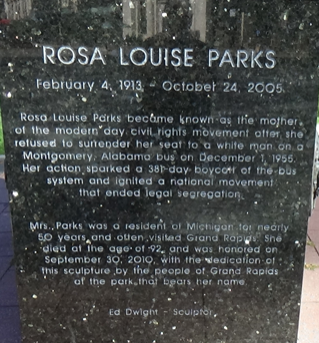
Screen Shot 2016-07-05 at 2.41.06 AMThe front side includes the following text pictured here on the left. Although the text on the front of the statue is accurate, it doesn’t capture all of what Rosa Parks was about, nor does it provide a more honest historic context of what brought her to Montgomery, Alabama.

According to the groundbreaking research in  Danielle McGuire’s book, At the Dark End of the Street: Black Women, Rape & Resistance – a New History of the Civil Rights Movement from Rosa Parks to the Rise of Black Power, racial segregation was not the only thing that brought Rosa Parks to Alabama.  

A 24 year old black woman named Recy Taylor was raped by a carload of white men in Abbeville, Alabama in 1944. The NAACP got wind of the incident and sent their best investigator, Rosa Parks, to Alabama to interview Recy. What Rosa Parks discovered was that a decade before the Montgomery Bus Boycott, the Black community was already organized and resisting White Supremacy. The difference was Black people were not just fighting for an end to racial segregation, they were fighting against the sexual violence of White men against Black women.51Rn6cw4JCL._SX334_BO1,204,203,200_

At the Dark End of the Street makes it clear that in addition to organizing against racial segregation, the black community was responding to the ongoing violence by white men against black women. The police and courts in Alabama did virtually nothing to hold white men accountable for these assaults against black women. Black women were being targeted by white men on the streets in grocery stores and on the buses.

Black people in Montgomery were organizing around these assaults and used a variety of tactics to draw attention to the sexual assault of black women. One action was to hang a banner that read, “The Rapist was White.” It happened to be that the church where the banner was hung was the same church that Dr. King would later be pastor of. A local committee was also formed in response to the rape and this group was so effective in their organizing that they got a Grand Jury hearing and the local Black ministers together for the very first time.

In addition, there were organized campaigns against the bus system, even boycotts, because of the ongoing sexual harassment on the buses in Montgomery. The bulk of the riders were Black women who worked as maids in White homes and could only use bus transportation to get to work.

So when Rosa Parks refused to move to the back of the bus, it was no surprise that thousands participated, especially women who had been fighting racism and sexism on the buses for over a decade.

During Reconstruction White Supremacists used Sexualized violence as a tool against freed slaves. It was during this time that the White Supremacists used the myth of Black male sexual predators as a way to demonize Black men and maintain power. McGuire states in At the Dark End of the Street, there is an old saying that grew out of the Jim Crow era which said, “The closer a Black man got to the Voting box, the more he looked like a rapist.

So while it is important that we recognize and honor the role that Rosa Parks played in the Montgomery Bus Boycott, it is equally important that we understand that she was part of the larger Black Freedom struggle that resisted the various ways in which White Supremacy was, and continues to be, manifested throughout the US.

Lastly, there is a statement by Rosa Parks etched on the side of the base of the statue that reads:

Screen Shot 2016-07-05 at 3.43.48 AM

We must not merely hear these words as coming from a deeply committed member of the Black Freedom struggle. We must take them seriously and continue to fight for the same kinds of things that Rosa Parks fought for. When she says she wants freedom, equality, justice and prosperity for all people, then we need to simply look around and realize that this vision has yet to be fulfilled in Grand Rapids. The fight for racial justice, economic justice, affordable housing, food justice, environmental justice and gender justice (just to name a few) continues. Let us honor the legacy of Rosa Parks by continuing to be involved in organized resistance.

Posted in Civil Rights/Freedom Movement | Tagged , , | Leave a comment

From militant strikes to anti-communist purges: the Grand Rapids labor movement after WWII

In previous articles we have looked at the fight for an 8 hour work day in Grand Rapids, the 1911 Furniture Workers Strike and the impact that the 1936-37 Flint Wildcat Strike had on Grand Rapids organizing efforts.

screen-shot-2016-03-11-at-3-45-53-am

Each of these examples of labor organizing in Grand Rapids continued to build upon the growing push for workers to join unions. After the UAW and the CIO began organizing in Grand Rapids, union membership grew significantly. However, union leadership at the national level cut a deal with business leaders and the Roosevelt administration and agreed to not strike while the US was involved in World War II.

Despite the no-strike pledge, union membership in the US grew from 7.2 million in 1940 to 14.5 million at the end of WWII. However, the strikes began almost the moment that the bombs stopped dropping on Japan. In September 1945, 43,000 petroleum workers and 200,000 coal workers struck. In October 44,000 lumber workers, 70,000 teamsters, and 40,000 machinists joined them.

Screen Shot 2016-06-30 at 12.03.05 AM

Then in November 1945, the UAW called its first major strike against GM since the company was unionized in 1937. Nearly a quarter of a million men walked out. In Grand Rapids, this same dynamic began where workers who had years of frustrations during the no-strike pledge of WWII began to challenge the capitalist class by engaging in walk outs and strikes.

In 1946, workers at the UAW Local 730 at the GM plant in Wyoming, Michigan were part of the national UAW strike that lasted for 113 days. (see photos above and below, sourced from The Story of the UAW Region 1-D) The UAW striking workers were fighting for better wages, pensions and improved working conditions, all of which were denied them during the no-strike pledge during WWII.

Screen Shot 2016-06-30 at 12.00.34 AM

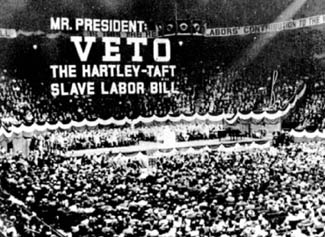
With the growing labor unrest and increased militancy of workers in the US, the capitalist class decided to fight back. In response to the growing influence of labor unions, Congress passed in 1947 the Taft-Hartley Act. It prohibited jurisdictional strikes, secondary boycotts and “common situs” picketing and closed shops. The law became known as the “slave-labor bill” in union circles.1947

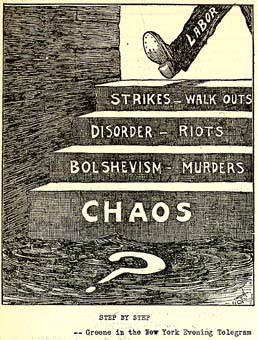
However, the Taft-Hartley Act was not the only tool that business owners used to undermine unions after WWII. There was a growing interest to attack and expose anyone connected to the Communist Party and those who embraced more radical ideals. This political tactic led to what became known as Red-baiting and eventually McCarthyism.

Beginning after WWII, communism now became the new boogeyman and ushered in the Cold War era.

Many people know about the blacklisting that took place with actors, directors and script writers in Hollywood, but less is known about the purges that took place in organized labor.

According to Michael Johnston’s thesis, Non-Union Grand Rapids: 150 Years of the Big Lie, Grand Rapids unions also participated in the “red scare.”

The earliest doctrinal battles of the Cold War years were fought out in Grand Rapids, beginning in late June of 1946. Fred Bonine, president of UFWA Local 415, joined with other locals from around the country in issuing a national resolution calling upon locals across the country to “divorce” themselves from the “communist wing of their union.”Step_by_step_greene

Bonine led his local out of the CIO and into the Upholsters of the AFL. As one of the largest unions in the area, and one of the largest unions in the entire UFWA, this Cold War red baiting and raising took on national significance.

The Kent County CIO Industrial Union Council was caught in the middle. In spite of the reputation as a conservative city, the CIO Industrial Union Council urged the local to “remain in the CIO to fight the reds.”

Johnston goes on to write:

The UAW used the red scare to raid the American Seating Company unit of UFWA Local 415. It began a protracted, bitter campaign to decertify the Communist influenced union. After two NLRB elections, the UAW finally ousted the furniture workers replacing it with UAW Local 135, chartered March 14, 1949. The UAW also raided the UE local at the York Band Instrument Company chartering a local there on January 19, 1950.

Thus, it was clear that the business class would use any means necessary to undermine the militancy of organized workers, both through legislation and by questioning their loyalty to the nation. This period of Grand Rapids and US history was the beginning of the decline of unions and organized labor, a decline that continues to this day.

Posted in Anti-Capitalism/Labor | Tagged , , | 2 Comments

Artwork highlights a People’s History in Grand Rapids – Print #9 – Gentrification as modern day colonialism

Christi.Poster.2016

This past semester, art students in Brett Colley’s class on printmaking, invited me to come talk about the Grand Rapids People’s History Project. The intent of the class was to have students investigate their own part of a People’s History of Grand Rapids and then make a print based upon an individual, social movement or a particular moment in history.

What we will be sharing from here on out over the next several weeks, are the result of what these students created, based on their own investigation or based on previous posting from the Grand Rapids People’s History Project. We are excited to have these newly created visuals to compliment the rich history of social movements from the resistance to white settler colonialism all the way up to the present.

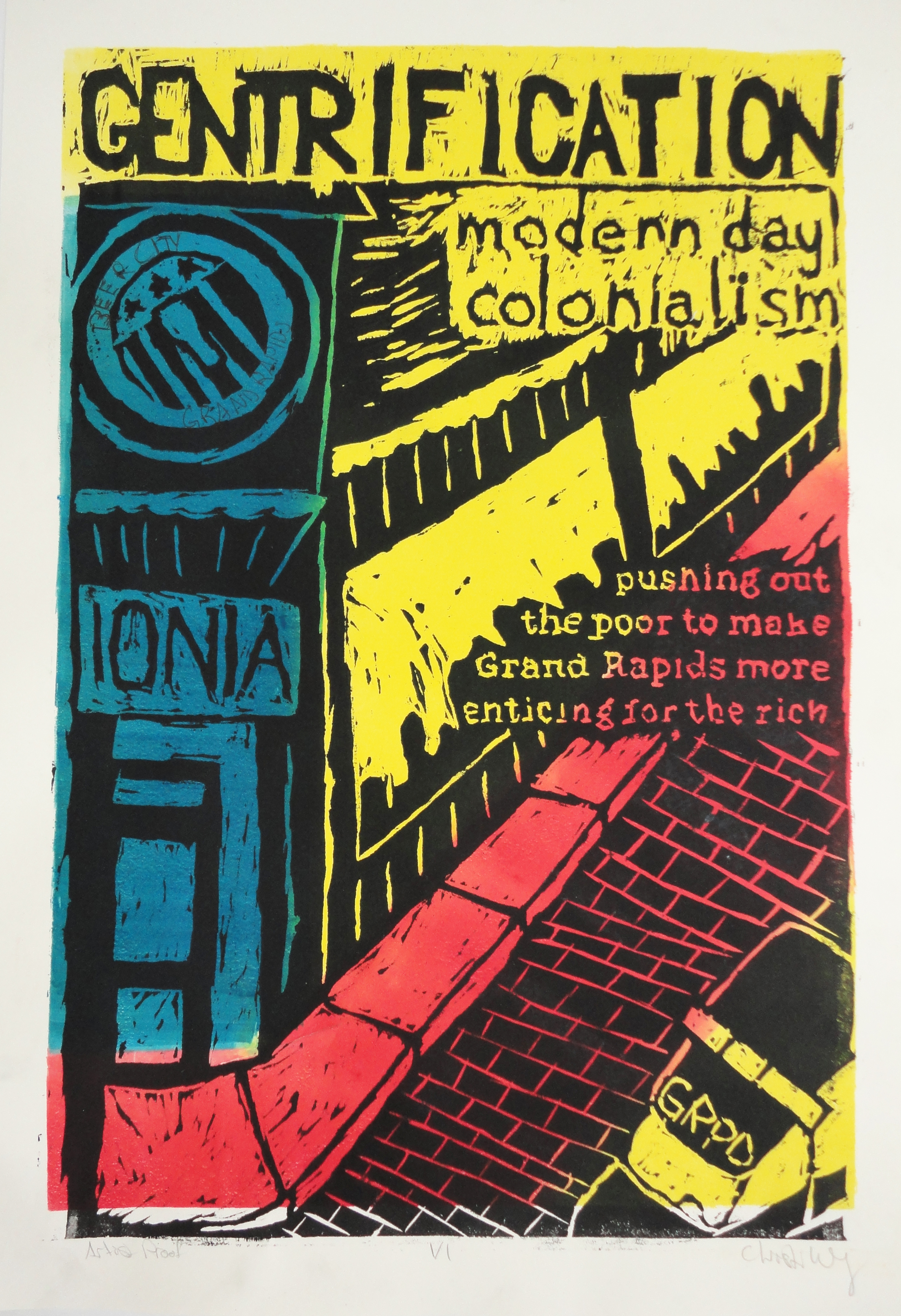
This print was created by Christi Wiltenburg. It communicates the idea that the current manifestations of gentrification are a form of modern day colonialism. One could certainly argue that the forceable relocation of indigenous people from what is now Grand Rapids, was a form of gentrification. 

Other examples of gentrification that we have seen in Grand Rapids, was the displacement of thousands of people when the highways were built through town, plus multiple examples of “urban renewal,” resulting in displacement of people in the Belknap area  and in the East Hills neighborhood

Gentrification as the new colonialism is also happening today in Grand Rapids, as is evidenced in numerous development projects, where displacement of working class people and communities of color is taking place, like the Coit Square project. 

Christi.Poster.2016

Posted in Neighborhood organizing, People's History Artwork | Tagged , , | Leave a comment

Artwork highlights a People’s History in Grand Rapids – Print #8 – Milt Ford, founder the the LGBT Resource Center at GVSU

McBrydeB.Poster.2016

This past semester, art students in Brett Colley’s class on printmaking, invited me to come talk about the Grand Rapids People’s History Project. The intent of the class was to have students investigate their own part of a People’s History of Grand Rapids and then make a print based upon an individual, social movement or a particular moment in history.

What we will be sharing from here on out over the next several weeks, are the result of what these students created, based on their own investigation or based on previous posting from the Grand Rapids People’s History Project. We are excited to have these newly created visuals to compliment the rich history of social movements from the resistance to white settler colonialism all the way up to the present.

This print was created by Brianne Freundt. The print was inspired by the life and work of the founder of the GVSU LGBT Resource Center, now named the Milton E. Ford LGTB Resource Center.

Here is an excerpt from an interview with Milt Ford, taken from the Grand Rapids LGBTQ People’s History Project.  You can also watch the full interview with Milt Ford at this link and watch the film on the Grand Rapids LGBTQ movement.

McBrydeB.Poster.2016

Posted in LGBTQ Movement, People's History Artwork | Tagged , , , | Leave a comment

Artwork highlights a People’s History in Grand Rapids – Print #7 – African American Community responds to Red-lining with Auburn Hills Project

This past semester, art students in Brett Colley’s class on printmaking, invited me to come talk about the Grand Rapids People’s History Project. The intent of the class was to have students investigate their own part of a People’s History of Grand Rapids and then make a print based upon an individual, social movement or a particular moment in history.

BruceJ.Poster

What we will be sharing from here on out over the next several weeks, are the result of what these students created, based on their own investigation or based on previous posting from the Grand Rapids People’s History Project. We are excited to have these newly created visuals to compliment the rich history of social movements from the resistance to white settler colonialism all the way up to the present.

The seventh print we feature is from Jasmine Bruce. This print was inspired by the organized actions from a group of African Americans in the early 1960s to purchase land for a housing development project. This action was a direct response to the racist practice of Red-Lining that took place in Grand Rapids and all across the country. 

Todd, Robinson, in his seminal book on Grand Rapids, A City Within a City: The Black Freedom Struggle in Grand Rapids, Michigan, writes about the importance of what happened with the Auburn Hills housing project in the early 1960s.

“The initiative by the four men boldly defied the dominance of segregated suburban space and facilitated the passage of the Fair Housing Ordinance on December 23, 1963. Their efforts represented one example of a stable integrated suburban neighborhood in Grand Rapids.”

BruceJ.Poster

Posted in Civil Rights/Freedom Movement, Neighborhood organizing, People's History Artwork | Tagged , , | Leave a comment

Artwork highlights a People’s History in Grand Rapids – Print #6 – The Anti-Nuclear Movement in Grand Rapids

Songer.L.2016

This past semester, art students in Brett Colley’s class on printmaking, invited me to come talk about the Grand Rapids People’s History Project. The intent of the class was to have students investigate their own part of a People’s History of Grand Rapids and then make a print based upon an individual, social movement or a particular moment in history.

What we will be sharing from here on out over the next several weeks, are the result of what these students created, based on their own investigation or based on previous posting from the Grand Rapids People’s History Project. We are excited to have these newly created visuals to compliment the rich history of social movements from the resistance to white settler colonialism all the way up to the present.

The sixth print we feature is from Linnea Songer. Songer’s print was inspired by an article posted from August 2014 on the Grand Rapids People’s History site about an anti-nuclear action that took place in downtown Grand Rapids in 1985 to commemorate the anniversary of the US bombing of Hiroshima. The action, depicted in the print, demonstrated that many of those at Ground-Zero in Hiroshima only had the outline of their bodies left, since people were incinerated.

Songer.L.2016

Posted in Anti-Nuclear Movement, People's History Artwork | Tagged , , | Leave a comment

Artwork highlights a People’s History in Grand Rapids – Print #5 – Marian Clements, founder of Well House

This past semester, art students in Brett Colley’s class on printmaking, invited me to come talk about the Grand Rapids People’s History Project. The intent of the class was to have students investigate their own part of a People’s History of Grand Rapids and then make a print based upon an individual, social movement or a particular moment in history.TannirC.Poster.2016

What we will be sharing from here on out over the next several weeks, are the result of what these students created, based on their own investigation or based on previous posting from the Grand Rapids People’s History Project. We are excited to have these newly created visuals to compliment the rich history of social movements from the resistance to white settler colonialism all the way up to the present.

The fifth print we feature is from Courtney Tannir. This print was inspired by the incredible witness and work of Marian Clements, the founder of Well House. Clements, who grew up in West Michigan, had struggled with mental health for much of her life. Marian was even institutionalized at one point, but eventually came to stay at a Quaker-run house in Grand Rapids that practiced what they called “radical hospitality.”

Radical hospitality is different from most homeless shelter work, where people opened their homes to people experiencing homelessness and allowed people to stay as long as they needed. People might stay just a few days, several months, or sometimes they became community members.

The house that Marian started in 1979 was purchased for just a few hundred dollars. The focus of the house was not only radical hospitality, but simple living and a deep commitment to non-violent activism. Eventually, Marian acquired a second house in the neighborhood and then a third, before she was diagnosed with cancer and died in 1997. Well House continues to work with those experiencing homelessness today. 

TannirC.Poster.2016

Posted in Neighborhood organizing, People's History Artwork | Tagged , , | Leave a comment

Artwork highlights a People’s History in Grand Rapids – Print #4 – Hendrik Meijer and Anarchism

This past semester, art students in Brett Colley’s class on printmaking, invited me to come talk about the Grand Rapids People’s History Project. The intent of the class was to have students investigate their own part of a People’s History of Grand Rapids and then make a print based upon an individual, social movement or a particular moment in history.

What we will be sharing from here on out over the next several weeks, are the result of what these students created, based on their own investigation or based on previous posting from the Grand Rapids People’s History Project. We are excited to have these newly created visuals to compliment the rich history of social movements from the resistance to white settler colonialism all the way up to the present.Cargill.K.Poster

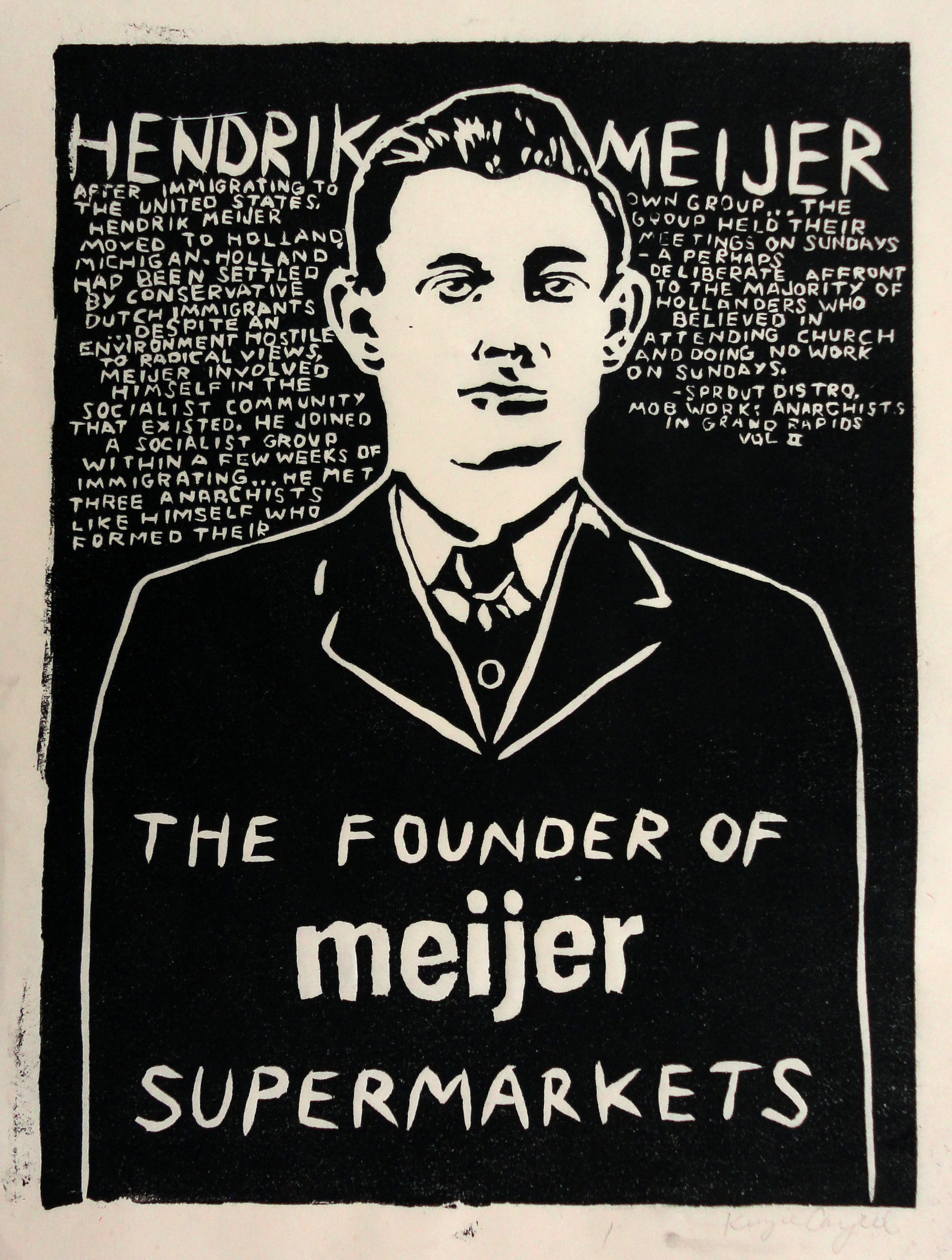
The fourth print we feature is from Kenzie Cargill. This print brings attention to the fact that for part of his life, the founder of Meijer stores, Hendrik Meijer, embraced Anarchism. The print by Cargill, was inspired by a zine created by Grand Rapids Anarchists distributed through Sprout Distro. Here is an excerpt from that zine on Hendrik Meijer:

After immigrating to the United States, Hendrik Meijer moved to Holland, Michigan. Holland had been settled by conservative Dutch immigrants who had seceded from the Dutch Reformed Church, outraged over what they perceived as a more liberal direction being taken by the Church. It was a conservative community with businesses closed on Sundays, regular church attendance expected, and pride in both Old Dutch traditions and the United States. A Holland

newspaper from around the time of Meijer’s arrival wrote, “We will not accept socialism, with its unworkable demands! Still less anarchism, with its wild dreams and demonic tools!”

Despite an environment hostile to radical views, Meijer involved himself in the socialist community that existed. He joined a socialist group within a few weeks of immigrating. Through that group, he met three anarchists like himself who formed their own group and set to work producing anarchist pamphlets. Despite its conservative nature, their group regularly had as many as 12-15 people in attendance and socialist speakers often passed through Holland. The group held its meetings on Sundays—a perhaps deliberate affront to the majority of Hollanders who believed in attending church and doing no work on Sundays. The group may have been called the “Modern Sons of Marx” although his biographer is unsure. During this period he also organized a memorial in Holland on the Haymarket anniversary and tried to get involved with a socialist newspaper. Letters from him describing the Dutch immigrant experience in West Michigan were also published in Recht door Zee, a Dutch anarchist newspaper. When Hendrik Meijer’s partner Gezina Mantel finally came to the U.S., the couple specifically chose to get married on November 11, 1912—the anniversary of the executions of the Haymarket anarchists.

This narrative of Meijer is not widely known and for good reason. The Meijer family, who are some of the wealthiest in the state, would not want the fact that their grandfather embraced for a time, both socialism and anarchism.  To read the entire zine from Sprout Distro, click here

Cargill.K.Poster

Posted in Anti-Capitalism/Labor, People's History Artwork | Tagged , | 1 Comment

Artwork highlights a People’s History in Grand Rapids – Print #3 – People First!

VolmarB.Poster.2016

This past semester, art students in Brett Colley’s class on printmaking, invited me to come talk about the Grand Rapids People’s History Project. The intent of the class was to have students investigate their own part of a People’s History of Grand Rapids and then make a print based upon an individual, social movement or a particular moment in history.

What we will be sharing from here on out over the next several weeks, are the result of what these students created, based on their own investigation or based on previous posting from the Grand Rapids People’s History Project. We are excited to have these newly created visuals to compliment the rich history of social movements from the resistance to white settler colonialism all the way up to the present.

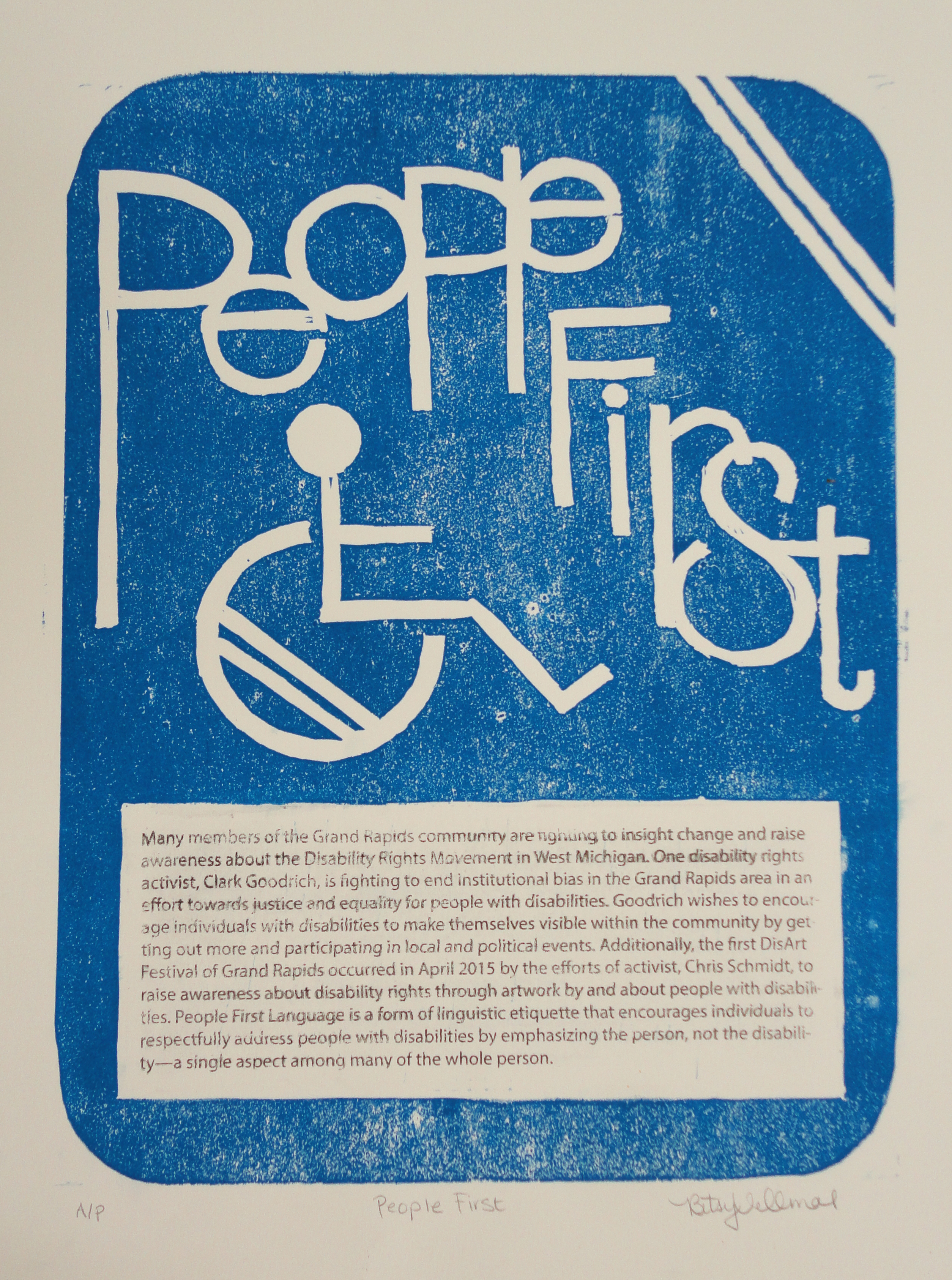
The third print we feature is from Betsy Volmar. This print not only honor’s the disability rights movement, it honors a Grand Rapids activist, Clark Goodrich. Clark is the founder of the ADAPT chapter in Grand Rapids and in January of this year, the Grand Rapids People’s History Project did an interview with Clark

This print is a fabulous tribute to Clark Goodrich and all the disability rights activists around the world.

VolmarB.Poster.2016

Posted in Disability Movement, People's History Artwork | Tagged , , | Leave a comment