Zoned Out: Again the City Votes to Demolish Homes in Grand Rapids (1995)

This article is from the Independent newspaper, the FUNdamentalist, November of 1995.

Just weeks after the Grand Rapids City Commissioners voted to destroy some 70 houses vcl-logoon the westside to make way for parking, they voted again in August to destroy more homes on Baldwin street just off of Diamond. Caving under the pressure from Valley City Linen, the commissioners voted to re-zone that area to allow the linen company to expand its business. This re-zoning, or spot zoning, is illegal according to neighborhood organizers from East Hills. The state policy that prohibits spot zoning was ignored by the commissioners under the rubric that if re-zoning is not granted the company will move out of the city and the neighborhood will be stuck with a large, vacant building. Is this another example of corporate bullying or were there other issues involved?

Apparently, Valley City Linen has been attempting to have the city re-zone the area for some 10 years. Neighborhood organizer John Wittowski said that “the East Hills board and staff have remained consistent throughout those 10 years. They opposed the re-zoning.” The neighbors also have resisted the company’s proposal over the years, less so in recent years, because they have seen Valley City Linen’s failure to follow through with responsibilities and promises given to  the neighbors.

DNGVSUvalleycity1

Over the years Valley City has bought up homes around their business. In each instance they have failed to maintain those houses to the point that they had become eyesores and eventually were torn down. At one point they even agreed to renovate a house on henry Street in exchange for the purchase of 1001 Baldwin. That too was a failure. Attorney Nyal Deems, who represented Valley City Linen at the commission hearings, justified the company’s failures by saying that “they just don’t know how to be in the landlord business.” A weak defense from a man who is also the mayor of East grand Rapids. East Hills neighborhood organizer, KC Caliendo said, “some of the neighbors eventually gave up because they knew that Valley City Linen would get their way. It’s like people were saying, “You can have the lots, just give us green space and a tree.” Valley City did put up a fence, but only after residents and East Hills members complained to the city. “That is one of the problems that we have had with Valley City Linen, they have not taken a proactive approach to comply with what they have agreed to,” said Wittowski. One wonders what Valley City Linen’s eventual commitment to the neighborhood in the event that they get too big for the space that they have been granted now? All along it has been Valley City’s position that expansion is necessary. They used the trump card of suburban flight if the city did not grant their wishes. But, according to neighborhood organizers, Valley City Linen’s case was not that solid.

There has been some speculation about why Valley City Linen did not expand eastward along Fulton street. They told the zoning board that Emergency Lock & Safe was never made a real offer. Then there is the issue of parking, that all-encompassing 20th century reality that stands as the primary determining factor in these disputes. First of all, Valley City Linen claims that before the illegal spot zoning was granted that they already did not have enough parking space. Neighbors say, however, that there is no apparent street parking by the companies employees. Again, there seems to be unsubstantiated requests for additional parking space.

This is confirmed by the fact that many of the employees, even by Valley City Linen’s own admission, are people from the neighborhood, most of whom walk or get dropped off. In fact, most of the company’s newest workers are recent immigrants, especially Guatemalans, who are placed through the Catholic Human Development Office (CHDO). KC Caliendo told me that, as of August, the CHDO was providing 32 workers who were walking to work or being dropped off. If Valley City Linen intends to keep these workers, which seems logical from a business point of view (cheap, local, non-unionized labor), then there is no concrete evidence of the need for more parking space. Yet, when looking at the supplement to the application for change in zoning, I discovered that the city personnel who prepared the 4 page plan, mentioned parking 19 times. The only word that was used more often in the 4 page plan, other than parking was the company’s name. Therefore, it seems that above all other arguments, parking was the key to the re-zoning request. Jobs and employees were mentioned a combined total of 3 times in the plan.

staticmap

As I listened to KC and John it became clear that in spite of resident, staff and board members of East Hills resistance to the expansion, the city voted in favor of the business. “If this is a democracy, then the many outweigh the few, but the people in power seem to have more standing,” said Wittowski. “What really bothered us was how the commissioners voted. We didn’t think they would have the nerve to vote that way after the westside fiasco. You think they would stop, especially in an election year,” lamented Caliendo. The only one on the commission that seemed to express any outrage was George Heartwell. He is also the only one who has a vision about about how to possibly deal with dilemma in the future. Heartwell said he would “reject all similar re-zoning requests until the city enacts a policy requiring unit-by-unit replacement of homes lost to commercial and industrial expansion.”

In the mean time what do neighborhoods do when confronted with their own demise? At the present it seems that despite what residents want, the city planners will do as they wish. Neighborhood organizers said that commissioners should at least have polled the neighborhood to see what people were thinking. But that was not done. So how do we respond to a planning department and city commission that does not seem to represent neighborhood interests? Bold and more direct actions is no doubt required. Companies should not be allowed to use the the threat of flight from the city. Neighborhoods should be more self-governed, especially if they are to have any future.

Planning Commissioner Rooney reflected the antithesis of the idea of more neighborhood self-governance when he said, “I don’t care about the future, all I am concerned about is the here and now.” Hopefully, we can resist such temporal illusions.

Posted in Neighborhood organizing | Tagged , , , | 1 Comment

The 8 Hour Work Day Battle and May Day in Grand Rapids

It is easy for us in the present to take for granted the 8 hour work day. However, organized labor spent decades fighting this battle all around the world, in the US and right here in Grand Rapids.

The Knights of Labor provided this wonderful anthem that reflected the spirit behind the 8 hour work day:


We want to feel the sunshine;

We want to smell the flowers;

We’re sure God has willed it.Bmk-PaGIQAAopyT

And we mean to have 8 hours.

We’re summoning our forces from

Shipyard, Shop and mill;

8 hours for work

8 hours for rest

8 hours for what we will.

The 8 hour work day struggle is generally connect to the 1886 Haymarket Uprising in Chicago, and rightly so (more on this later). However, the fight for 8 hours came decades before 1886, even in Grand Rapids.

An effort to organize for an 8 hour work day in Grand Rapids was actually adopted for city workers in 1867, but it was repealed the very next year. (The Story of Grand Rapids: A Narrative of Grand Rapids, Michigan, by Z.Z. Lydens)strike

Labor organizers were fighting to win a shortened work day as early as 1881. One can barely make out this clip from the Grand Rapids Daily Eagle, which shows that workers were attempting to fight for a 10 hour work day.

These efforts were eventually fought in a highly organized manner from the capitalist class, with the creation of the Grand Rapids Furniture Manufacturers Association, the first of its kind, in 1881. This battle continued for decades and its resistance was most visible in the 1911 furniture workers strike, which, amongst other demands, was fighting for an 8 hour work day. However, there was another roadblock to the shortened work day and it came from the Calvinist immigrants.

According to Michael Johnston’s thesis, Non-Union Grand Rapids: 150 Years of the Big Lie, it was reported in the Grand Rapids Evening Leader, in May of 1886, a group of Hollander furniture workers continued working until after the four o’clock whistle had blown. Asked to explain their reasons for not leaving at the end of an eight hour day, they said they were being paid for overtime work. It was only a coincidence that they were still working after 10 hours. Everyone, including the Hollanders, knew the real reason why they continued to work, yet the incident caused more amusement among the rest of the furniture workers than anger.

However, the struggle for the 8 hour work day continued, despite the efforts of the furniture barons and Dutch immigrants embracing a protestant work ethic.

In 1886, there was threat of a major strike in Grand Rapids, according to the New York Times:

The threatened strike at Grand Rapids is finally averted, and to-day is given up to a holiday there. The employers accept eight hours as a day’s work with a corresponding reduction in wages on all workmen above $1 per day. On this basis an advance of 5 per cent is made, with the promise of as much more in two months. No question is raised over the employers’ announcement that they will run their factories in their own way, employing and discharging whom they please. These matters are expected to adjust themselves.maydaycartoon-lg

However, the 8 hour work day did not continue, unlike the reduction of wages, since the power and deception of the furniture barons knew no bounds.

In addition to the threat of a strike by workers in 1886, Grand Rapids hosted an 8 hour a day/May Day parade in the downtown, only four years after the first May Day parade was held in New York City.

Again, we turn to Johnston’s thesis, Non-Union Grand Rapids: 150 Years of the Big Lie, which sheds some light on the organizing for an 8 hour work day that preceded the May 1886 parade.

The Furniture WorkersProtective Association, under the skillful leadership of Charles Johnston, began agitating for an eight hour day at nine hours pay in March and succeeded in reducing the workday to eight hours a day for several weeks before and then after May 1, 1886. This May Day affair would be the largest labor action in the city prior to the great 1911 furniture strike and one of national significance.”

Johnston notes that all throughout March and leading up to June of 1886, there were efforts to organize walkouts at several Grand Rapids factories, to picket and even use the threat of violence in numerous instances. However, some union presidents advocated against such practices and Johnston cities this as maybe the first instance of where the term “Company Union” was given to the more mainstream unions in Grand Rapids.

However, not all unions adopted such complacent policies and there were plenty of recent immigrants to Grand Rapids who were much more open to socialist and anarchist approaches to organizing in the later part of the 19th century and early part of the 20th century. This was in part due to the city’s proximity to Chicago, which was in many ways the center of radical labor organizing.haymarket-riot-hero-AB

Chicago not only was the place of the famous Haymarket Uprising, it was home to numerous militant socialist and anarchist groups that had been organizing amongst workers throughout the city and traveled throughout the Midwest, to places like Grand Rapids. Several of the people who were charged with “inciting violence” at the Haymarket Uprising, like August Spies and Albert Parsons, wrote and spoke frequently throughout the Midwest. August Spies even came to Grand Rapids on more than one occasion to share his views on radical organizing and anarchist politics. For a more detailed discussion of the Chicago/Grand Rapids connection we highly recommend the well researched zine entitled, Mob Work: Anarchists in Grand Rapids Vol. 1, published by Sprout Distro. 

These connections to the more radical labor movement in Chicago certainly is what created the space to even imagine the 1911 Furniture Workers Strike in Grand Rapids. This history should tell us is that there was a rich tradition of fighting for an 8 hour work day, militant unionism and a longer tradition of celebration International Workers Day on May 1, rather than the more business friendly Labor Day celebration in September.

Ten years ago, in the Spring of 2006, an estimated number of roughly 10,000 people marched in Grand Rapids for immigration right, particularly the undocumented worker. Many of those who march were from Latin American countries who still celebrate May Day. It is with the most recent wave of immigrant labor that we might find the seeds of radical organizing, the kind the led to May Day celebrations around the world and in Grand Rapids. Workers of the World Unite!

Posted in Anti-Capitalism/Labor | Tagged , , , | 3 Comments

Julian Bond’s 1969 anti-war and anti-racism message in Grand Rapids

In October of 1969, former Georgia legislator, SNCC founder and NAACP President, Julian Bond, spoke at Aquinas College.Screen Shot 2016-04-26 at 1.07.34 PM

The best article on Bond’s visit to Grand Rapids in 1969, was written by John Ottenhoff with the Calvin College student newspaper. Ottenhoff follows a chronological approach to what Bond had to say at the Catholic college. 

Bond began his talk by quoting speeches from three prominent African Americans in US history. First, Bond read part of Frederick Douglas’ famous Independence Day speech. Ottenhoff writes that Bond quoted this excerpt from Douglas’ speech: “There is not a country more guilty of bloodshed anywhere in the world than the United States.”

Next Bond cites a bishop and politician from the Reconstruction era, Henry McNeal Turner. The quote from Turner that the Calvin student cites is, “The black man cannot protect a country that does not defend him.”

Lastly, Bond shared thoughts from Dr. John S. Rock. Rock was an abolitionist, a doctor and a lawyer. Bond cites a 1958 speech he gave, where Rock coined the phrased Black is Beautiful. 

Bond used the thoughts of these famous Black men to make the point that the conditions for Black people haven’t changed much from the 1860’s to the 1960’s.

Bond then went on to talk about the topic of Vietnam and made the point that the US does not respect the rights of the Vietnamese and more than they do “Cubans, blacks or college students.”

The important thing about what Bond is doing here is that he provides an early example of an intersectional lens to various topics, and, like so many other black revolutionaries from this period, always linked the black freedom struggle to other anti-colonial struggles around the world.

The SNCC founder then talked in more detail about the condition of black people in America, but made the important distinction about who the racists are in the US. Bond said, “The real villains are the many people who call themselves decent and responsible, who think poverty is a state of mind, who say all blacks are lazy. The villains are the so-called white liberals who are lazy and do nothing.

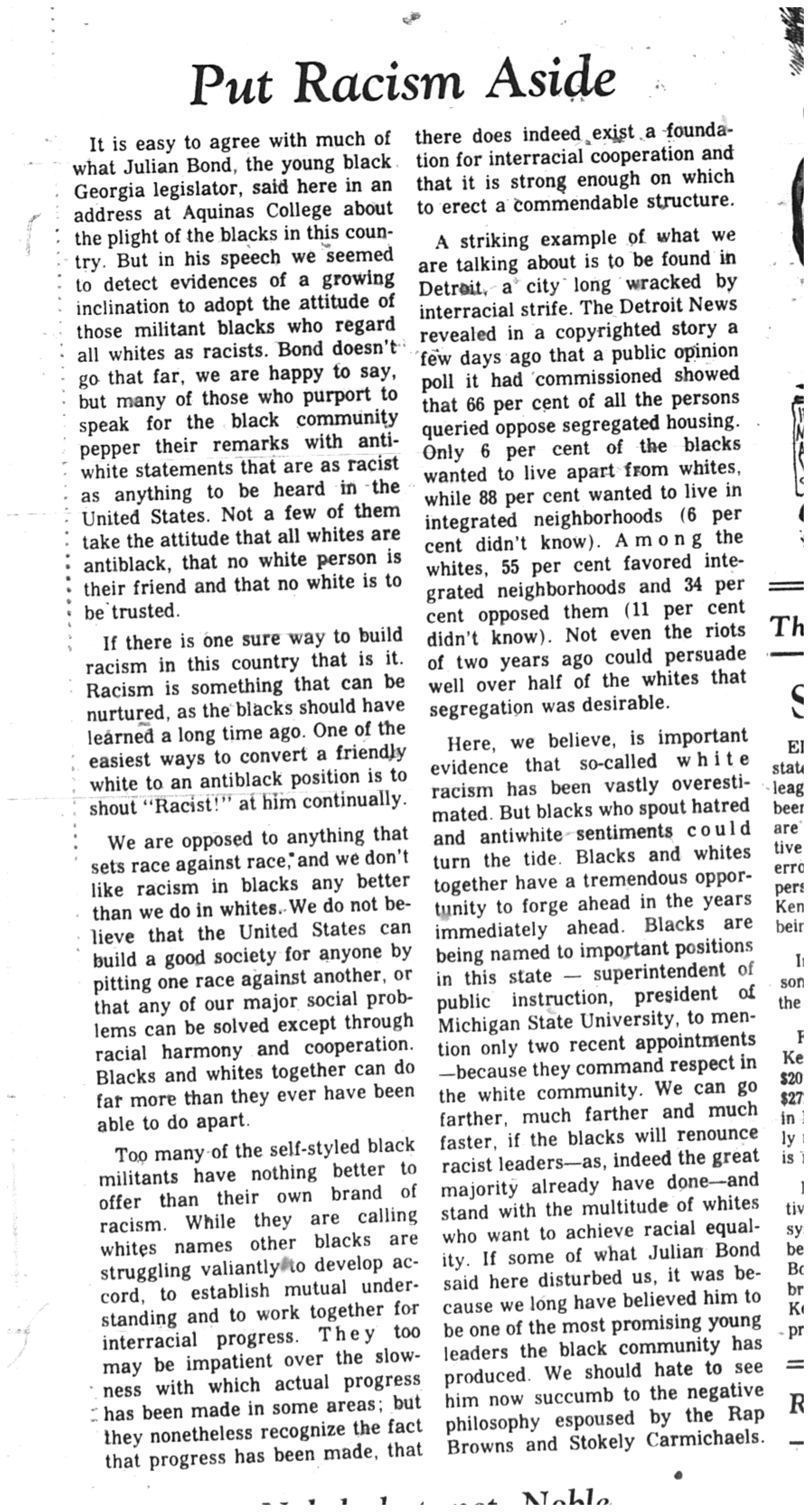
There was one other piece written on Julian Bond’s visit to Grand Rapids, an editorial from the Grand Rapids Press 2 days later. The Press editorial is instructive, as it not only reflects the bias of the Press, but underscores a deeply white supremacist mindset.

We think it is worth it to reprint the entire editorial so that people can read for themselves how deeply racist their views are.

Bond

Posted in Civil Rights/Freedom Movement | Tagged , , | 1 Comment

GR Press Coverage of Stokley Carmichael visit to Grand Rapids – 1967

hqdefault

On May17, 1967, the Student Non-violent Coordinating Committee (SNCC) and Black Power advocate, Stokley Carmichael, spoke at Fountain Street Church to a standing room only crowd.

Since we do not have a transcript of what Carmichael said, we must rely on a Grand Rapids Press story that appeared on May 18, 1967. In the article, Carmichael addressed several themes in his talk. First, he spoke about how all civil rights legislation was about civilizing white people. 

Another area that Carmichael addressed was the Vietnam War, where he made the points that this was a way to diminishing the ranks of blacks by forced recruitment and it was another indication that whites engage in violence all the time, yet they cry foul when violence is done to them.

The Black Freedom struggle leader also talked about white cops in black neighborhoods and that black cops should not join the AFL-CIO, since they practiced racism in their ranks. One final comment was Carmichael’s response to J. Edgar Hoover, who claimed that Stokley was part of the Revolutionary Action Movement (RAM). Stokley responded by calling Hoover a note taker. What he meant by that was that Hoover just took notes while the cops surrounded black people and beat them.41-Jyxg3zeL._SX299_BO1,204,203,200_

There was a second short article in the Grand Rapids Press, which acknowledged that Carmichael had meet with roughly 350 members of the black community at the First Community Church AME. People at that meeting addressed dissatisfaction with community conditions, with public education and with the Campau Housing Project in particular. Carmichael did encourage high school students from Central, South and Ottawa to get organized and become part of SNCC.

The irony was that just 2 months later, police officers in Grand Rapids pulled over and abused several young black students, which erupted into a 3 day rebellion in July of 1967. Many of the people involved in this rebellion were black high school students. 

Lastly, it is worth noting that there were threats against Carmichael coming to Grand Rapids. Two white men living in Belmont had their homes raided by the FBI. The FBI found assault rifles, bombs, dynamite and 2 sub-machine guns in their possession, as reported by Jet Magazine. The magazine also reported that “the men were charged with possession if illegal weapons, but were released on their own recognizance.”

Posted in Civil Rights/Freedom Movement | Tagged , , | 2 Comments

The 1916 City Charter change in Grand Rapids was nothing short of Class Warfare

During the 1911 Furniture Workers Strike and its aftermath, the business community and leading industrialist, began to develop a plan that would significantly alter the way electoral politics was done in Grand Rapids. 

The 1911 Furniture Workers Strike revealed several things to wealthy industrialist. First, there was a growing threat of Socialist and Anarchist politics, particularly with the Socialist Mayoral candidate, Edward Kosten, in the 1912 Mayoral race. Out of the 14,772 votes cast in the Mayoral race in 1912, Kosten received a total of 2,315 votes in a three candidate race, which was roughly 1 out of 7 votes.Screen Shot 2016-04-14 at 10.53.39 AM

Second, the wealthy industrialist of Grand Rapids were further committed to the notion that, in the words of Chief Justice John Jay, “the people who own the country ought to govern it.” Not only was this sentiment embraced by the wealthy industrialist in Grand Rapids, it was endorsed by Frank M. Sparks, the political correspondent for the Grand Rapids Herald. Sparks had written a book, The Business of Government Municipal Reform.

In his book, Sparks wrote, “just as ownership in the modern corporation had been divorced from management, so, too, must the individual citizen let professionals guide the direction of municipal life.”  Sparks went on to say, “Citizens were like shareholders in the modern municipal corporation. If they wanted more efficient government they must be prepared to surrender direct control of policy to elected commissioners who would serve as a board of directors and in turn hire professional managers.”

Third, the wealthy industrialist were deeply concerned about the current political ward system in Grand Rapids. The majority of working class people had too much influence in the outcome of elections, so a new ward structure was proposed in the 1916 City Charter.

Grand Rapids, at the time, was made up of a twelve ward system, with 2 aldermen elected from each ward and a strong mayor. (see Grand Rapids ward map above) What was proposed in the 1916 City Charter was to have a three ward system with two commissioners from each ward and a weak Mayor, meaning that the Mayor would only have one vote and in a sense be a glorified commissioner. In addition, there would be a City Manager position, which would essentially run the day to day tasks and make recommendations. For many, the City Manager position was the real power behind city hall.

This third factor, in determining the city’s political future, would limit bloc voting, particularly among ethnic communities and religious sectors, and give greater control to electoral outcomes. The voting numbers in the 1916 Grand Rapids City Charter were revealing.Strike

In August of 1916, voters went to the polls to determine the future political structure of Grand Rapids. The new Charter won by a small margin of 7,693 votes in favor to 6,012 votes in opposition. According to Jeffrey Kleiman’s book, Strike: How the Furniture Workers Strike of 1911 Changed Grand Rapids, the wards that voted overwhelmingly in favor of the Charter change were made up of the city’s elite.

The Second, Third and Tenth wards provided enthusiastic support for the proposed changes. Here lived the industrialists, lawyers, and bankers who formed the leadership of the Furniture Manufacturers Association, and the Association of Commerce. These men shared social and business connections through Kent Country Club and the Peninsular Club, and many were members of Fountain Street Baptist Church.

By contrast, those who voted against the City Charter changes in 1916 were made up almost entirely of working class constituents. The wards voting against the changes were the twelfth ward in the southwest part of the city and the entire west side.

Again, according to Kleiman, “After a decade of struggle, the furniture manufacturers and other economic leaders of the new industrial city finally controlled the government.” We would all do well to recognize this history of the voting structure in Grand Rapids and not assume that it has change changed much over the years.

Posted in Anti-Capitalism/Labor, Neighborhood organizing | Tagged , , , | 11 Comments

Residents ignored again as Grand Prix Committee pushes to convert downtown GR streets into racetrack – 1996

Since as early as 1992, a DeVos and two others have been talking about holding Grand Prix races in downtown Grand Rapids. These races are held elsewhere in the country, although generally not on city streets. The noise is outrageous and can be heard over a mile away.

Screen Shot 2016-04-11 at 12.30.46 AM

At any rate, as one might gather from the presence of a DeVos, even such a crazy idea as this is no mere fantasy. In fact, it has been taken seriously by several city officials. Until recently it was being planned for July, 1997. Now it is tentatively set for August, 1998.

Such an event is said to attract business to the area. In the eyes of some, that seems sufficient to justify virtually anything. Corporate sponsors would cover a good deal of the cost, and it is anticipated that many people would actually pay to witness these cars racing around.

One of the major corporate sponsors is Exxon, of the Alaska oil spill fame. Promoters don’t seem to care what reputation the sponsors bring, so long as they bring money.

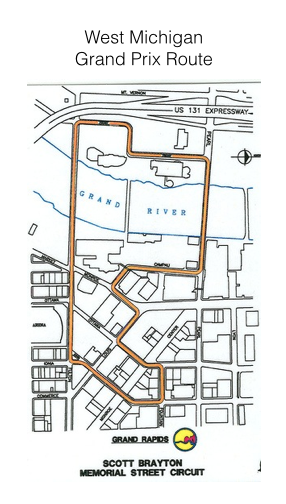
To set up for such a race, which would be held over a three day weekend and cover a circuit about 2 miles long, streets must be rotomilled and repaved. Manhole covers would have to be welded shut. Blockades must be set up to protect spectators and others. The route is proposed to fall within DDA (Downtown Development Authority) boundaries, “so the DDA can be used as a financial resource to assist in the payment of street improvements.” The DDA, dominated by rich, white men who do not live in downtown, or necessarily even in the city, has control over millions of tax dollars that are diverted from schools and general government.

A committee supporting this idea says total costs of over $2.5 million would involve essentially no cost to the city other than some staff time. That staff time, in some cases at $30 – $50 an hour, has perhaps already been considerable, though no estimate is available on total staff time cost. In addition, there is apparently no contemplation of rental charges for use of downtown streets. Of more concern, citizens would be barred from use of those streets during most of the three-day-period. Apparently, no cost has been assigned or even figured for that loss of use.

In discussing the idea initially, one might think that the committee pushing for this event would want to get the reaction of Grand Rapids citizens generally, and especially of those who live and/or work downtown. Not so. In setting up initial meetings to pursue the idea, Craig Kinnear, director of the Downtown Management Board, invited presidents or directors of GVSU, the Chamber of Commerce, the Grand Action Committee, other businesses and tourist promotion groups and owners/managers of various large businesses downtown. NO average citizens were invited., NO residents or representatives of resident groups were invited, NO neighborhood association representatives were invited, NO workers or representatives of worker groups were invited and NO students were invited. In short, business as usual.

When Craig Kinnear was asked why the planning group was so limited, he responded that any plan needs final city approval, and that public input could occur at that time. He touted the idea as, “an opportunity to showcase Grand Rapids.” Asked if he had any concerns about using Grand Rapids streets to “showcase” such exploitative companies as Exxon, he said simply, “No.”

Editor’s Note: In 1998 and 1999, the West Michigan Grand Prix was held in downtown Grand Rapids. Hundreds of residents, in places like the Morton House, were prevented from leaving or entering their residence and hundreds of workers also had limited access to the downtown area. 

One can see from the video where part of the race route was located.

Posted in Neighborhood organizing | Tagged , , , , | 3 Comments

Grand Rapids Heartside Park threatened by off ramp -1996

The linked article on the Heartside Park is re-published by the FUNdamentalist newspaper, which was published from 1991 – 1998 in Grand Rapids. 

heartside-park

The Heartside Park almost didn’t happen. As the linked article suggests, there were lots of political and economic efforts that threatened the park’s viability. 

Efforts began in the mid-1990s to create a park in the Heartside neighborhood, one that would serve many of the people who relied on social services from a variety of agencies. The park gained traction, but there were numerous obstacles to overcome.

First, other entities, particularly the Catholic Schools, were looking at the creation of a park that would primarily benefit their sports programs. Initially, they looked at a possible Heartside Park space, later they looked south of Wealthy and eventually to Knapp St. SE.

Then there was the issue of the City Commission approving an off ramp that wold significantly reduce the park size. (see photo where ramp is to the left of the park leading up to the Van Andel Arena)

3595833637_7702fbc067_b

Not to be deterred, the Heartside Park efforts were finally realized in 1997, after years of a battle between the city and downtown businesses who resisted the creation of a space that would cater to the “homeless population.”

People raised money, held concerts and finally won a battle despite the city’s master plan calling for a park in the Heartside area. Numerous agencies rallied around what was being called, The People’s Park.

However, the park is under constant scrutiny, especially as development projects have sprung up around the park, specifically the Downtown Market, which has never been in favor of the park that is a haven to people subjected to poverty.

Posted in Neighborhood organizing | Tagged , , | Leave a comment

The Grand Rapids African American Museum and Archives: An Interview with George Bayard

Screen Shot 2016-04-05 at 7.58.27 PMSomething very exciting is underway, something that is critical to the history of Grand Rapids.

The Grand Rapids African American Museum and Archives project. If is very fitting that the acronym, GRAAMA, is rooted in the person that tells the stories, that holds the dreams and that lifts the voices.

Screen Shot 2016-04-06 at 8.26.16 AM

The Grand Rapids African American Museum and Archives project is still in its infancy,
but the momentum is building and George Bayard invites us to contribute. People can contribute oral histories, archives materials and of course, they can contribute financially.

We sat down with George last week to talk about the project, its vision, the wealth of information and the importance of a counter-narrative to White Supremacy. Says George, “we recognize that the Grand Rapids Press, in doing our research, it was one sided in the way they depicted our community.

Posted in Civil Rights/Freedom Movement | Tagged , | Leave a comment

To say anything further would only give comfort, or possibly discomfort, to white racists: The Grand Rapids Press Coverage of the Dr. Martin Luther King Jr. assassination – 1968

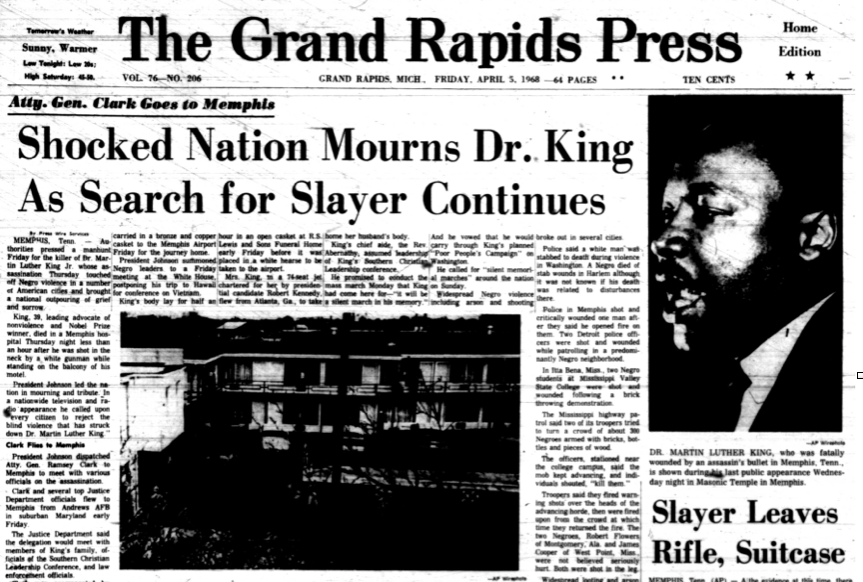
It has been 50 years since the assassination of Dr. Martin Luther King Jr. Much has been written about his murder, but what did the Grand Rapids Press have to say about the incident when it happened?

Screen Shot 2016-04-04 at 1.08.35 AM

There was front page coverage of the King assassination and subsequent articles. Most of the coverage was about the particulars of the assassination, what the Press calls a “national mourning,” and Negro violence.

In dozens of US cities, an uprising broke out, as Black people enraged at the murder of Dr. King took it out on the White population for this criminal act. Not surprising, the commercial media simply framed the uprising as unjustified violence. There were reports of violence done to property, looting and rioting. There was also reports of violence directed at police officers.

Such actions were completely understandable when one considers that a Black uprising had been going on for years. The commercial media and the Grand Rapids Press did not frame it that way, but any competent scholarship understands that an uprising was inevitable. The Watts uprising was one of the first major forms of insurgency, but the 1967 uprisings were a major threat to White Supremacy. The fact that an uprising took place in the aftermath of the King assassination, only underscores the level of frustration with institutionalized racism, which seemed impenetrable.

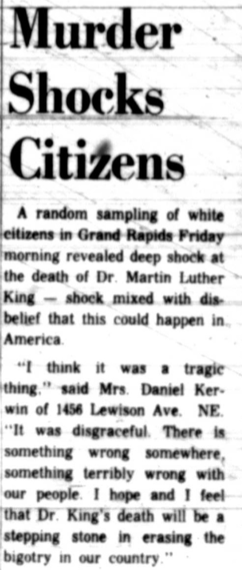
The Local Reaction to King’s AssassinationScreen Shot 2016-04-04 at 2.35.31 AM

In an article, “Murder Shocks Citizens,” the Press sought first to get reaction to the death of Dr. King from White citizens. Mrs. Daniel Kerwin stated, “It was disgraceful. There is something wrong somewhere, something terribly wrong with our people. I hope and I feel that Dr. King’s death will be a stepping stone to erasing the bigotry in our country.”

Mrs. John Condon said, “I am humiliated and ashamed. I’s ashamed for the white man who did it and ashamed for the white race. I have no where America is going from here.”

Mrs. John C. Sprik stated, “I was surprised that he didn’t get it before. It seems that the leader of anything, one way or another, they get them.”

Mary Wreford of Bemis St. SE said, “I am shocked that White people could be shocked. It is surprising that they didn’t realize before the raving madness that affects this whole nation.”

There were also various reactions from the Black community. Rev. Lyman Parks (who later became Grand Rapids Mayor), was asked his opinion on the direction that America would take. “I don’t know. I just don’t know. But I think it becomes the responsibility of us who believe in the techniques of nonviolence preached by Dr. King.”

Jerome Sorrels, president of the NAACP in Grand Rapids stated, “I am deeply shocked. I know of no man who could step in and fill Dr. King’s shoes. From here on, the future looks dim to me.

Reggie Gatling, referred to as a black power militant, said, “Members of the black community had a meeting last night and decided we would not give out a public statement that would be reflective of feelings. We’re in mourning for Dr. King, but to say anything further would only give comfort, or possibly discomfort, to white racists.”

And Gerald Brown, another black power advocate and Carl Smith, director of the Black People’s Free store, said Gatling’s statement was “correct.”

Defending Business as Usual in Grand Rapids

It is instructive that the Second Ward City Commissioner, William Worst stated, “I’m happy though that our community is taking this calmly and not resorting to any unusual violence.” This is really code for, “thank God the Black people are not rioting.”

In another Press article, “Grand Rapids officials recognized, however, that the situation still was touchy Saturday, and denied a request for a permit to hold a peaceful, silent march in tribute to Dr. King.

Mayor Sonneveldt said, “I discussed the request with the department heads of the city and it was the consensus that it would not be wise to permit such a demonstration.”

The Mayor had said earlier, “I’m proud of our city,” as matters remained normal in the community, while violence erupted across the nation.

Black people would be denied the right to a peaceful assembly to morn the death of Dr. King and the White power structure would maintain business as usual, or as the Grand Rapids Press said, as matters remained normal.

Posted in Civil Rights/Freedom Movement | Tagged , , | 4 Comments

From Chicago to Grand Rapids, Lessons in Liberation: An Interview with Jose Cha Cha Jimenez & the Young Lords

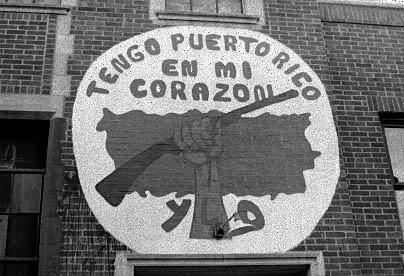
prenmicorazon

The other day we had the opportunity to sit down with Jose Cha Cha Jimenez, one of the founders of the Puerto Rican Revolutionary groups, the Young Lords.

Jimenez reflects on the fact that the Young Lords were formerly a gang and transformed into a powerful revolutionary organization.

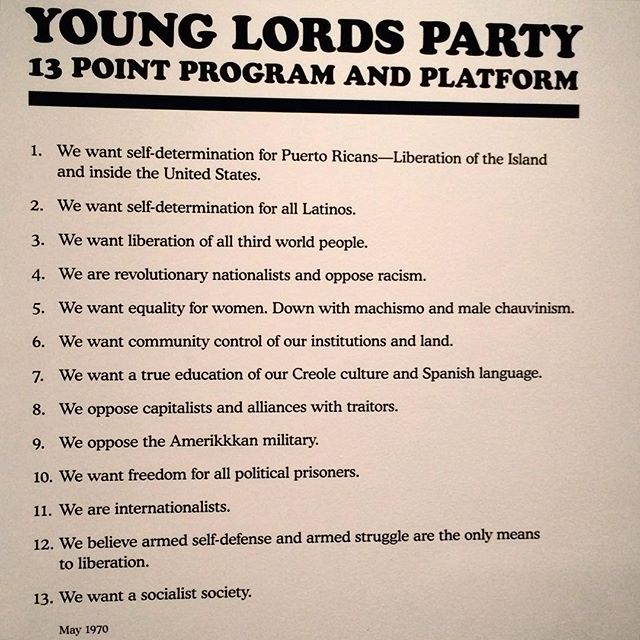
The Young Lords began in cities like Chicago and New York, but soon spread to numerous cities across the country, maintaining their street-cred, but organizing with other militant groups like the Black Panther Party for Self Defense, the Brown Berets, and the American Indian Movement.11326044_991368227580983_777802558_n

Much has been written about the Young Lords, but more importantly there is a great archive of interviews and other materials that provide a wealth of information about this important US-based liberation movement.  

The interviews we conducted with Jose Cha Cha Jimenez are intended to provide a first hand account of the transformation of the Young Lords in Chicago, discussion about what kind of organizing they were engaged in, how Grand Rapids is facing some very similar threats to neighborhood autonomy and gentrification, and lessons learned for future revolutionaries.

The interview is divided into questions that we asked of Jose.

Posted in Civil Rights/Freedom Movement | Tagged , , , , | Leave a comment