Not at play in the fields of the Lord: The Bible League and Genocide

Editor’s Note: It is clear to anyone who investigates the history of West Michigan that religion has played a significant role in both promoting and resisting systems of oppression. The religious right for nearly 200 years in West Michigan has acted as a counter-revolutionary force to either silence or co-opt efforts to challenge power and privilege. This is the first in a series of postings that look at the role and function of the religious right through a People’s History lens.

Reprinted from The FUNdamentalist (April 1996)

In October, Ralph Reed, director of the Christian Coalition, spoke in Grand Rapids by invitation from the Acton Institute. (Founded by a Catholic priest, the Acton Institute believes that Christianity and Capitalism make great bedfellows) In attempting to localize the influence of the Religious Right I gave a presentation at the Institute for Global Education the month prior to Reed’s visit. While researching the local connections I was amazed at how many groups there were and what role they play on the international scene. This essay will focus on the Wycliff Bible Translators/Summer Institute of Linguistics work and their relationship to the Illinois based group, The Bible League, which has its Latin American branch based in Jenison, Michigan.New-slider-BibleLeague

Around the turn of the century a growing number of Christians, called Millennialists, thought that the Great Tribulation would occur by the year 2000. This cosmological view of the world prompted many missionary groups to work towards evangelizing the planet before the rapture, with the hope of bringing more souls to Christ. One such young evangelist, Camerond Townsend, felt that more than any other population in the world, indigenous people would benefit the most.

After being challenged to translate the Christian New Testament into a Mayan language known as Cakchiquel, Townsend decided that he would develop an organization to translate the Christian bible into all the indigenous languages in the world. Thus the Wycliff Bible Translators came to be. This was in the 1930’s when there was some antichurch sentiments running through Latin America. To avoid the appearance of being missionaries, Townsend decided to call his overseas operation the Summer Institute of Linguistics (SIL), to lend more credibility to his efforts. In the end the SIL, who’s claim that they were not an evangelistic organization, came under significant fire for their deception as a linguistic group and the role they would play in the colonization, exploitation and genocidal policies directed at many indigenous communities around the world.

While researching the historical role of SIL I discovered that a local group, The Bible League, was translating Christian bibles for SIL in Mexico and Peru. I wrote to The Bible League to ask if they were aware of the accusations made against SIL by well known scholars, anthropologists and Indigenous groups? A Rev. Chester Schemper wrote me back stating that “SIL publicly and categorically denies these charges as completely false. We have every reason to accept SIL’s categorical denials.” Rev. Schemper and the folks at SIL may categorically dent these accusations, but there is too much credible scholarship that says otherwise.

Mexicowycliffe-logo-colour
SIL formally has its beginnings in Mexico. Cameron Townsend was invited to Mexico by a government official who was impressed with Townsend’s work in Guatemala. Townsend was quickly able to win over the administration of Lazaro Cardenas in supporting his project to learn the native languages of southern Mexico. Cardenas was very impressed with Townsend’s projects that he even bought him a brand new car to show his gratitude. So why would a government that tended to be anti-clerical give such support to a Christian group like SIL? Consistent with most “liberal” and “revolutionary” governments in the Americas, Cardenas was hoping to bring the indigenous population more fully into the national identity. This strategy has been employed mostly to provide cheap labor for expanding markets, but also to snuff out potential indigenous led insurgent movements or the support of those movements. The work of SIL fit nicely into this nationalist program.

Beginning in the 1970’s, however, SIL came under attack from Mexican activists, indigenous groups and anthropologists. One example of this criticism came from anthropologists who were shocked when they found out that a SIL translated dictionary of the Tzotzil speaking Maya of southern Mexico had eliminated both Spanish and native words for ideological concepts that threatened the status quo. Interestingly this came at a time when there were significant conflicts in the region. Another anthropologist cited in Is God An American: An Anthropological Perspective on the Missionary Work of the Summer Institute of Linguistics (Hvalkof & Aaby, 1981), observes that SIL encouraged indigenous people to submit to the repression since it was being perpetrated by the local authorities. “If any of you are killed by the bosses….do not retaliate. God is the one who has set the bosses in authority over us; therefore we must pray for them. They are part of God’s plan…God is in control and He always works for our good. It is impossible for anyone to kill us before God says we can come home. If we are killed by them, let us consider that since God is over all, this is part of his will.”b070124128a0b46ecb167010._AA240_.L

In 1979, a commission from Mexico’s College of Ethnology and Social Anthropology had presented the government with a report that concluded “SIL supports the expansion of capitalism in areas rich in natural resources, opening these areas to the capital markets and turning the population into a docile and cheap labor force.” (Spiritual Warfare, Diamond 1989) This comes as no surprise when one realizes who has been funding SIL over the years. In Thy Will Be Done, the authors give us this list: the Pew Family Sun Oil Company, Nelson Baker Hunt Placid Oil, Standard Oil of New Jersey, Weyerhauser, Samuel Milbank Corn Products Corporation, USA military surplus, USAID, US Department of Defense, CIA and the US State Department just to name a few.

When I wrote The Bible League and inquired as to their relationship with SIL, I also asked “do you think that Indigenous communities that have practiced their own forms of religion for centuries need Christianity? Is Christianity a superior form of religion, and how do you respect people’s basic right to engage in their own form of worship and beliefs?” Their response was “The Bible League is convinced that what the world needs more than anything else is the Bible, which introduces men to Christ in who people can find hope for now and eternity….If the people were to respond to it, this would certainly be a lot better world to live in.” At this point it would do us well to ask for whom is it a better world to live in? From all of the sources I have read and cited here, just in regard to SIL, suggests that indigenous people are worse off than they were before the missionaries invaded their territory. In fact, SIL has been very intolerant and antagonistic towards the religious traditions of the indigenous groups they have come in contact with.

SIL has viewed indigenous religious beliefs and practices as the “principle abode of Satan.” (Fishers of Men or Founders of Kingdom, Stoll 1982) In standard imperial fashion this missionary group even equated the indigenous peoples troubles with their practice of “witchcraft and shamanism.” With this kind of thinking it is understandable that these kinds of religious groups would feel that their work is not only good, but necessary. Indeed, like much of the Cold War rhetoric, SIL saw the influence of communism in many countries, where nationalist or revolutionary movements grew, as the influence of Satan. To collaborate with US government agencies or US client state authorities was standard fare in the battle for people’s souls. This imperialist practice even reached into the realm of culture. Stoll cities one example where SIL was “supplanting Amuesha sacred music with its own. Set to Amuesha words, all too familiar tunes like ‘O My Darling Clementine’ and ‘The Battle Hymn of the Republic’ were leaping out of cheap play-back only cassette players which translators distributed from Peru to Guatemala.” This may not seem like such a big deal to The Bible League or many others, since it is the very nature of missionary groups to engage in this type of religious and cultural imperialism, but in the realm of international law it is simply called genocide.

According to the 1947-48 Genocide Convention “genocide does not necessarily mean the immediate destruction of a nation. It is rather intended to signify a coordinated plan of different actions aimed at the essential foundation of life of national groups, with the aim of annihilating the group themselves. The objectives of such a plan would be the disintegration of the political and social institutions of culture, language, and national groups…” This type of genocide, sometimes called cultural genocide, is stated quite clearly by the North American Congress on Latin America in regards to SIL, “The integration policies, however designed to abolish the reservation, wipe out the material basis for any possible continuance of indigenous culture. These policies force upon the Indians a whole spectrum of relationships based on private ownership of property and remove the underpinnings of their cultural survival.” (Report on the Americas – NACLA 1973)

For the past 20 years or so SIL has been the target of much criticism by numerous groups, especially indigenous. In 1980, at the Inter-American conference, delegates denounced SIL and asked that conference participants withdraw an honor that had been given to SIL founder Cameron Townsend in 1972, Benefactor of the Linguistically Isolated Population of America.” The decision was unanimous. According to Guatemalan author Victor Perera “SIL officials pressured Guatemalan politicians not to ratify funding for the Academy of Mayan Languages in 1990” for fear of losing control over linguistic work in the country. (Unfinished Conquest, 1993) Perera goes on to cite Mayan cultural activist Demitrio Cojti on the SIL, “The time has come for Mayas to reclaim their own languages as well as the distinct cultural vision they sustain. We have no more need of foreign excavators and interpreters of our Maya heritage.”

It is my view that as Mayans and other Indigenous people struggle to reclaim cultural autonomy, and in some cases political sovereignty, we need to respect and support these efforts. The Bible League, even though it may deny the charges of SIL participation in government and corporate crimes, it is still an accomplice in genocide. In many ways they serve the same function as Catholic priests did who blessed the European conquest of the Americas, chaplains who blessed soldiers and bombs as they murder civilians, or Christian leaders who encouraged the anti-semitic and fascist policies of Nazi Germany. One might ask how providing bibles overseas could be equated with the heinous atrocities committed in the previous examples? One may remember that US Chief Justice Robert Jackson, who presided at the Nuremberg trials against war criminals, sentenced Julius Stricker to death for his part in the Nazi extermination campaign. Stricker’s crime was acting as the editor of a German newspaper that dehumanized the Jews and contributed to the German public’s acceptance and participation in genocide, particularly with the racist caricatures of Jews on the pages of Der Sturmer. The Bible League does no less, since its literature promotes a cultural assimilation that can lead to cultural genocide.

I would encourage people to challenge the Bible League on this matter by contacting them at 16801 Van Dam Road, South Holland, Illinois, 60473 or call the Jenison, Michigan office at 616-457-3900. Also, I would suggest that we investigate and challenge the activities of any and all foreign missionary groups to see if they are engaged in similar activities. Ultimately we may need to call into question and challenge the very nature of mission work, since it is based upon the assumption that the truth they proclaim is superior to that of Indigenous people.
Posted in Indigenous Resistance, Religious Right | Tagged , , , , | 2 Comments

Statues, Jay Van Andel and the lie of Free Enterprise

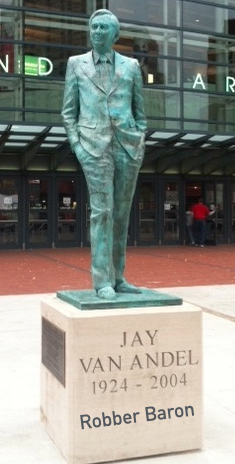
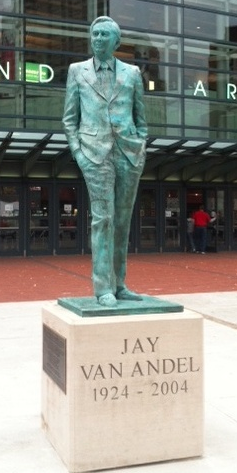
A few days ago we posted a piece that examined one of the statues in the Community Legends series, Chief Noonday. Today, we look at another statue, that of Amway co-founder Jay Van Andel.Screen Shot 2016-01-28 at 11.53.44 PM

Van Andel’s was one of the first statues to go up in the series that is funded completely by another member of the local capitalist class, Peter Seechia. Van Andel, who in personality, was the exact opposite of Rich DeVos. The other founder of Amway, Jay Van Andel was quite and reserved, but make no mistake about it, his politics were every bit as ruthless as that of Rich DeVos.

Van Andel, like his Amway co-founder, funded numerous rightwing groups, both religious and secular. The religious groups that Van Andel funded while he was alive and continues to fund through his foundation are The Acton Institute, Bethany Christian Services, Campus Crusade, Creation Research Society, Morality in Media, Mel Trotter Ministries and Guiding Light.

In the secular arena, Van Andel was a big supporter of Grand Valley State University, Calvin College, Hillsdale College, Frederick Meijer Gardens and Grand Action. In fact, Van Andel was the largest single donor (besides taxpayers) to the construction of the Van Andel Arena, which is where his statue is located.

Van Andel was also a big supporter of the Grand Rapids Chamber of Commerce and had a hand in the founding of the Right Place Inc. In addition to donating money to support rightwing causes and organizations, Van Andel was also an active player in determining the policy work of several keys national groups that have had a significant effect on federal and foreign policy.-6f3cc1390ec1b74f

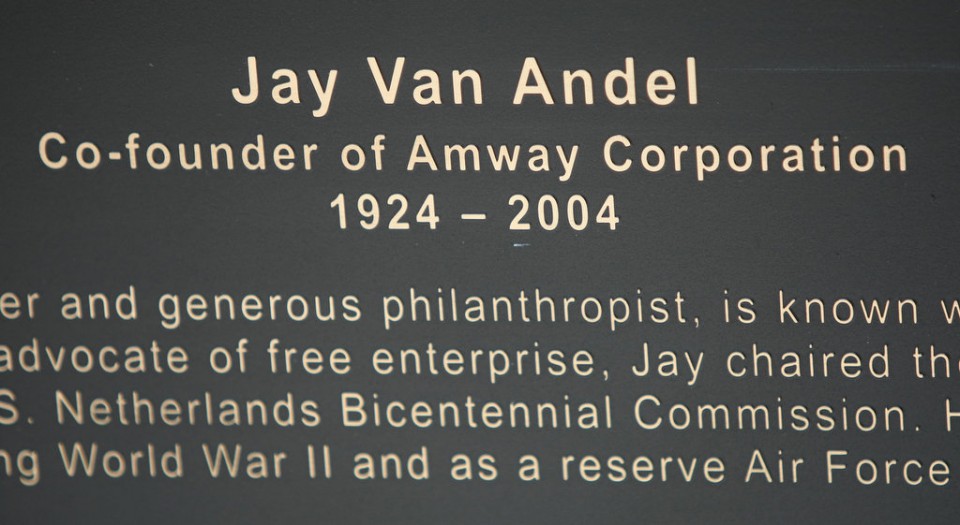
Before we look at some of the national groups that Van Andel worked with, it is important to note that the main message on the plaque the immortalizes the Amway co-founder is that he was a tireless “advocate for free enterprise.” Van Andel believed that business should lead the way to creating prosperity and freedom, especially when the government doesn’t put limited on what the market can do. Well, at least this was the public message that Van Andel was fond of espousing, but in private he was in no way interested in an unfettered market. In fact, Van Andel, like most capitalists, want the state to intervene on behalf of private capital, especially when it serves the interests of the wealthiest part of the capitalist class.

The Heritage FoundationScreen Shot 2016-01-29 at 3.04.18 AM

For decades the Heritage Foundation has crafted public policy that has been adopted by every US administration, beginning with the Reagan administration. Van Andel was a trustee for the Heritage Foundation from 1984 – 2004 and was part of the process that saw numerous public policy changes come about because of the influence of the foundation.

Most notable has been the Heritage Foundation’s promotion of conservative economic programs. They wrote the incoming Reagan administrations policy guide Mandate for Change that advocated the elimination of Food Stamps, Medicare, child nutritional assistance, farm assistance, legal services for the poor, and the repeal of a $1,000 tax exemption for the elderly.

The Heritage Foundation continues to play a crucial role in determining national policy, around economic issues, immigration policy, trade policy and climate change.  

The Chamber of Commerce

Not surprising, Jay Van Andel was deeply involved in the largest pro-business lobbying group in the country, the US Chamber of Commerce. In fact, Van Andel was Chairman of the national group for a period of time. The Chamber, which often likes to present itself as a defender of the small business owner, is one of the largest electoral contributors in the nation. According to Open Secrets, the US Chamber has spent $1.2 billion on lobbying since 1998. 

In addition, the US Chamber of Commerce has been one of the most consistent climate deniers in the country and has fought hard against any policy that supports working class people. The Chamber has opposed efforts to get paid sick leave policy passed and numerous other pro-worker policies. As Chairman of the US Chamber of Commerce, Van Andel made sure that whatever policies were being decided in Washington, they needed to benefit the capitalist class that he was a part of.
National Endowment for DemocracyNED LOGO VEKTOR

May the least known of the groups that Van Andel was deeply involved with, was the National Endowment for Democracy, also known as NED. NED was created during the Reagan years as a mechanism to push neoliberal economic policies around the world and funding governments or political parties that would best serve the interest of the US. Allen Weinstein, who helped draft the legislation establishing NED, was quite candid when he said in 1991: “A lot of what we do today was done covertly 25 years ago by the CIA.” 

Jay Van Andel was on the Board of Directors of the National Endowment for Democracy and served in that capacity while the NED was funding death squad governments in Central America, funding opposition parties in Nicaragua and supporting pro-US dictatorships throughout Latin America, Africa and the Middle East.Screen Shot 2016-01-29 at 4.15.36 AM

One of the more recent campaigns that NED has been involved in is the effort to undermine the government of Venezuela. The NED has pumped millions of dollars into Venezuela in the form of propaganda material, the funding of opposition groups and the backing of opposition political parties. The campaign by NED in Venezuela is counter-revolutionary in nature and that has been the primary function of the organization since it was founded in 1983.

This last point is an important one, since counter-revolutionary politics is exactly what Jay Van Andel was involved in most of his adult life. Like the Robber Barons of the late 19th century, Jay Van Andel not only sought to increase his wealth after the founding of Amway, he sought to suppress any efforts that put his pursuit of wealth in jeopardy.

Posted in Anti-Capitalism/Labor, Lies Across Grand Rapids | Tagged , , , , | 9 Comments

Monuments, propaganda and settler colonialism in Grand Rapids

This posting is part of the Lies Across Grand Rapids series that looks at how land marks, monuments and other historical markings tell either a distorted view history or a history that defends power and privilege. Chief Noonday

There are numerous statues scattered throughout the downtown and near downtown area by a group known as the Grand Rapids Community Legends Inc. This project has been spearheaded by a member of the local power structure, Peter Seechia.

The statues primarily honor people whom the local power structure idolizes such as Jay Van Andel, Lucius Lyons, Bishop Baraga, but does include the likes of Rosa Parks. However, the information that accompanies the statues is equally important to the statue itself. This is clearly the case with the statue adjacent to the GVSU downtown campus by the Eberhard Center, which is home to the statue of Chief Noonday, also known as Noahquageshik.

The Chief Noonday statue is an important one to think about for a variety of reasons. First, Noonday, unlike another Native leader from this area, Blackskin, signed on to the Treaty of 1821, which conceded land to Euro-Americans who were part of the expansionist colonial plans. Noonday was won over by Rev. Isaac McCoy, the head of the Baptist Mission, which was established along the Grand River in the early part of the 19th century. As we have noted before, the various christian missions played a key role in furthering white settler colonialism in what is now referred to as West Michigan. 

When I asked current leader/activist from the Tribal community that still considers the land in West occupied territory, what he thought of the Noonday statue, Lee Sprague replied, “Noonday probably would not have been who the Tribe would have picked to memorialize, industrialists think differently.”

However, the more important point that the Chief Noonday statue plays lies within the intent of those who chose the statue in the first place. The Grand Rapids Community Legends Inc. no doubt chose the Noonday statue for a variety of reasons. The statue is part of the larger project that is used to market the city for tourists. The statue also is a way for white people with power and privilege to say they are honoring diversity by having some statues be dedicated to non-white people from the history of West Michigan. But the most important reason, the reason that this statue is so important to the local white power structure, is that it communicates a narrative that perpetuates a lie.

Chief Noonday plaque

In looking at the text that accompanies the statue, one gets a clearer understanding of the function of the statue. First, it’s important to point out that it says, “In 1834, a large number of American settlers began moving into the region.” People of European descent began moving into the area at least a decade earlier, but the point to make here is on the wording. The statue names these people as settlers, when it fact they are white settler colonialists. Settler Colonialism is a process by which one group of people takes over land of another people, by force or other means. Here it is worth quoting Native scholar Roxanne Dunbar-Ortiz to clarify what settler colonialism is.

“Settler colonialism has best been defined as more of an imposed structure than an historical event. This structure is characterized by relationships of domination and subjugation that become woven throughout the fabric of society, and even becomes disguised as paternalistic benevolence. The objective of settler colonialism is always the acquisition of indigenous territories and resources, which means the native must be eliminated. This can be accomplished in overt ways including biological warfare and military domination but also in more subtle ways; for example, through national policies of assimilation.”

Such a recognition is critical, because it radically alters the narrative from merely American settlers coming to the area in large numbers, to Euro-Americans engaged in settler colonialism, which resulted in the theft of land and the displacement of thousands of Native people from this area.

The text that accompanies the statue does say at one point, “After the dispossession of their lands,” but such a reference is an after thought and does not center the narrative around settler colonialism.

Fundamentally, what the narrative of this statue serves is a white supremacist narrative, where white people can feel good about honoring a native person, but deny the historical factors that determined the fate of Native people. The statue is just another way of lying about the realities of settler colonialism and avoid having to acknowledge that the land that makes up Grand Rapids was stolen from Native people and is the root cause of the disproportionately high rates of poverty and poor health of the tribal members that still reside in the area.
Screen Shot 2016-01-26 at 10.13.02 AM

Posted in Indigenous Resistance, Lies Across Grand Rapids | Tagged , , , | 4 Comments

Fighting Institutional Bias: An Interview with Disability Rights activist Clark Goodrich


adapt_1007
This is the first in a series of interviews and postings that looks at the people and the history of the Disability Rights Movement in West Michigan.

We recently had the chance to have a lively conversation with Clark Goodrich, a disability rights activist and founder of the ADAPT chapter in Grand Rapids. In Part 1 of the interview Clark talks about his own personal journey, growing up with a disability and what led him to become involved in advocacy and activism work.

In Part 2 of the interview, Clark talks about the work he has done with ADAPT and some examples of actions he has been involved in across the country. Part 3 of the interview Clark discusses the difficulty of bringing the energy of national actions to the local level and then discusses an action that he and others did at the Greyhound Bus station in Grand Rapids.51xuUEHI3zL._SY344_BO1,204,203,200_

In Part 4 of the interview, Clark responds to questions around the ableist culture that still exists and the ongoing fight against institutionalized bias. In the last part of the interview, Clark talks more specifically about the climate for disability justice in the greater Grand Rapids area and what efforts and possibilities exist for the movement he is part of.

For those wanting a more detailed investigation of the history of the Disability Rights Movement in the US, we highly recommend the book, A Disability History of the United States, by Kim Nielsen. For those interested in the work of Clark and the local ADAPT chapter, you can find them on Facebook at Grand Rapids ADAPT. In addition, Clark provided us with some archival photos from ADAPT actions and campaigns over the years. Go to this link to see archival photos.

Posted in Disability Rights Movement | Tagged , , , | 1 Comment

A Brief history of the KKK in West Michigan

It is important as we continue to reflect on and investigate a People’s History of Grand Rapids, that we not ignore the systems of oppression and power that have historically sought to impose their will on various sectors of civil society.Screen Shot 2016-01-12 at 2.06.02 AM

One organization, which has a long history of activity in West Michigan, is the Ku Klux Klan. There has not been any definitive work done on the KKK in West Michigan and new research continues to take place, but there are numerous sources on the Klan operating in this area to allow us to draw some conclusions.

There is some evidenced, based upon the research of Hope College professors, that there was some Klan presence in West Michigan in the later part of the 19th century. However, it wasn’t until WWI where we see evidence of a significant Klan presence in Michigan, even in West Michigan. This is important, since the post-WWI Klan had just as much of distain for Catholics, Jews and “immigrant hordes,” as they did African Americans.1511405_10206433781057901_1224493182922768646_n

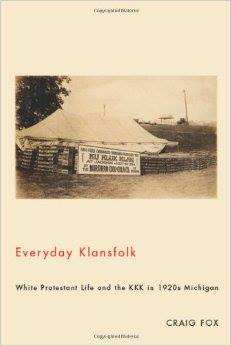
One of the best works on the KKK in Michigan, is Craig Fox’s book, Everyday Klansfolk: White Protestant Life and the KKK in 1920s Michigan. According to the author’s research, there were an estimate 80,000 Klan members in Michigan in the 1920s, with 5,000 being in greater Grand Rapids.

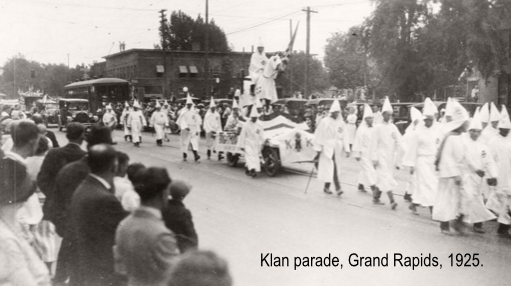
Todd Robinson, in his ground breaking book, A City Within a City: The Black Freedom Struggle in Grand Rapids, MI, states that there was a KKK “club” based at South High, “which was considered one of the most prestigious secondary schools in Grand Rapids.” More importantly, Robinson notes that there was a 1924 Klan parade planned in Grand Rapids, but because of bad weather, the parade was postponed until the following year.

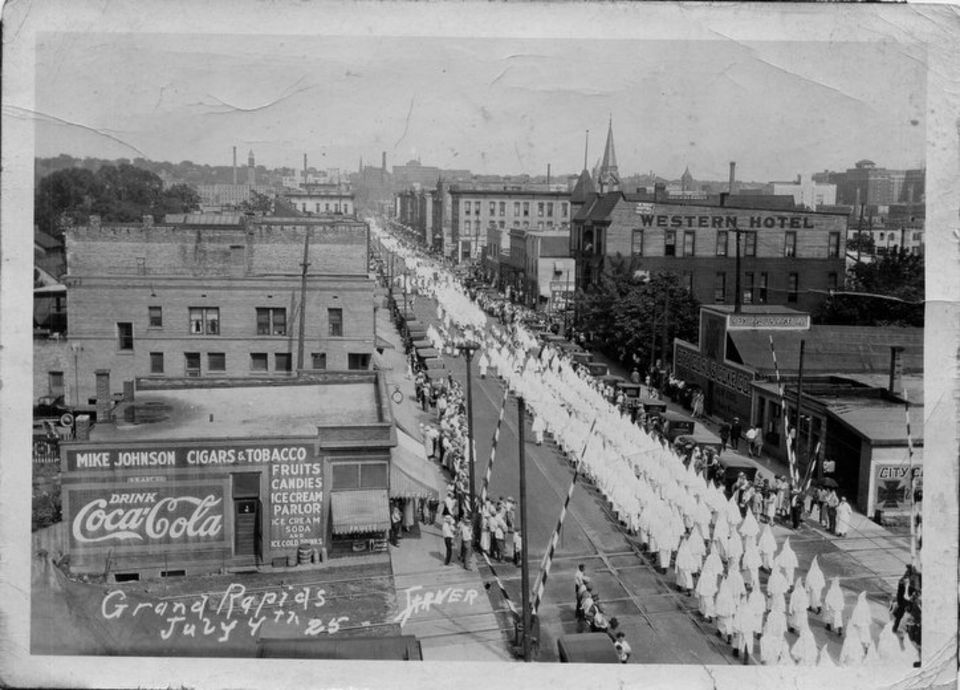
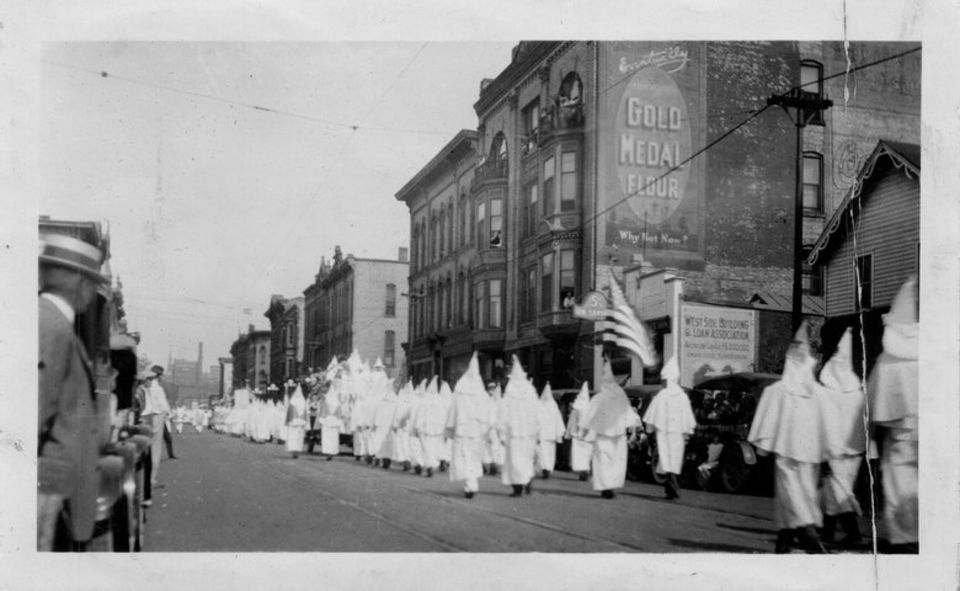
Most likely the largest Klan gathering in Grand Rapids took place on the 4th of July in 1925. The KKK had an estimated 3,000 people marching on the westside of Grand Rapids. Interestingly enough, this area of Grand Rapids, was dominated by Catholic immigrants from Poland, Germany and Lithuania. These were populations that would not have been terribly receptive to the Klan’s message, but the KKK’s decision to hold the parade on the westside may have been due to their decision to hold a rally after the parade at John Ball Park.

KKK in GR 2

According to a retrospective piece by GR Press writer Garrett Ellison, where he relies on GVSU history professor Matthew Daley, Ellison writes, “Members began arriving in Grand Rapids in the weeks ahead of July 4 and set up a tent city on the municipal outskirts near the Bridge Street hillside. Daley said mentions of “a symbol” seen atop the hill the night of July 3 suggest Klansmen fired off a cross, possibly with a matching one over Belknap, to announce their presence the next day.” Such a display certainly sent a message to the residents of Grand Rapids. 

KKK in GR

However, the Klan’s presence on Independence Day of 1925 would have a significant impact on the African American community in Grand Rapids. The Klan’s July 4 parade certainly sent a message to the Black community, which in the early 1920s numbered less than 3,000. First, it sent a message of intimidation, since Blacks were well aware of the terror tactics the Klan engaged in since their founding shortly after the Civil War.

A second, and equally important consequence of the 1925 Klan parade, is that it compliments, even solidifies the larger White Supremacist practices that made up the dominant culture in Grand Rapids. In his book on racism in Grand Rapids, Robinson states:

Discriminatory signs located in the windows of restaurants and businesses up and down Division Street declared, ‘Prices subject to change without notice.’ Even a basic commodity, such as coffee, routinely cost black customers five times as much. They paid fifty cents, while whites paid only ten cents.” Robinson goes on to say, “Few social, cultural and economic options were available for blacks in the city. The City’s social clubs, theaters, restaurants and hospitals banned or restricted blacks.” In other words, Jim Crow policies and practices were deeply entrenched in Grand Rapids, thus the Klan parade also played a larger roll in sending a message to the black community about their place in the furniture city in the 1920s.Screen Shot 2016-01-12 at 2.10.47 AM

Grand Rapids, nor West Michigan, has seen anything that comes close to the 1925 parade held by the Klan, but the KKK continued to have a presence in West Michigan in a variety of ways. The last rally the Klan held in Grand Rapids, was in 1995, in front of the old Court House/police station on Monroe Avenue in downtown Grand Rapids. The rally featured a handful of Klan members playing bad music and making brief speeches to a mostly hostile crowd of counter-protestors. Some protestors threw eggs at the Klan, while a few people were arrested for entering the area closed off by police, to supposedly prevent violence from taking place. One of those arrested was Rob LaDew, former publisher of Equality Magazine. For an independent account of the 1996 Klan rally in Grand Rapids, go to this archived article

Media Mouse also has some well-documented information on Klan activity in Michigan, including West Michigan in recent decades.

“The Ku Klux Klan has a long history of activity in the Midwest and in Michigan (in the 1970s Klansmen in Michigan used bombs to destroy school buses in order to prevent desegregation) and is probably the most well-known racist organization in the United States. However, since the 1980s the Klan’s influence has declined as it has split into different factions while failing to attract the interest of younger racists. Still, the Ku Klux Klan’s various splinter groups have remained active in varying capacities, with Michigan being home to chapters of The Empire Knights of the Ku Klux Klan, Imperial Klans of America, United Northern and Southern Knights of the Ku Klux Klan, and the National Knights of the Ku Klux Klan. Of these groups, Michigan is the national headquarters for the United Northern and Southern Knights of the Ku Klux Klan, which is based in Fraser, Michigan.”

Media Mouse also lists Klan activity since the 1980s, most notably their role in the 2004 anti-affirmative action Ballot Proposal, known as Prop 2. The KKK was not only distributing pro-Prop 2 literature, they were a financial donor to the Ward Connerly led campaign to undo affirmative action in Michigan. Here is a short clip from the documentary, Arise: The Battle over Affirmative Action. 

While Klan presence in West Michigan has diminished in recent decades, it is important to understand what role it has played historically in the Grand Rapids area and how it connects to the larger climate of White Supremacy and institutionalized racism that is deeply entrenched in Michigan’s second largest city.

One last resource that is worth looking at, is a 2008 lecture at GRCC by GVSU Professor Matthew Daley during Black History month. Daley’s lecture focuses on the history of the Klan in Michigan.

Posted in Civil Rights/Freedom Movement | Tagged , , , , , | 3 Comments

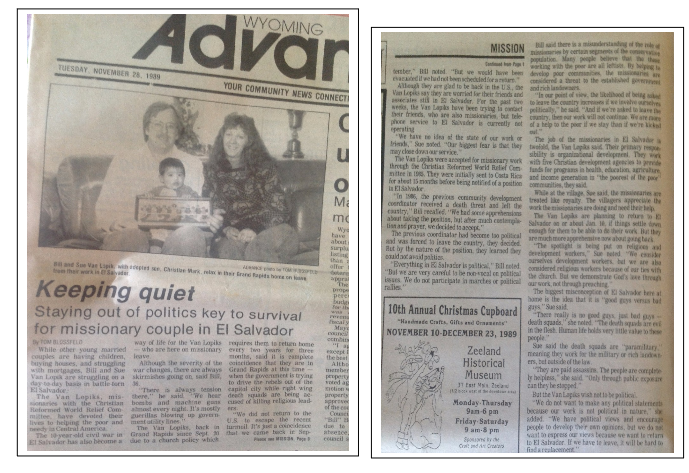
“We learned solidarity from those who thanked us for staying in the country when other North Americans had left”: An Interview with Bill Van Lopik on doing Solidarity work in El Salvador in the 1980s and 90s

This interview is with Bill Van Lopik, who, along with his wife, spent years doing justice work in El Salvador while calling Grand Rapids home. Bill is one of the hundreds of people from Grand Rapids who were part of the Central American Solidarity movement in the 1980s and 90s.

GRPH – When did you first get involved in Central American Solidarity work and what influenced you to do so?Screen Shot 2016-01-07 at 10.19.37 AM

Bill – My involvement in the Central American Solidarity movement was rather serendipitous and unplanned. My wife and I were hired by the Christian Reformed World Relief Committee (CRWRC) in 1985 as community development interns in Costa Rica. We were naïve and uninformed about what was transpiring in Central America other than knowing that there was lots of civil strife going on in every country in the region outside of Costa Rica. We had no idea the extent in which our own country was fomenting and funding these internal wars in Nicaragua, Guatemala and El Salvador. Our perspective and awareness radically changed in 1986 when a staff position with CRWRC opened up in El Salvador because of death threats against a former staff member. After much discernment we decided to accept the job knowing full well the risks that could be involved in moving to such a volatile situation. We started reading as many books as we could get to try to comprehend the basis of the conflict beyond the Cold War rhetoric that was consistently espoused on US network TV.  One book that was particularly stirring to me was “Weakness and Deceit” by Ray Bonner. In it he explained how the war was actually based on a gross inequitable distribution of land in the country where the landed elite were oppressing anyone who called for land reform and a more just society. It did not take long after arriving in the country that I could confirm what Bonner was writing about.

We did not show up in El Salvador as participants or even as knowledgeable bystanders of the Central American Solidarity network. Our orientation came from traveling to every department of the country, accompanying our Salvadoran development partners to remote villages as we passed by suspicious military convoys. We learned solidarity from those who thanked us for staying in the country when other North Americans had left, and we learned it from people like Archbishop Oscar Romero and the other slain priests who continued to call for peace justice in the country at the expense of their own lives. This was our orientation to solidarity in Central America.

GRPH – You spent quite a bit of time living and working in El Salvador. How did that experience influence a) how you saw US foreign policy; b) how you understood what it means to be in solidarity with oppressed people?

Bill – As I reflect back on what I learned during my experience in El Salvador some 25 years ago the following are the most salient things are learned and I believe still are true today.

The majority of the US populace believed that the war was about fighting communist insurgents that were coming over from Cuba and the Soviet Union. This belief was based upon on a sophisticated indoctrination campaign espoused by the Reagan administration. However, the truth was that it was a rural peasant revolt against the rich, landed elite. I do not deny that this revolution had outside supporters but it was not the intention of the FMLN to establish a Soviet style government in El Salvador. They wanted land reform more than anything else. I believe that the US leaders knew this but feared that they might not be able to control and coerce a new revolutionary government as they were able to control the established aristocracy. This is why they continued to support the Salvadoran government no matter how brutal and corrupt it was.

Over time low intensity warfare can start to feel “normal.” Much of the fighting, torture and misery of the war was occurring in the countryside, far away from urban areas. People in the cities were fooled to think that things in the country are relatively OK outside of an occasional electric or water outage due to the bombing of a rural utility line. This prolonged type of warfare is insidious because it is done in the darkness of nightfall, in fringe areas, to people who are invisible and difficult to account for, and away from any credible documentation.SAn SAlvador, El Salvador 82_resized

To equate democracy to voting is a complete farce. The Salvadoran government (and US government) was also touting El Salvador as a bastion of democracy because elections took place on a regular basis. Salvadoran elections however were so filled with fraud, manipulation and corruption that there is no way that anyone could classify them as indications of a vibrant democracy.

Mainstream media cannot be taken as the source of truth. We would consistently witness an event in the country that would be distorted and politically molded once we saw it on either the Salvadoran TV or even US TV stations.

War is a profit making venture for many people. The US was pumping about $1 million a day to fund the war in El Salvador for about 10 years. Much of that money went to pad the pockets of the military elite in the country. While the war was going on, generals, majors and colonels were constructing multi-million dollar mansions located on the hills overlooking San Salvador. Military brass became the new elite of the country replacing the old landed-elite that the revolution was originally started against.
The American public was very much ignorant to what was occurring in El Salvador or Central America in general. Most people had no idea where to locate El Salvador on a map, they only knew that there was fighting there and the communists were trying to take over. Whenever we spoke in churches throughout the West Michigan and explained the complexity of the situation in El Salvador there would inevitably arise a question from the audience that would seemingly undermine whatever explanation that I could offer about the situation and that question was “well, what side are we on.” I unfortunately knew that the “we” they were referring to was the United States government official stance and not my own personal stance. With the assumption that whatever side the US government was on, that was the right and only side to be on as an American.

GRPH – When coming back to West Michigan after being in Central America, did you speak or write about your experiences? If so, talk about what that looked like and how you were able to communicate what you saw/experienced to people in West MI.Screen Shot 2016-01-07 at 10.02.41 AM

After returning to the U.S. in 1992 and the Peace Accords were signed I felt a great muzzle lifted from me and I could freely talk about my experiences in El Salvador. I had opportunities to speak at local area colleges, write some articles and talk on public access television. I would subsequently return to El Salvador on a yearly basis for the next 11 years as part of my board duties with CRISPAZ. I found that public interest in El Salvador quickly waned as the perception took over that once Peace Accords were signed, then everything in the country was fine. The reality is that El Salvador continues to suffer from the trauma and after-effects of the war and ongoing US policy (ie immigration, domestic policy supporting the deportation of gang violence, etc.) The number of civilians killed from violence on a daily basis is equivalent to the mortality rates during the war.

GRPH – In what ways were you involved in Central American Solidarity work while living in West Michigan?

After leaving El Salvador in 1992 I became very involved in organizations and networks that desired to keep the spotlight on Central America even as the international media was turning its’ attention on other hot spots around the world.

I became a board member with the organization CRISPAZ (Christians for Peace in El Salvador). This organization arranges delegations from the US to visit El Salvador and learn the reality of the situation there by visiting communities, interviewing local leaders and talking to war survivors. This organization has educated thousands of North American students and church groups on what solidarity with Salvadoran is all about. I served on the board of CRISPAZ for 12 years and was President of the Board for one term. 

After settling back in West Michigan I felt I needed to be around other like-minded individuals who were knowledgeable, passionate and proactive about continuing to focus on injustices in Central America. I found this support group at the Institute for Global Education where I was able to participate as a board member for a number of years.

In 1994 I became acquainted with Frank Girard who was a long-time socialist and activist. I greatly respected Frank and his deep and long-standing conviction to socialist principles in spite of the obvious unpopularity of these views in Grand Rapids. I would regularly attend his SEE meetings (Society for Economic Equality) and appear on his Public Access television program. I felt that I needed to be around people like Frank after our time in El Salvador.1123_COLO_SOAEatchProtest3p

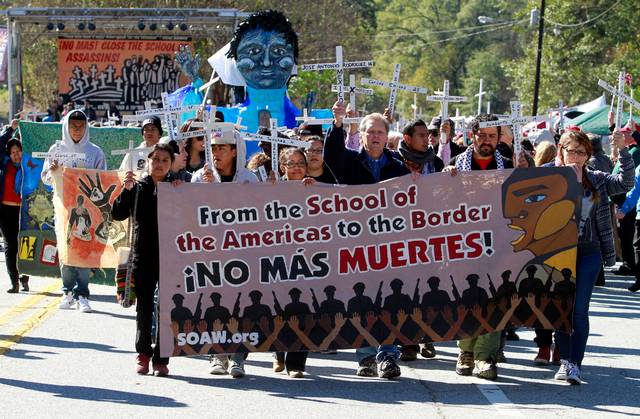
In 1996 I was asked by Jeff Smith to help him chaperone a group of Aquinas College students to a demonstration outside the gates of Fort Benning, Georgia. We, along with thousands of other activists, were advocating the closure of the School of the Americas which was the source of training for so many military soldiers involved in war crimes throughout Central America. The trip was notable for me for a number of reasons, primarily because I was in charge of driving a van load of college students to the demonstration. I unknowingly drove our van right onto this large military base with our demonstration posters proudly displayed in the windows. I did not know of my mistake until we were surrounded by military police and escorted to a large administrative building at the center of the base. We were told to step out of the van with our hands up and escorted to a prison type building where photos and finger prints where taken of us. All the while I was wondering how I was going to explain this to the administrators at Aquinas. After briefly interviewing all fifteen of us we were given very official letters instructing us not to return to Fort Benning for a period of 10 years. The experience reminded each of us that the practice of solidarity needs to involve some personal risk so that we can understand in a small way the oppression that so many go through on a daily basis in Central America by merely exercising their human rights.

GRPH – Do you think your experience working in El Salvador was connected to the larger Central American Solidarity Movement? If so, how?

Screen Shot 2016-01-06 at 10.48.56 AM

When we lived in El Salvador and even when we would make occasional visits back to the states during that time of 1986-1992 we were quite conscious about staying on the periphery of the CA Solidarity Movement. Our main focus at the time was not getting kicked out of El Salvador. We knew our phones were tapped, we saw helicopters circle low over our house on a weekly basis and we saw the leaflets that military planes dropped throughout the city that said “if you see foreigners engaged in any suspicious activities please immediately inform the authorities.” We did not want to be kicked out of the country and have all the programs that were directly benefitting many of the poor in El Salvador shut down because political opinions. We were doing solidarity work behind the scenes and out of the media. I remember explicitly an interview with a WOODTV reporter during the November, 1989 FMLN offensive who asked us our opinion on who the “good guys and bad guys” of the war were. Although we had an opinion we chose not offer it to the reporter to for fear that it might jeopardize our returning to El Salvador at the time. This was emotionally frustrating for us at the time but we understood that we were taking a long-view of solidarity with the poor of El Salvador. We were happy that others were being more aggressively lending their voices in denouncing this cruel war and US involvement in it. In the end, when we permanently left El Salvador people would come up to us and thank us for “staying” through the toughest years to experience the war side by side our partners even after many others had fled the country.

GRPH – How did this work impact your life?

Bill – The issue of land rights, land ownership and land tenure and how this was played out as a contributing factor to the war in El Salvador and basically throughout Central America has stuck with me for the past 30 years. I eventually went back to school for my doctorate in order to do more research on how lack of land tenure can stifle the socio-economic development of poor communities. Inequitable land tenure is a lens through which I now view most cases of civil unrest throughout the world. El Salvador taught me this and my time there has both forever blessed and tainted my worldview.

Screen Shot 2016-01-06 at 10.49.13 AM

GRPH – Why is it important for people to know this history about the Central American Solidarity Movement?

Bill – During the 1950’s, 60’s, 70’s and 80’s all of the wars in Central America were framed within the Cold War mentality. The United States was intent on keeping any hint of Soviet-style communism from having a foot-hole on the North American continent. Therefore, any type of insurrection, civil strife or rebellion against the governments in power was seen as a communist incursion. It did not matter that people were revolting against extreme oppression and injustice. We just did not want to see any hint of communism on our continent and saw it as something to be squelched at all costs. This was the line given to the American public and pretty much swallowed by most of them in a tone of mass hysteria and fear. That tone of hysteria and fear is very much alive and well today as Islamic terrorists are seen as the new threat to American way of life. In El Salvador the US was willing to sacrifice thousands of innocent lives in a proxy war in another land “so that” communism didn’t come to our door. Likewise, now, the US government is still willing to sacrifice innocent people in other lands “so that” terrorism doesn’t come to our door. Our proxy war of today is happening in Syria and Iraq at the expense of civilian lives because of our fear that ISIS fundamentalists will somehow take over our country. Another solidarity movement is required in light of today’s time and situation.

To understand the present it is essential to know the history. There is no doubt in my mind that the present issues of immigration, powerful drug cartels and environmental degradation can be traced to the violence of the 1980’s in Central America. It is not hard to connect dots if we understand what was occurring and why it was happening and who was sponsoring it.

Posted in Central American Solidarity Movement | Tagged , , , , | Leave a comment

Neighborhood wins battle against outside development forces in Grand Rapids 1997

This article first appeared in a September/October 1997 issue of the FUNdamentalist. Last month we posted another story about a development/gentrification project in the Belknap neighborhood. This article deals with a battle in the near south east part of Grand Rapids, at the northern edge of the SECA neighborhood. 

In the late 1970s then the City of Grand Rapids was finalizing plans to turn the westside of Division near Buckley into an industrial park, residents expressed their dissatisfaction.

Many people had lived there since the early 1950s and were now being told that they had to move because the City needed to create an industrial park so as to keep businesses in the tax paying limits of Grand Rapids.for-streetvibes

When the deal was finished people living on the east side of Division, near Buckley, expressed concerns that they might be next. City planners told them not to worry, their neighborhood would be left alone.

This story was told by Rev. Roger Van Harn, the Pastor at Grace Christian Reformed Church, which has been a stable component of what is called the Forgotten Corner Neighborhood. Less than 20 years after residents of the mostly Black, low-income neighborhood were given assurances about it remaining a residential area, they find themselves in a struggle to keep their homes.

In the Fall of 1996, a local group called the Concerned Citizens Council (CCC), came to the neighborhood group with a proposal and plans to build a youth center on the 400 block of LaGrave. This ambitious $4 million plan would cover most of the west side of the 400 block of LaGrave and necessitate parking space on several other lots on the 400 block of Sheldon. The neighborhood group was open to this idea, but needed more information before getting behind the project.

The Concerned Citizen’s Council set up meetings over the next several months with the interested parties and members of the neighborhood. In February of 1997, the Planning Department of the City of Grand Rapids brought forth plans to “re-develop” the neighborhood in such a way that would “complement the CCC plan,” said City planner Bill Hoyt.

Three concept plans were laid out, all of which would radically alter the makeup of the neighborhood. At a minimum 30 homes would be displaced, as well as 6 – 8 businesses. The neighborhood quickly organized to resist such a plan.

Screen Shot 2016-01-04 at 12.45.14 AM

The Concerned Citizens Council, still determined to build in that neighborhood, asked if they could meet with the residents to get support for a zoning variance that was necessary in order to build. Some 25 residents met in April with the 2 architects that designed the plan. No members of the CCC were present. The neighbors present voted unanimously to oppose the youth center proposal. Some neighbors candidly asked, “Why don’t you build this project in your own neighborhood?” In addition to those types of sentiments the residents realized that if the project went through, then the larger development plans the City has present would seem almost inevitable.

In early September of 1997, Rev. Van Harn had notified this writer that he had been asked to sit on a task force to develop a park plan for the Forgotten Corner Neighborhood. Upset, some of the neighbors went to see City Planner Bill Hoyt. He was asked, “what the hell they were doing and why no one from the neighborhood was asked to sit on the task force?” Hoyt said that Rev. Van Harn was invited, but residents said that Roger, although he worked in the neighborhood, did not live there.

Not getting anywhere, the neighbors held a special emergency meeting. Residents had known from recent experience that what had happened to the near west side that was demolished for a parking lot (where the current YMCA is now located) would happen to them if they were not organized. Residents also knew that unless they could get the support of the larger community that would not be able to save their neighborhood. Residents began circulating a petition that asked City residents to support the neighborhood’s desire for no displacement of homes, rental units or businesses.

In addition to the petition drive residents decided that they would write a letter to City Planner Bill Hoyt to demand that they be included on what was being called the Wealthy/Division Park Task Force. The letter was delivered shortly after the neighborhood meeting, but they never received a response from the City. Believing that the City needed to adhere to the Open Meeting Act, about a dozen neighbors showed up at the park task force meeting. A few members of the Heartside Neighborhood Association also attended, since the proposed park plan would impact both the areas north and south of Division & Wealthy.goggla-gentrification-class-war

The meeting was called to order by City Manager Kurt Kimball, who at one point said it might be necessary to hold secret meetings in the future. The task force was chaired by Lou Rabaut, a lawyer in the same firm as Mayor Logie and husband of the recently elected City Commissioner Lynn Rabaut. The neighbors were told that the purpose of the task force was to determine the need for park space in area 4 of the City, which covers between Wealthy & Burton and US 131 & Eastern. They cited several studies which already acknowledged the need for park space, but what came next made clear their intentions all along.

Val Lazdins, also with the City Planning Department then showed the neighbors a map targeting the Forgotten Corner Neighborhood with the proposed park plan. Some residents then asked if the task force was to determine the need for a park in area 4, why then would a detailed map of the Forgotten Corner neighborhood have already been drawn up? Lazdins evaded the question.

To their credit there were some members of the task force that were concerned over the fact that no one from the neighborhood was invited to be on the task force. This created a whole new discussion that finally led Kurt Kimball to allow submissions of representatives from both the Heartside and Forgotten Corners Neighborhoods.

Afterwards Lou Rabaut and Kimball both went on about their plans to hold meetings in the neighborhood for citizen input. Most the neighbors felt quite patronized considering that they referred to many members of the task force as stakeholders in this grand plan.

Some of these stakeholders were: Valerie Simmons , also with the Mayor’s law firm and a member of the Concerned Citizens Council; Dan West, a member of the GR School Board and CCC; Micki Benz with St. Marys Hospital and John Kennedy, CEO of Autocam and a major financial backer of Catholic Central High School. Since not all information has been made public on this matter it was hard to know for sure which stakeholders want., but some conclusions can be drawn.

Catholic Central has also been interested in the same area of land in the Forgotten Corner Neighborhood ever since they pulled out of the Heartside park plan. Despite the construction of a new sports complex out on Knapp NE, Catholic Central has expressed an interest in an athletic field/park space that could be utilized by their students and St. Andrews students during the day. This possibility is closer since the neighborhood just found out that John Kennedy bought the vacant land on the 400 block of LaGrave for a mere $140,000. The neighbors also found out that Catholic Central was interested because 1st Ward City Commissioner Jim Kozak, when confronted, admitted that he had met with Catholic Central planners during a September debate in Heartside.

The neighborhood residents believe that groups with a great deal of money have decided that the Forgotten Corner neighborhood is expendable.No one seems to listen to them when they say that the most stabilizing factors for the area would be new housing.

As a compromise with the Concerned Citizens Council, the neighbors suggested that the organization build on a site on the corner of LaGrave and Wealthy, a sizable vacant lot that is already zoned commercial, so as to not further disrupt potential long term housing possibilities for the neighborhood. In response to the City’s desire to put in a park at the 400 block of LaGrave, the neighbors suggested that the city develop the land just north of Sheldon Complex for a park space, an area that would actually be larger than the 400 block of LaGrave and would not require any houses to be demolished. However, both ideas seemed to fall on deaf ears at the meeting.

The task force will be meeting over the next 5 months and will eventually make recommendations to City Manager Kurt Kimball, who will in turn bring a plan before the City Commission. The Forgotten Corner neighborhood needs to continue to be pro-active in order to fight outside forces. Catholic Central has vastly increased its use of space for student parking over the past 13 years, moving south of Wealthy into the neighborhood. Catholic Central could have been encouraging students to use the bus or carpool, but then again expansion plans of economically privileged families is more important than that of low income neighbors made up of mostly Black and Latino residents.

Editor’s Note #1: The Concerned Citizens Council decided to use the land north of Sheldon Complex to build their youth center, which never came to fruition since they failed to raise adequate funds. The City of Grand Rapids did not push for a park space in the 400 block of LaGrave and Catholic Central decided to move all student athletics to the Knapp NE location. The Forgotten Corner neighbors WON!

Editor’s Note #2: In 1998, St, May’s Hospital bought land in the neighborhood for staff parking. This action prompted the neighbors to organize for long term planning to prevent any further incursion into the neighborhood. The neighbors host a day long planning meeting to makes some determinations about the long term future of the neighborhood. The Inner City Christian Federation, which at the time had its headquarters on the corner of Jefferson and Logan got involved in the discussion, which eventually led to their decision to operate without neighborhood consent and violate agreed upon principles to NOT displace any residents when new development projects began. ICCF deceived residents and acted independently. A longer description of these events can be found at this link

Posted in Neighborhood organizing | Tagged , , , , | Leave a comment

Defending Wealth from the Pulpit in 1996

Systems of power always have their own priests to sanction their actions. This has been especially true of monotheistic traditions throughout history and for Christianity in particular in West Michigan.Screen Shot 2015-12-28 at 3.26.32 AM

For anyone who reads this website it is clear that those from varying faith traditions have also been involved in campaigns and movements for social justice. However, in West Michigan, religion often acts as an apologist for power or at least as a buffer, but either way the result has been devastating for thousands of people who have been subjected to poverty and exploitation.

This brief article is reposted from a November 1996 issue of the Indy newspaper, The FUNdamentalist. The prayer below could easily have been invoked at the end of the 19th century or yesterday from any number of pulpits in the area. Nonetheless, it is a reminder of how institutions function in the service of power and oppression.

Mast.Stan

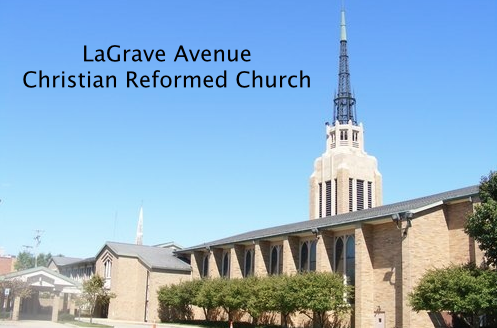
It has been said that the LaGrave Avenue Christian Reformed Church in Grand Rapids has one of the wealthiest congregations in the city. It has been home to members of the DeVos family and former Congressman Paul Henry. Therefore, it is not surprising when one reads the prayer invoked by Rev. Stanley Mast (pictured here), pastor at LaGrave Ave. CRC, a prayer that he read at a $1,000 a plate fundraiser in Detroit for the Republican Party.

It was a prayer in which Rev. Mast glorified wealth, at least that is how I understood the message. In the event that I am missing some ecclesiastical nuance that other people may be hip to, we reprint the prayer that first appeared in an August 5 article of The New Yorker magazine.

“Oh God, as we gather together tonight to honor important people in our country, we pause to acknowledge that you are master of the universe and Lord of the nations.

As we focus on finance and politics, we give you thanks for the gift of wealth, we thank you for the privilege of living in America, this great land of freedom, a land that not only allows but encourages the individual pursuit of wealth.

We thank you, Oh God, for the success so many of us have had in that pursuit. Bless our guests of honor. May their generosity and faith inspire us all. May the right people be elected. And God Bless America. Amen.”

Posted in Anti-Capitalism/Labor, Indy Media | Tagged , , , | Leave a comment

1980s Holiday Themed Political Cartoons Draw Attention to Militarism

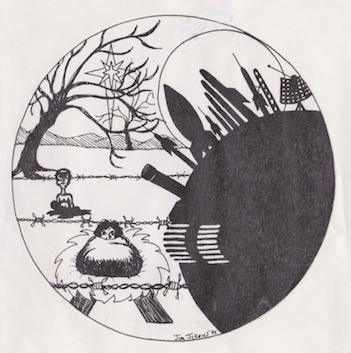
In previous postings we have looked at the work of Grand Rapids cartoonist Jim Jirous in the 1980s, with his work on Central America and anti-nuclear themed cartoons. Nativity cartoon

Jirous created political cartoons for a housing collective in Grand Rapids that produced its own newsletter called Koine Orama, which is Common Vision in Greek. Koine Orama was published by activists from a housing collective modeled after the Catholic Worker movement, so the content sometimes had overtly religious messages. In this first cartoon, Jirous uses the Christian Nativity scene, but instead of wise men and animals, you see military hardware and poverty reflected in the image.

Santa cartoonIn a second cartoon, you see Santa Claus and his reindeer flying in the sky. Satellites in both the US and the former Soviet Union are picking up some sort of signal and both think that it is a military strike. This paranoia was very palpable in the 1980s, particularly with nuclear weapons like the Cruise Missile, which had its own guidance system and flew along the terrain, making it hard to pick up via satellite detection. The engines for the Cruise Missile were manufactured in Walled Lake, Michigan at the time.toy cartoon

A third political cartoon from Jirous with a holiday theme was this cartoon that depicted the hyper-militarized toys that were heavily marketed towards kids. Jirous uses sarcasm to communicate his distain for the war toys that contributed to the normalization of violence and militarism in US culture.

These cartoons provide a rich visual history into some of the activism in Grand Rapids in the 1980s.

Posted in Indy Media | Tagged , , , | Leave a comment

1991 Pamphlet demonstrates how Red Lining continued in Grand Rapids and what was being done to address it from the grassroots

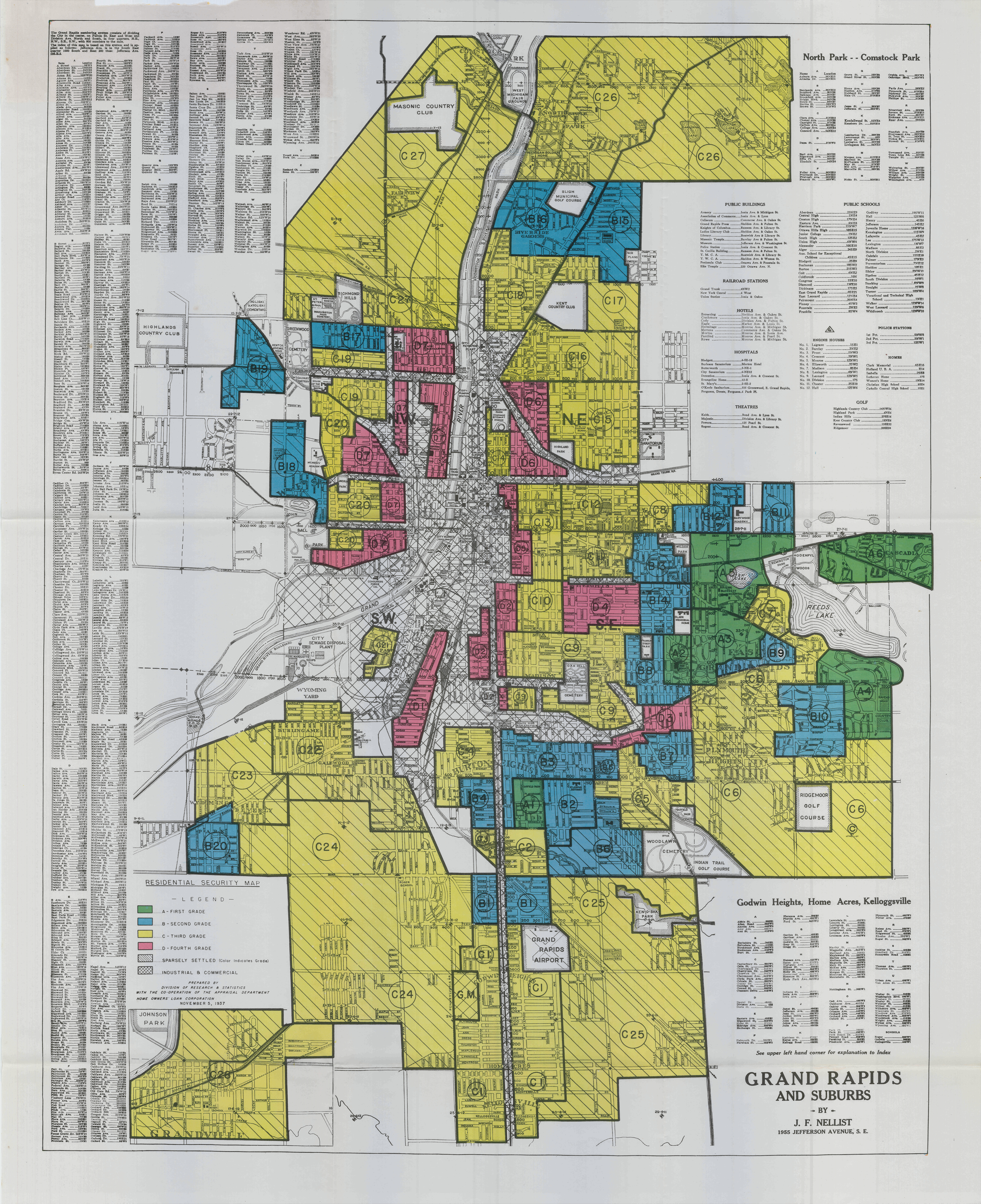
GrandRapidsHOLCmap-MED

Red Lining, a discriminatory practice by which banks, insurance companies, etc., refuse or limit loans, mortgages, insurance, etc., within specific geographic areas, especially inner-city neighborhoods, has long been a practice in Grand Rapids. One recent example if that of Mercantile Bank, which is being sued by several Black business owners who believe that the bank purposefully withheld loans and caused them to go out of business. 

Todd Robinson, in his important book, A City Within a City: The Black Freedom Struggle in Grand Rapids, Michigan, documents the practice of red lining that primarily impacted the Black community beginning in the 1920s.

Pictured here is a map from the Home Owner’s Loan Corporation (HOLC) from 1937, that demonstrates where red lining was taking place in Grand Rapids. To understand the color coding, go to this link http://www.historygrandrapids.org/tilemap/2596/the-holc-map.

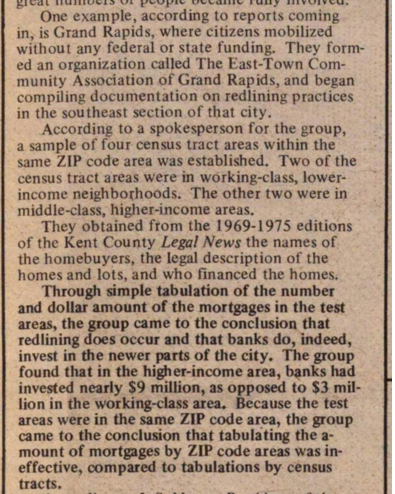
People have not sat by idly, while banks and other lending institutions have engaged in the racist practice of red lining. In an article from a July 15, 1976 article in the Ann Arbor Sun, Grand Rapids activists organized to investigate and challenge the practice of red lining. Here is the text from that article:

Screen Shot 2015-12-17 at 9.08.54 AM

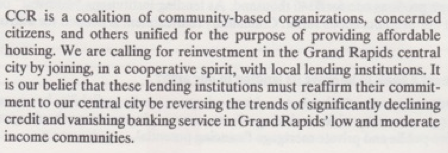
In 1991, a group calling themselves the Coalition for Community Reinvestment (CCR) produced a pamphlet that provides data on the practice of red lining in Grand Rapids, plus information and resources on how to fight red lining. 

The mission of the CCR in part reads:

Screen Shot 2015-12-17 at 9.15.16 AM

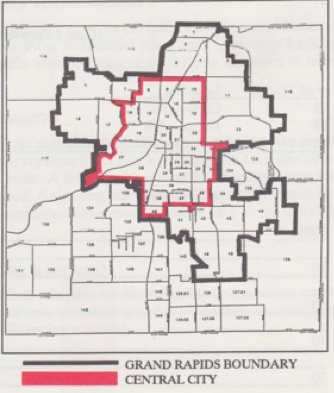
In the map shown here, one can see the area of Grand Rapids they have identified as being impacted by red lining practices. The data they provide in their pamphlet also shows that Screen Shot 2015-12-17 at 8.54.44 AMof all the mortgage loans providing by banks/lending institutions in 1991, only 8% of loans were provided for people wanting to purchase a home in the core area of Grand Rapids. 

Looking back at the history of red lining in Grand Rapids is important, not just for understanding what has happened in the past, but to see the connection to what is happening now. There is a current “housing boom” in Grand Rapids, but very little of it is affordable housing. Therefore, we always have to ask ourselves, Who Benefits from from the current housing projects? In many ways, this so called housing boom is just the latest version of red lining that continues to marginalized communities of color and working class people in the Greater Grand Rapids area.

Posted in Civil Rights/Freedom Movement, Neighborhood organizing | Tagged , , , | 3 Comments