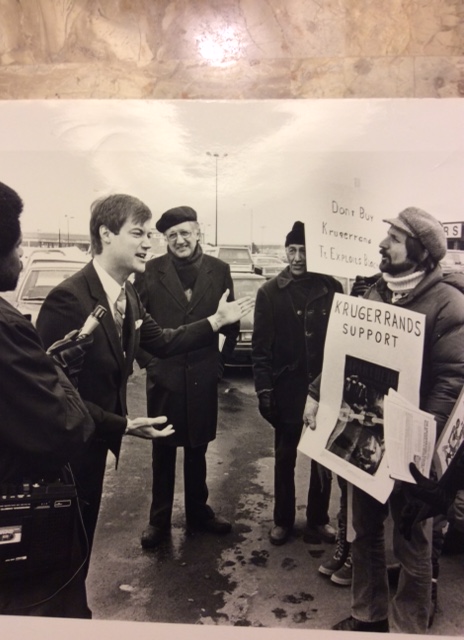
Archival photo of Anti-Apartheid Protest in Grand Rapids

Krugerands

Thanks to Barb Lester, we wanted to post this picture from the early 1980s. The South African Anti-Apartheid Working Group of the Institute for Global Education organized a protest outside a local company that was selling South African coins known as Krugerrands.

In an early posting, we interviewed Rev. Doug Van Doren, who was heavily involved in the Anti-Apartheid campaign and during that interview he mentioned the Krugerrand protest.

This protest was part of a a campaign that lasted years and saw many victories locally that contributed to the South African government ending the policy of Apartheid.

Posted in Anti-Apartheid Movement | Tagged , | Leave a comment

More White Lies: Grand Rapids and Settler Colonialism

Last week, we began a new section for the Grand Rapids People’s History Project, entitled Lies Across Grand Rapids. The purpose behind this part of the larger project is to provide a critical look at historical landmarks and how they can perpetuate hegemonic narratives about this community.

Hegemonic narratives serve multiple purposes. First, such narratives are an attempt to tell history from the point of view of those with power and privilege. Most of us are familiar with such narratives, since US history is generally taught as the chronological high points of people in power, such as presidents, capitalists and philanthropists.Indigenous-History

Hegemonic narratives, by their very definition, also omit or marginalize the voices of those who have resisted the exploitation and oppression of those in power – Indigenous people, slaves, abolitionists, workers, women, immigrants, queer identifying, etc.

However, there is a third consequence of hegemonic narratives. If we are told history through a narrow lens and don’t hear the voices of those most marginalized, then our ability to creatively imagine new narratives about present day systems of power will be significantly limited. For radical historians like Howard Zinn, the point of doing a People’s History, is to not only come to terms with history from below, but to help us frame how we view what is happening in the here and now.

For those who have visited the Grand Rapids People’s History Project site, it is clear that the work we have done does not follow some chronological script. Projects areas are undertaken based upon information and research we have come across, input from supporters and inspiration from other people engaged in People’s History work.

One important example of this work is Roxanne Dunbar-Ortiz’s book, An Indigenous People’s History of the United States. Dunbar-Ortiz does not write an exhaustive account of the ways in which native lands and native people were plundered, rather she gives us the framework for a new narrative how the history of the US. The primary analytical point that the author makes is that the US was founded on an ideology and practice of settler colonialism.

“Settler colonialism has best been defined as more of an imposed structure than an historical event. This structure is characterized by relationships of domination and subjugation that become woven throughout the fabric of society, and even becomes disguised as paternalistic benevolence. The objective of settler colonialism is always the acquisition of indigenous territories and resources, which means the native must be eliminated. This can be accomplished in overt ways including biological warfare and military domination but also in more subtle ways; for example, through national policies of assimilation.”

For Dunbar-Ortiz, we cannot talk about the US, past or present, unless we come to terms with the ongoing legacy of settler colonialism. Such a reframing of the narrative is indeed radical, but it is ultimately necessary of we are serious about how we read and make history now.

Settler Colonialism in Grand Rapids

Using the important analysis of Dunbar-Ortiz, one can see how Grand Rapids is the result of settler colonialism. Indigenous communities existed here for centuries before European colonizers came to West Michigan. This fact is usually noted in Grand Rapids history books, but only enough to merit a few pages.

In Z.Z. Lydens’ book, A Look at Early Grand Rapids, he attempts to portray what happened to the native population as tame compared to other parts of the country. “The history of Grand Rapids does not have a backdrop of conflict with the Indians. There were no tales of raids and scalpings and scourging of the settlement with flame.”Native Treaties in MI

While it is true that the level of violence against Native people, in what is now called West Michigan, was not as overt as was done to Lakota or Sioux nations, the violence was real and systemic. Lydens’ commentary is instructive, since it not only limits any understanding of violence, it ignores how settler colonialism functions.

The reality is that thousands of indigenous people lived along the Grand River prior to the European invasion. Most in these native communities experienced displacement by force, religious colonization, the flooding of their communities with alcohol and displacement through legal maneuvers known as treaties. There were numerous treaties that resulted in the takeover of Native land by settler colonialists throughout what is now called Michigan (see map above), but settler colonialists have a long history of violation of those treaties

In terms of what this meant for Native people who lived along the Grand River in what is now Grand Rapids, many of them fled to areas in the Great Lakes that in the first half of the 19th century gave them a better chance of surviving settler colonialism.

There is little of this history that is documented by settler colonial historians, but there are glimpses of what some of the consequences were to Native communities and Native culture. For instance, according to local historian Gordon Olsen, we know that many of the burial mounds were destroyed by settlers who excavated the burial mounds to use as filler for other areas of the developing city that had been removed to construct roads. In fact, according to Olsen (A Grand Rapids Sampler) Charles Belknap wrote about this process since as a young boy he brought water to the men involved in the excavation project. Much of the contents of the burial mounds were destroyed, while others were sold to museums or kept as souvenirs by settler colonialists involved in the early development of Grand Rapids. (see map for believed locations of Native burial mounds)Native Burial Mounds

Beyond these few references to Native people in the area, little is written about them again in most history books about Grand Rapids or West Michigan. The near omission of Native life in this area is not surprising, since the limited references serve the hegemonic narrative about the “origins” of Grand Rapids. If we acknowledge that a whole community of people were here and then forcibly removed through a variety of means then we are more likely to have to come to terms with the real foundations of what constitute Grand Rapids. Such a reckoning might even influence how we organize ourselves today, with the possible delegitimization of the current systems of power that need the hegemonic narrative to justify the ongoing development and progress in Grand Rapids.

To counter the hegemonic narrative, it is our intent to conduct interviews with local Native historians to allow them to share their rich tradition of not only how they remember the European invasion, but what their oral tradition tells them about what life was like before the waves of settler colonialists occupied their land.

Posted in Indigenous Resistance, Lies Across Grand Rapids | Tagged , , , | 14 Comments

Lies Across Grand Rapids: Confronting Visible Local History

This is the beginning of a new section to the Grand Rapids People’s History Project, where we will examine public and visible examples of how the narrative of Grand Rapids history perpetuates the values and perspectives of the dominant culture and local ruling class.

51CvaOtILdLWe will follow the model used by radical historian James Loewen, in his insightful book, Lies Across America: What Our Historic Sites Get Wrong. Loewen takes us on an enlightening tour of the US and examines historical markers in big cities and small towns to see what lens history is communicated. We will do the same thing, by looking at markers, statues and other public and visible manifestations of how the ruling class narrative is perpetuated.

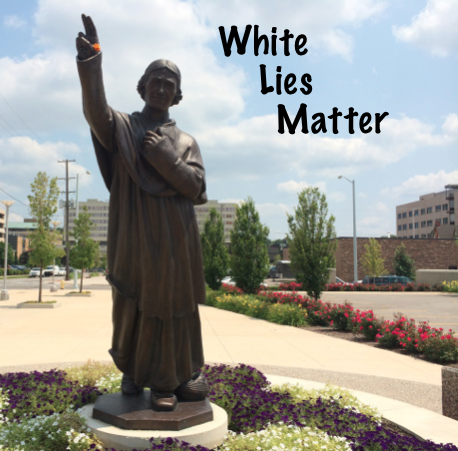
In the first example, we look at one of the statues that have been erected over the last decade of people referred to as “Community Legends.” This project has been spearheaded by local robber baron Peter Seechia. This project plans to erect 25 statues in total and currently has completed six – Lucius Lyons, Chief Noonday, Bishop Baraga, Jay Van Andel, Helen Claytor and Lyman Parks.

White Lies Matter

We begin with an investigation of the statue in front of the Grand Rapids Cathedral, dedicated to Bishop Baraga. The Community Legends project has this short narrative on Baraga: 

Bishop Baraga brought Catholicism to Grand Rapids when Michigan’s second largest city was barely a village. Baraga is known as the “Snowshoe Priest” for his trappings across Michigan’s wilderness. He is mostly associated with missionary work in the Upper Peninsula, but his second mission in the New World was established in 1833 in a cornfield west of the Grand River near present day Saint Mary’s Catholic Church.Screen Shot 2015-08-12 at 12.26.52 PM

Baraga, according to some sources, founded a mission in what would become Grand Rapids, but his real legacy is the work he did in the northern part of Michigan and the UP.

Much of the news coverage of the statue ceremony states that Baraga did a great deal of missionary work amongst the Ojibway. The statue of Baraga has several bronze tablets around its perimeter, with one of them stating that Baraga created an Ojibway-English dictionary, “that is still in use today.”

While Baraga comes across in the media and church accounts as a saintly man, there is something that is glaringly missing from what function the bishop played in the colonization of the Great Lakes region.

What has come to be the acceptable norm in the US is that those who do missionary work are highly respectable individuals. However, the fundamental nature of missionary work is to not only convert people to your beliefs, but to automatically denounce the existing spiritual traditions of those you mean to convert.

More importantly, Baraga’s interaction with the Ojibway people also paved the way for genocidal policies that Europeans have implemented over the past 150 years in this area.

Those policies include the outright killing of Native people, stealing Native lands, forced relocation and taking Native children from their communities to put them in boarding schools, something the Catholic Church did in Michigan. The history of these boarding schools included denying Native children to speak their language, dress in traditional clothing, subjected to Christian teaching and also physical and sexual abuse, as is well documented in Kill the Indian, Save the Man: The Genocidal Impact of American Indian Residential Schools.

This is the legacy of Bishop Baraga, however well intentioned he was, since his committed to converting the Ojibway paved the way for the harsh policies that followed.41Ii7UTdnRL._SY344_BO1,204,203,200_

Native American scholar George Tinker, author of the book Missionary Conquest: The Gospels and Native American Genocide, refers to Christian missionaries to Native Nations as “partners in genocide.

Tinker goes on to describe the significance of White missionaries this way:

Told from an Indian perspective, the story is far less entertaining and much less endearing. Pain and devastation become dominant elements as Indian anger erupts to the surface. Indeed, today the white missionary, both in the historical memory of Indian people and in the contemporary experience, has become a frequent target of scorn in most segments of the Indian world. Many implicitly recognize some connection between Indian suffering and the missionary presence, even as they struggle to make sense not only of past wrongs, but also of the pain of contemporary Indian experience. The pain experienced by Indians today is readily apparent in too many statistics that put Indians on the top or bottom of lists. For instance, Indian people suffer the lowest per capita income of any ethnic group in the US, the highest teenage suicide rate, a 60% unemployment rate, and a scandalously low longevity that remains below sixty years for both men and women.

Not surprising, such commentary did not accompany the unveiling of the Baraga statue in the summer of 2012. The lack of this kind of critical voice or perspective reflects how deeply ingrained the dominant culture, a culture of conquest and settler colonialism, is in this country and this community.

The celebration of the unveiling of the statue of Bishop Baraga not only legitimizes what was been done to Native communities, it normalizes and sanitizes the history of genocide in the Americas.

Posted in Lies Across Grand Rapids | 8 Comments

It’s not important that we win every battle. What’s important is that we fight. Interview with Cole Dorsey on the History of Animal Rights Organizing in West Michigan

We recently interviewed Cole Dorsey, who was an active member of West Michigan for Animals in the 1990s in Grand Rapids. 

How old were you when you joined West MI for Animals? What motivated you or inspired you to get involved with Animal Rights/Animal Liberation?

Cole – I joined WMFA when I was 13. My aunt had a big impact on me and she had been a member of PETA. She had old PETA magazines and it was there that I had my first exposure to not only the animal rights movement but also to contemporary examples of people participating in civil disobedience for what they believed in.Screen Shot 2015-08-05 at 1.33.57 AM
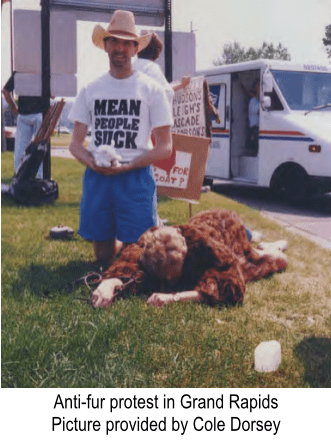
I contacted the national office of PETA  and asked for contact information for local members to get involved with. They sent me a large list of animal rights groups across the Midwest. Most notable to me then and the proceeding years were WMFA and KALL (Kalamazoo Animal Liberation League). It was with these groups that I devoted much of my time for the next couple years.

Since we were just a high school student at the time, did you experience any discrimination and different treatment because of your age?

Cole – Actually I was in middle school when I joined. I didn’t experience anything different at first. At first I was warmly welcomed by everyone.

One of the first things I remember I did with WMFA was go with an older member to a conference of companies selling science related products. The purpose was to find examples of products and projects that could be used in place of animal dissection in public schools. A lot of work was put into this by Harold Mercer especially. He wrote articles and made contact with many of the local schools administration. ‘We could then go to the administration of local school districts and present our alternatives and reasons why schools should give up animal dissection from its curriculum’. That was the strategy as it was explained to me. Although I respected that that work was being done I wasn’t interested in that strategy. I wanted direct action. I wanted to shut down fur stores, rodeos, circuses, animal factories, and vivisection laboratories by any means. The majority of the rest of the members felt the same way which became more evident, and divisive, as I started organizing protests at the fur stores as a WMFA member.

What kinds of campaigns and actions were you involved in? and can you give some examples of specific actions?

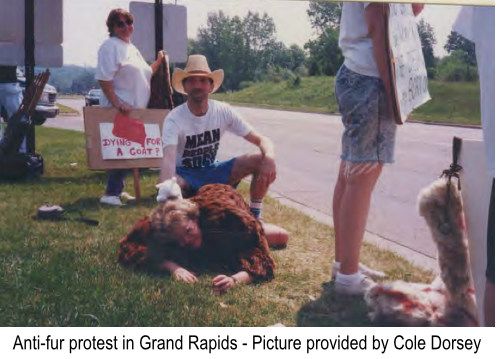
Cole – I liked WMFA and KALL very much because they used a variety of tactics not just stand and picket. I was always down for a protest but I wanted to also be active. I wanted to stand in the driveway of the fur store or vivisection laboratory and not allow business to continue as usual. We decide what happens and “we’re shutting this down”. When the police come we then decide whether to cede or not. The point being that we are not sitting idly by with our signs.Screen Shot 2015-08-05 at 1.39.06 AM

We are putting our bodies on the line and saying “no more.” Even if it only lasted until the cops came or some people got arrested it felt more fulfilling than just standing for hours with a sign while people screamed obscenities at you from their car as they drove by which it felt like a lot of times.

The only protest activity that the Humane Society was doing at that time was against the Klein Rodeo in Sparta. Most of their protesters were old and would sit in lawn chairs and hold their signs. Some had umbrellas for the 2 hour protest. We would discuss how we wanted WMFA to be different. We didn’t want to just attend an obligatory protest because we’re an animal rights group. We wanted to do whatever it took to end the rodeos, fur trade, factory farms…

We tabled literature at public events. Some of us went to a tabling that KALL had in a shopping mall. It gave us the idea to begin tabling more broadly. I remembered we were allowed to table inside the Target store on Alpine a couple times. We had some graphic literature of animal victims of product testing and the pharmaceutical companies whose products were animal tested. After a couple times we weren’t invited back. We continued to table at public events and teamed up with some of the local nutrition and pet food stores for “dog wash” fundraisers.Screen Shot 2015-08-05 at 1.34.37 AM

More importantly, I think, was that these groups obtained, released, and pressured businesses that sponsored animal abuse ie rodeos, circuses, etc. There were definitely results from phone calls,letters, and picketing of businesses that sponsored animal abusive entertainment. We spent a whole summer of picketing, every weekend, a carriage company in downtown Grand Rapids. The owners of the horse drawn carriage company were also attempting to start a new rodeo in a small town north of GR called “The Circle R Rodeo” if I remember correctly.  Several of us went to a few of the first rodeos in an attempt to document animal abuse and potential violations. Even though we attempted to “blend in” we eventually were identified and denied entry.

We regularly protested each of the 4 fur stores in town. Also the circus whenever it was in town.

Many of us went a lot to support groups and actions in other cities. Mostly, KALL in Kalamazoo and a group in Chicago. I remember going to one of the anti-fur actions in Chicago where several people were arrested for chaining themselves to the door and denying access to everyone. That had a big impact on me.

What was the public response to the animal rights/animal liberation activity you were involved in then?

Cole – It really depended on the action.  Typically it would usually be 50/50 in public support at our protests. People would yell at us to “get a job” as they sped by while others would give us honks in support.

The rodeo and circus protests were definitely more aggressive because we were coming face-to-face with those attending these events.Screen Shot 2015-08-05 at 1.38.09 AM
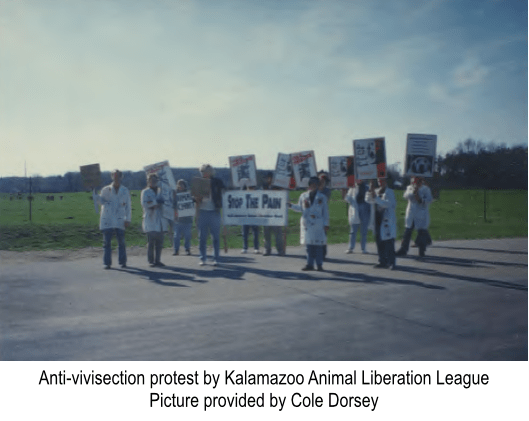
What kind of tactics were used by WMFA?

Cole – Aside from protesting members were writing letters, and making phone calls to pressure sponsors to end support of rodeos and circuses and for department stores to stop selling fur.

There was also direct action going on at that time that was not sanctioned by WMFA or undertaken by any “organized” group.  I know that roadkill was delivered to the steps of fur stores and that fur coats were damaged on the racks of their stores. I know that “blood” was splashed on their windows and windows were broken. I also know that more than one fur coat got splashed with “blood” while being worn in public in Grand Rapids. I believe all these actions collectively, coupled with society’s changing attitude towards fur, had a major impact on the fur industry in GR. Today I think Leigh’s in East Grand Rapids is the only store selling furs these days.

There were several sponsors we got to quit supporting the Circle R Rodeo. I believe our continued efforts, on many fronts, is what ended the Circle R Rodeo after only putting on a handful of rodeos.

There were attempts made to covertly document animal abuse at circuses and rodeos.

We publicly shamed those wearing fur as they left GR Symphony performances.

How did you involvement in West Michigan for Animals impact your involvement with other radical, social justice issues?

Cole – I was involved actively with WMFA until I began going to meetings put on by The Socialist, Frank Girard and then shortly thereafter organized into the IWW. It was then that I learned about and began to study capitalism and its affects on the world. I then understood that there will be no animal liberation until the working class overthrows the ruling class and capitalism. I fully support all those in the animal liberation movement today even though I think we should organize on our jobs, and in our industries, into One Big Union to “live in harmony with the Earth” as the IWW Preamble states. I believe animal liberation can only come after we overthrow capitalism and the ruling class.

After being organized into the IWW I also become involved in organizing actions against police brutality/murder. This work was done as a member of Revolutionary Anarchist Youth (Grand Rapids).

I learned at an early age not to cross a picket line. That includes animal rights pickets.

Were there any lasting relationships developed as a result of your involvement with WMFA?

Cole – Unfortunately, I got involved in drugs as a teenager and ended up being locked up for a few years. I lost contact then but have since regained contact with some old members of WMFA through social media.

In looking at some of the archival material from WMFA, it is clear that there was some tension between a more reformist approach and a more liberationist approach. How did you navigate that tension during your time with WMFA?Screen Shot 2015-08-05 at 1.37.33 AM
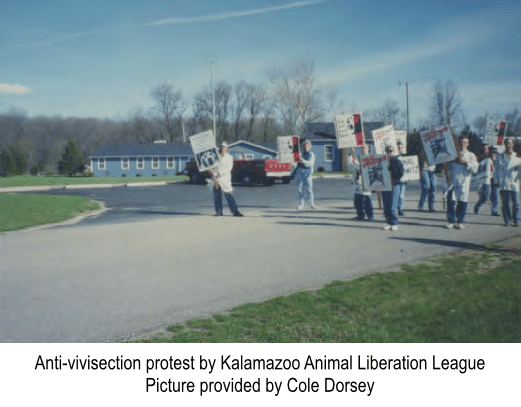
Cole – Navigate it? Shit, it caused a split. I was more interested in direct action/civil disobedience and animal liberation. ‘No compromise’ was my attitude. Soon after I joined it was clear that this attitude was shared by most of the other members of the group. Except the “leadership”.

It came to a head at the meeting following our most recent cascade fur salon protest. It was my third protest at that location with WMFA. It was the first that we were walking back and forth across the driveway to block potential costumers. A contingent of us went into the store to confront a costumer and the owner. It was the first time the police had been called to a WMFA action. It became a point of contention.

At the meeting my actions and my age were brought up. The argument was, ‘if he gets arrested or injured we will be held liable and open to lawsuit because he’s a minor’. They wanted to make being at least 18 years old a requirement for membership. It was rejected and that fraction of the group  left and quit participating in any way with WMFA.

Do you think it is important for the current generation of Animal Rights/Animal Liberation activists to be familiar with the work done by previous generations? If yes, why?

Cole – Absolutely. We should always know and learn what has worked and what hasn’t  in movements for social/economic justice. Knowing that putting pressure on sponsors was effective for us 20 years ago can be useful for those trying to put an end to animal abusive entertainment today.

There is an old IWW saying, “It’s the fights themselves that prepare the worker for even greater tasks and victories.” It’s not important that we win every battle. What’s important is that we fight.
Posted in Animal Rights/Animal Liberation | Tagged , , , , | 5 Comments

West Michigan Nuclear Resisters took part in campaigns throughout the state in the 1980s through the early 1990s – Part II

(In Part I, we looked at campaigns against nuclear weapons production and deployment in Michigan.) no-nukes

Grand Rapids also had nuclear connections to the Military Industrial Complex. The Defense Logistics Agency had (and still has) a branch location in the office building at 678 Front St. NW, in Grand Rapids, right along the river.

The Defense Logistics Agency’s main function was to channel military contracts to companies in West Michigan. In the mid-1980s, local activists were able to track down the location of the office, based on Department of Defense data.

Between 1987 and 1989, numerous actions were taken at the Front St. office location as an attempt to raise awareness about nuclear weapons contracts in West Michigan and to directly disrupt business as usual at this local cog in the Military Industrial Complex.

Most of the action involved the distribution of information about the Defense Logistics Agency to the rest of the tenants in the building and to people walking or driving by, since the office is located at the westside of the Sixth Street Bridge. On several occasions banners were hung off the Sixth Street Bridge calling attention to the technical work being performed inside in preparation for a nuclear holocaust.

However, most of the actions were in the form of resistance, where activists went inside the building to disrupt the daily workings at the Defense Logistics Agency. On one occasion, activists went inside and began putting flyers on all the desks or handing them to clerical staff about the dangers of nuclear weapons production and the horror of nuclear weapons being used. According to one of those involved in the direct action efforts (who choses to remain anonymous), the clerical staff were rather sympathetic to the message, but those in administrative positions would become immediately confrontational.

On several occasions activists would not leave the office when asked to by office personnel. However, activists refused to leave the building and would stay and continue to make statements about the evils of nuclear weapons. Office staff at the Defense Logistics Agency would then call Federal Building security guards to come over and physically remove those involved in the action. Sometime activists would not cooperate and had to be carried or drug out of the building.Screen Shot 2015-07-28 at 11.25.23 AM

One other major action was when activists planned to enter the building and pour their own blood on military documents they had seen when disrupting activities in the office. However, the day that activists had planned to enter the building to pour blood on military contracts, the building was secured and only those who worked in the building could enter.

Those involved in the action decided to pour the blood on the steps of the building (pictured above). The demonstration lasted for several hours with activists handing out information to people entering the building. During this process, people were unaware of the blood on the steps of the building and ended up bringing blood into the building on the bottom of their shoes. One activist, Richa, said that this was symbolic of the bloodshed brought about by US Militarism.Screen Shot 2015-07-28 at 11.25.51 AM

In addition to handing out literature, the Reverend George Heartwell (pictured here at the top of the steps) performed a sort of exorcism of the building, a tactic that had been used by other activists around the country to dramatize the horror of nuclear weaponry and militarism.

Another example of nuclear resistance that took place in Grand Rapids in 1990-91, know as the Homes Not Bombs Campaign. This campaign was designed to educate the public about the cost of nuclear weapons production and how many homes could be built with the same amount of money. The other part of the campaign was to confront lawmakers who continued to vote in favor of weapons production.

The Homes Not Bombs Campaign in Grand Rapids lasted for over a year with their education efforts, plus there was a direct action component that lasted 2 weeks in the summer of 1990. Grand Rapids activists built shanties, like the one pictured here, and slept in front of the federal building on Michigan street. During the two weeks of action, activists handed out information on the campaign, had conversation with people who walked past the federal building, held workshops and some activists committed civil disobedience by having a sit in in the offices of former Congressman Paul Henry and former US Senator Carl Levin.Homes Not Bombs

During the 2 week action, activist also built additional shanties during the night, when there was only one security guard inside. Sometimes those involved with this action built the shanty around some of the large exterior columns of the federal building on the Michigan Ave. side of the building. Using power tools, they bolted a wood frame around the columns and then added cardboard, which had messages written on the outside for the public to see.

The next day, federal building security personnel would recruit maintenance people from the building to tear down the shanties, with activists only turning around and building more the next night.

This campaign and the shanty town action also involved many people who were radicalized during the so-called US War in the Gulf, which began in January of 1991 and only lasted 45 days. For many new activists, this was the first time they witnessed the human and economic cost of US militarism in what some media scholars refer to as the first 24-hour TV war. 

Posted in Anti-Nuclear Movement | Tagged , , , , , | 2 Comments

West Michigan Nuclear Resisters took part in campaigns throughout the state in the 1980s and early 1990s – Part I

In two weeks, much of the world will be reflecting on the 70th anniversary of the US bombing of Hiroshima and Nagasaki, Japan. The world witnessed the brutal violence unleashed from those early versions of nuclear weapons, but it did not stop the US and other nations from continuing to manufacture and test these weapons.FreePlowshares8

However, just as nation states engaged in nuclear proliferation, grassroots efforts emerged to resist the production, testing, deployment and use of nuclear weaponry around the world. In the US, this resistance took on many forms, such as education, civil disobedience and direct action against the production, testing and deployment of these weapons.

Grassroots resistance groups engaged in physical occupation of facilities where research and weapons manufacturing took place. Resisters got arrested at Congressional offices when elected officials voted for more funding for weapons of mass destruction. Other people entered US military bases where nuclear weapons were being deployed, particularly Air Force bases, which transported nuclear missiles on B-52 Bombers. And then there were those who began planning direct action, sometimes involving the taking jack-hammers to missile silos peppered through rural US.The later form of direct action activist became known as the Plowshares resisters, named after the Hebrew Prophet Isaiah’s vision. The first of such actions was captured in a docu-drama known as In the King of Prussia, which dealt with activists arrested for entering A GE plant in the town of King of Prussia, Pennsylvania, which made nuclear weapons components.

West Michigan saw its share of activists participate in such actions, both across the state and here in Grand Rapids.

Beginning in the early 1980s, with the Reagan administration aggressively promoting the use of nuclear weapons, activists began doing research on Department of Defense contracts with private companies to make parts for nuclear weapons. This research was critical at the time, since these contracts were with companies who only made one part of the nuclear weapons, thus making it harder to determine how many were involved in nuclear weapons production.

A group of activists came together in Lansing, known as Covenant for Peace, which began a years long campaign against a nuclear weapons manufacturer in Walled Lake, Michigan, Williams International. The campaign began with research and reconnaissance work before engaging in direct action. The first direct action took place in 1983, with people entering the property of Williams International and to prevent workers from entering the building in order to build more nuclear weapons parts. One of those arrested with Matthew Goodheart, who was working for the Institute for Global Education in Grand Rapids in the early 1980s. Screen Shot 2015-07-22 at 4.15.41 PM

Goodheart and others were charged with trespassing in the District Court. However, out of fear that such actions would continue to take place, Williams International worked with the legal system and got a judge in the Circuit Court to adopt an injunction (front page seen here). This injunction would allow the court to demand that anyone who was arrested resisting the weapons manufacturing at Williams International, be required to sign a statement saying they would never take such action again. If those arrested did not sign the court document, they would be given an indefinite sentence, meaning they would stay in jail until they signed the statement or until the judge decided to release them.

Another major campaign that took place against nuclear weapons in Michigan, was a campaign against the Wurtsmith Air Force Base, located in Oscoda, MI. This bases was one of many US nuclear deployment installations, where B-52 Bombers carried nuclear weapons 24 hours around the clock in the air. This was done to make sure that some nuclear weapons would not be destroyed in the event of a nuclear attack.Screen Shot 2015-07-22 at 12.24.39 PM

A campaign was begun against Wurtsmith in 1984, with actions like the one pictured here, where activists entered the base on specifics days of the year to protest the presence of nuclear weapons on the base. The action depicted in the picture here took place on the Hiroshima bombing anniversary in 1985. The person in the photo is Theresa Wylie, who was part of the Koinonia House in Grand Rapids. Theresa, along with several other people from West Michigan were arrest in August of 1985, but released later that same day by US military officials. After years of resistance and US military restructuring, Wurthsmith Air Force Base close in 1993.

In Part II, we will look at some examples of nuclear resistance that took place in Grand Rapids that involved direct action.

Posted in Anti-Nuclear Movement | Tagged , , , , , | 3 Comments

Anti-Fur campaigns were part of West Michigan for Animals Direct Action efforts in the 1990s

In the past week we have posted stories about the anti-vivisection work of West Michigan for Animals (WMFA) and their campaign to fight animal abuse at area rodeos in the 1980s and 90s.  

WMFA was also deeply committed to resisting the cruelty cause by the fur industry in West Michigan.Screen Shot 2015-07-14 at 12.34.39 PM

Anti-fur organizing also began in the late 1980s in West Michigan and we have some details from archival materials on that work. According to a newsletter from August of 1995, Cole Dorsey was head of the Anti-Fur Committee. A high school student at the time, Cole was deeply committed to resisting animal cruelty, especially what was perpetrated by the fur industry.

In an October/November 1996 newsletter it states, 

Cole Dorsey, our Anti-Fur Committee chairman, is attempting to organize events at all four Grand Rapids fur stores (a never before accomplished feat). The different events will be scheduled at different times, but volunteers are needed. Who has Friday off? A tentative schedule includes: A Walk Through Woodland Mall (Hudson’s) with a banner stating, “I’d rather go naked than wear fur,” A Press Conference, A picket (Cascade Fur Salon), A candlelight vigil, and a Walk from Leigh’s Fur Salon to Jacobson’s. Cole will contact members prior to these events with a finalized schedule. COMPASSION IS THE FASHION!”Screen Shot 2015-07-14 at 12.30.00 PM

The Grand Rapids People’s History Project spoke with Cole recently and asked him to share his thoughts on the anti-fur organizing from 20 years ago.

A lot of our actions in WMFA, when I was a member, targeted fur stores and fur wearers. At that time there were 4 stores selling furs in Grand Rapids. They were: Leigh’s Fur Salon, Cascade fur salon, Jacobson’s, and Hudson’s.

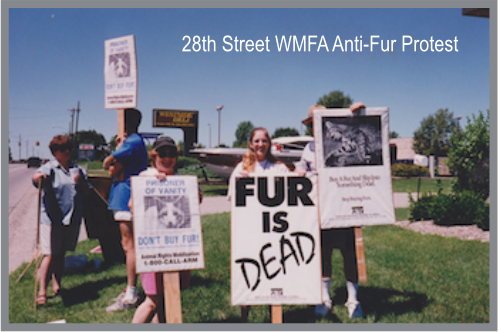
We regularly picketed each location. The pickets became increasingly more militant. We started blocking/interfering with driveways and entrances. It got to the point that at the cascade fur salon the owner would call the police as soon as he saw we showed up because he expected a confrontation. Jacobson’s and Hudson’s were department stores inside larger malls. In east Grand Rapids and Kentwood respectively.

At that time PETA was producing posters with a picture of a skinned animal with the words “Fur is Dead” on them.  A member had the idea to secure the posters on the back of our coats and go into the stores as costumers shopping. We were able to make a couple of visits like that to each store before they began recognizing us and kicking us out upon entrance for “creating a disturbance”.

We also targeted fur wearers. We would go to the GR Symphony performances and wait for the attendees to exit. We had our signs, traps, and furs that were donated to the group that we coated in “blood”. We would engage with those wearing furs as they left the building. These engagements turned into physical confrontations more than once.”

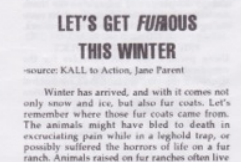
Screen Shot 2015-07-14 at 11.33.32 AMWork against the fur industry was also featured in the Winter 1996 newsletter from WMFA. The lead article, entitled Let’s Get Furious This Winter, focuses on the actual harm done by the fur industry. The article talks about animals that are both trapped and those raised on “fur ranches.” The article continues by stating, “These pain and pleasure feeling animals are then killed by gassing, suffocation, or anal electrocution.”

However, the WMFA newsletter piece then goes on to encourage people to make their anti-fur sentiments known, by wearing buttons, putting out literature and wearing a fake fur coat with red paint splattered on it. In addition, the newsletter states many fur stores had closed in recent years because of the education and organized resistance. This result, was in part, due to the efforts of West Michigan for Animals.

Posted in Animal Rights/Animal Liberation | Tagged , , , , | Leave a comment

West Michigan for Animals and Anti-Vivisection organizing in the early 90s

A few days ago we posted a story on the birth of the group, West Michigan for Animals (WMFA). Beginning in 1992, WMFA began organizing around Animal Rights/Animal Liberation, with some of the earliest campaigns around challenging various rodeos that look place in West Michigan.History6

Sometime in the early 1990s, WMFA also worked on educating schools about the harm done to animals used for classroom dissection. The involvement of WMFA around vivisection was built on the work being done around the US for nearly a century, especially by groups like the National Anti-Vivisection Society (NAVS).

West Michigan for Animals began organizing around the issue by talking with area school district leaders about the use of animals for dissection. Most of the area school districts were contacted, including GRPS, schools in Kentwood, Kelloggsville and even area parochial schools, as is noted in this article from the Advance newspaper. 

Screen Shot 2015-07-09 at 12.01.59 PMThe story from the Advance is instructive, particularly when reading the arguments made by schools, especially science and biology teachers, who claimed that dissection was an essential learning practice for students.

Around the same time as the Advance article came out, WMFA member Dick Mercer, had a Guest Column published in the Grand Rapids Parent Magazine. In his column, Mercer argues against the cruelty to animals, the economic cost to schools, the stress on students and the fact that even in 1992 (when the column was written), there were technological advances made that made classroom dissection unnecessary.

“The use of animals in dissection started in the 1920s, and at the time was thought to be a viable way to teach. Today, it is not only stupid but also archaic. When space age tools such as videos, computers, models and overlays are available at a one-time cost – reusable and less stressful – why must the schools persistently resist?

Screen Shot 2015-07-09 at 12.52.35 PM

These archival materials demonstrate that area animal rights/animal liberation activists were not only protesting the abuse of animals for entertainment, but the abuse of animals for so-called education purposes.

Posted in Animal Rights/Animal Liberation | Tagged , , | 2 Comments

The Birth of West Michigan for Animals and their Anti-Rodeo Campaign

Last winter, we posted an introductory article about one of the earliest known Animal Rights/Animal Liberation groups in the Grand Rapids area, known as West Michigan for animals.

In that initial posting we made the point that the current efforts around banning the use of circus animals in Grand Rapids and other animal welfare campaigns are making gains because of the hard work that earlier activists engaged in.

mobilization2The Grand Rapids People’s History Project has recently met with some of the animal rights/animal liberation activists from the 1980s and 1990s. Some of them have shared archival material and others have agreed to be interviewed for future postings.

In looking at the archival material and talking with some of the originals members of West Michigan for Animals, it appears that the group was formed in 1983. Some of the founding members of the Kent County Humane Society and went to picket the rodeo that used to take place in Wyoming, Michigan. After activists connected at this action, several of them went to a national Mobilization for Animals Rally at the Primate Research facility in Madison, Wisconsin. (pictured here)

Upon returning from this national action, local animal rights activists were inspired to do more organizing, particularly at the local level. Thus, in early 1983, West Michigan for Animals (WMFA) was founded and sought out a non-profit status in Michigan.

Since several of the founding members met at the Wyoming Rodeo protest in 1982, they made rodeos an early focus of their work.1988 Rodeo filming

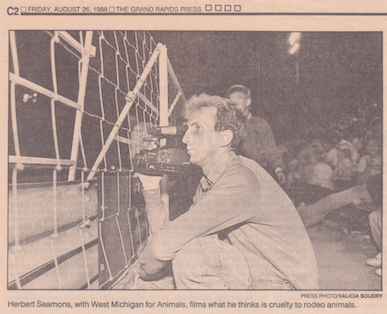
At that time there were rodeos taking place at several locations in the West Michigan area,  including Wyoming, Sparta and Grattan. The group investigated and documented abusive treatment of animals, as you can see from this photo that appeared in the Grand Rapids Press, where founding member Herb Seamons is seen filming at a local rodeo in 1988.

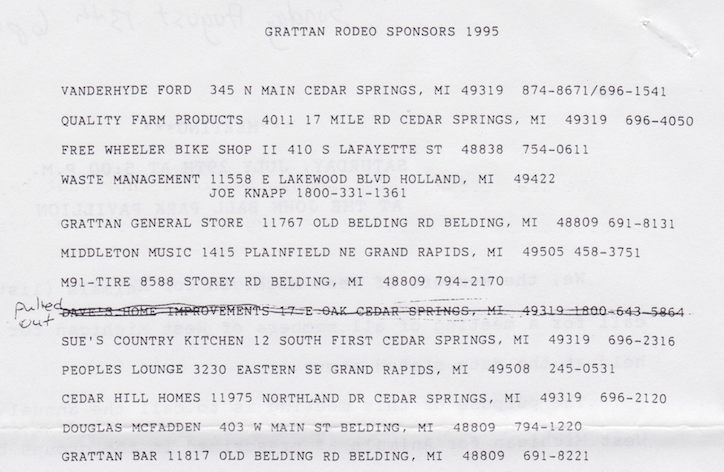
In addition to documenting animal abuse, WMFA began to use other tactics, such as popular education through signs and handouts to people who attended rodeos. Beyond public education, the group pressured financial sponsors of area rodeos. In 1995, WMFA had published a list of rodeo sponsors and sent each of those sponsors a letter

Screen Shot 2015-07-07 at 1.43.35 PM

In the letter, WMFA focused on informing these sponsors about the cruel treatment of animals used at the rodeo. In addition, WMFA stated they would contact St. Jude’s, which was the recipient of the rodeo fundraiser, and they would be contacting Kent County Animal Control to see if regulations were being violated.

These tactics and others eventually paid off in one instance. While doing research on the rodeo that took place in Wyoming, the group discovered that the City of Wyoming was providing funds for the rodeo, despite the fact that the rodeo was losing money. Again, WMFA pressured sponsors with letters and picketing. The financial debacle of the Wyoming Rodeo that was exposed was what eventually caused it to shut down.

This is just one example of the type of organizing and campaigns that West Michigan for Animals was involved in during the 1980s and 1990s. It also demonstrates that organized resistance can be effective and it can be a source of inspiration for people involved in similar struggles today.

Posted in Animal Rights/Animal Liberation | Tagged , , , , | 2 Comments

1991 GRTV Show provides a window into past organizing in Grand Rapids by the LGBTQ Community

In 1991, the Lesbian and Gay Network of West Michigan had begun its campaign to get the City of Grand Rapids to pass an ordinance that would provide anti-discrimination protections for the LGBT community.Screen Shot 2015-06-22 at 5.14.09 AM

The ordinance did not pass until 1994, but for three years people were talking about this issue, organizing and raising awareness.

A Grand Rapids City High student named Gene Sampson, hosted a show on the Grand Rapids Cable Access Channel GRTV in 1991, which featured two members of the Lesbian and Gay Network, Dr. Holly Van Scoy and Bryan Ribbens. The other two guests on the show were Bill & Jan Van Oosterhout, who at the time were members of PFLAG – Parents, Families and Friends of Lesbians and Gays.

The show is in two parts, where Gene and his guests talk about homophobia in West Michigan, the ordinance campaign and challenging attitudes and stereotypes about the LGBTQ community.

Posted in LGBTQ Movement | Tagged , , , | 1 Comment