Haiti and Grand Rapids: Part 3 (1993)

screen-shot-2016-12-20-at-9-10-16-am

This is the third part of three articles from 1993, written about the Haiti/Grand Rapids connection, a series which appeared in the Independent newspaper, The Fundamentalist.

Part 1 looked at a Grand Rapids-based company, H.H. Cutler, which had moved their manufacturing to Haiti (including other countries) and eventually closed their production in town despite benefitting from years of tax breaks. 

Part 2 featured a story about a West Michigan religious organization (Haiti Baptist Mission), which had been working in Haiti for decades, engaging in exploitative forms of White Savior politics. 

The third part in the series from 1993 ties the other two stories together and looks at how US policy has impacted Haiti historically and at the time this series was written.

The Clinton administration had just come to power at the beginning of 1993, a coup in Haiti had occurred the previous year and US trade policy had been promoting Haiti as a free trade zone. The US Agency for International Development (AID) had been directing funds to Haiti to attract multination corporations, particular in the garment sector.

Below is the beginning of the article on Haiti from 1993, an article you can read in its entirety by going to this link

screen-shot-2016-12-20-at-9-09-38-pm

Posted in Anti-Capitalism/Labor, Anti-War/Anti-Imperialism | Tagged , , | 1 Comment

Rockford Baptist Mission to Haiti: Curing the African Mind (1993)

(This is the second posting on Haiti in 1993 during the US Embargo against the country that was meant to punish the Aristide government for defying US policy. The first posting dealt with a Grand Rapids company that was profiting from cheap Haitian labor at the time. This article is reprinted from the Fundamentalist 1993.)screen-shot-2016-12-12-at-6-51-02-pm

The Haiti Baptist Mission has an office in Rockford, Michigan. Cliff Welsh (former GVSU professor) mentioned it as being one of the prominent missions in Haiti.

Mission literature describes itself this way:

The Baptist Haiti Mission serves more than 250 Haitian-pastored churches with thousands of members. More churches are being built every year to meet the growing demand of Haitians turning away from Voodoo and turning to Christ.”

Voodoo derives from various religious traditions, particularly African, and is the predominant religion in Haiti.

Literature says the Mission runs various health clinics and services, agricultural programs, education, child care and other programs, all of which are strongly Christian-centered. It says the Mission began shortly after John Turnbull came to Haiti in 1934 and “recognized the tremendous needs of the people. He determined that with God’s help he could effect both physical and spiritual change in the lives of the people of this impoverished nation.”

Judy Zylstra,a Christian Reformed World Relief Committee missionary who now works with Haitian refugees, says of the Baptist Haiti Mission, “I see them working in a very good way. Evangelism is a much bigger part of their mission than ours. They had self-help crafts; they provide jobs for local people.”

A story in the Grand Rapids corporate daily paper, The Grand Rapids Press, on the Baptist Haiti Mission, written early in 1990, was titled, “Generations of Service,” with a subtitled “Turnbull family’s mission centers on spiritual and social needs of Haiti.” It says the Mission has set up “schools, hospitals and churches,” and has helped to dramatically reduce the illiteracy rate. It quotes Turnbull as claiming Voodoo, the indigenous Haitian religion, is largely responsible for the country’s poverty.244847

The article notes that the Mission is not specifically Baptist, but receives support from Methodists, Episcopalians and Catholics, amongst others.

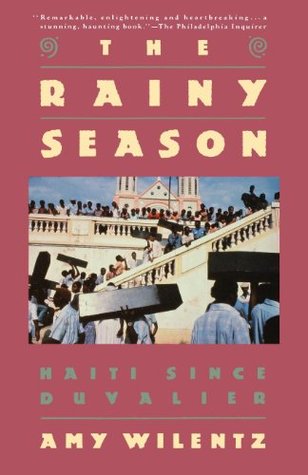
The article did not quote any practitioners of Voodoo or others who may have been critical, despite the fact that a book had then recently come out that offered a far different perspective on the Mission and its activities. Amy Wilentz, in her 1989 book, The Rainy Season: Haiti Since Duvalier,” has the following to say about the Mission:

“They’re so stupid. To us, it looks like utter stupidity, but that is the African mind.”     Wallace Turnbull

Wilentz goes on to say that Wallace Turnbull, who has been “a fixture on the Haitian scene since the 1950s,” now runs “a large plantation-style mission” that is “next door to the Duvaliers, former mountain retreat.” The Duvalier’s, with considerable USA government support, ran one of the most brutal and corrupt dictatorships in the world for 34 years.

When Wilentz asked Aristide about Turnbull and another well-known missionary, Max Beauvoir, Aristide replied, “Beauvoir? CIA. Turnbull? Same thing.” Wilentz says many people say that Turnbull is a CIA informant.

Wilentz says that Turnbull has strongly opposed Aristide and has started or contributed to numerous false rumors designed to discredit the highly popular leader.

Describing the Mission itself, Wilentz says that of many missions in Haiti, Turnbull’s is “The most famous and perhaps the most grandiose of all.” It “now has 250 branches throughout Haiti.” At the main mission in Haiti, Turnbull “presides over some 250 Haitians who call him ‘Bos,’ and who rake and hoe and harvest and sew in return for clothing and religious schooling and care from the small but clean medical clinic.”

“In general, Pastor Wally doesn’t pay his workers, he feeds them, usually with food from CARE’s Food for Work program. The mission uses the food as pay, which saves the mission money. Here, Food for Work once again has all the earmarks of slavery except that the peasants who work the mission land do not receive a parcel of land for their own cultivation.”

Posted in Religious Right | Tagged , , , | 1 Comment

Resisting the Vietnam War: Interview with Paul Milanowski

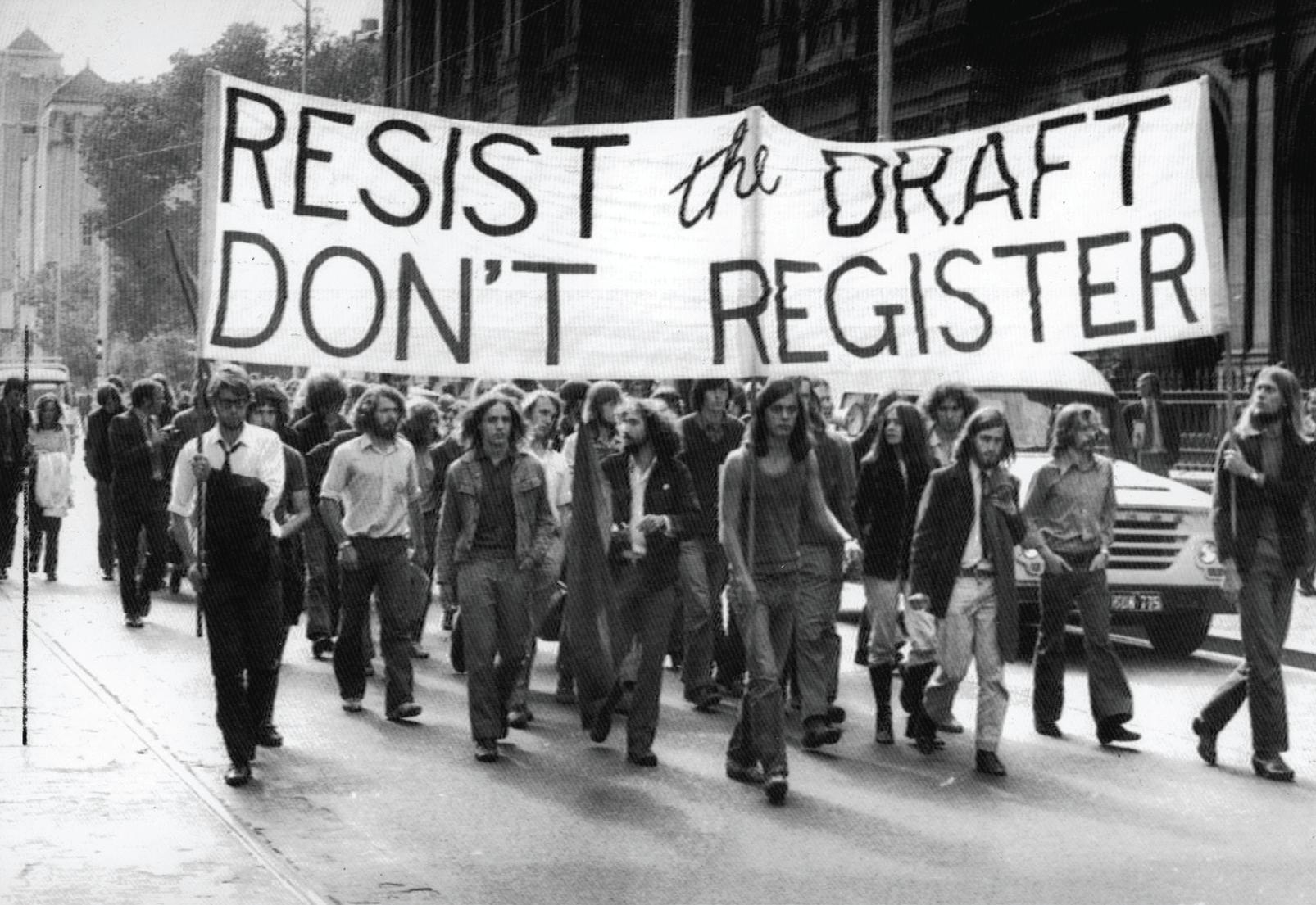
draft-resistance

This interview was conducted in December of 2016 by the Grand Rapids People’s History Project.

Fr. Paul Milanowski talks about how he got involved in doing anti-Vietnam War work in the mid-1960s, his involvement with doing draft counseling, doing tax resistance and other actions that took place in the late 1960s in Grand Rapids.

Paul eventually decided to do a self-imposed exile in Canada in the early 70s to work with the young men who had resisted the Vietnam War by going to Canada instead of subjecting themselves to the draft.

Fr. Milanowski continued to do social justice work around civil rights, anti-nuclear and Central American solidarity in the early 1980s. At one point in the mid-1980s he moved to London during the Reagan years and did work with a parish that provided free meals and found housing for those on the street.

Posted in Anti-War/Anti-Imperialism, Vietnam War Resistance | Tagged , , , | 2 Comments

Giving Haiti the Business: Grand Rapids-based H.H. Cutler Leads the Way (1993)

(This article on Grand Rapids-based company H.H. Cutler and trade policy in the early 1990s is re-posted from the Independent newspaper, The FUNdamentalist Nov/Dec 1993)

According to the National Labor Committee report, “Haiti After the Coup,” H.H. Cutler was the leading importer of apparel sewn in Haiti during the three-month period of the OAS embargo.haiti

The company was one of 66 that sought and received an exemption from that embargo. During that three months it imported 335,508 pounds of apparel sewn in Haiti; about 20% of all USA apparel imports from Haiti during that period.

H.H. Cutler, with annual sales of nearly $200 million, was also one of 26 companies that signed a Washington Post ad in December of 1991, which said in part: “Please, Mr. President, give America and Haitian workers the best Christmas present yet by allowing them to go back to work. By lifting the US embargo, you will save lives and lay the economic groundwork for a permanent, stable democracy.”

This was in the face of repeated calls for a tough embargo by Aristide, who was elected President with about two-thirds majority.

H.H. Cutler had already been sending much of its cut material to the Caribbean for sewing, jobs that might have been kept in Grand Rapids. Spokesperson Martin Hale, quoted in this area’s monopoly newspaper over two years ago, said, “It’s a matter of survival, part of our strategy for remaining competitive.” Nothing was said about the horrible conditions that the company was promoting and using.

Greg Lambert, H.H. Cutler Secretary-Treasurer, said in a telephone interview that Cutler has facilities in the Dominican Republic, Jamaica and Mexico, as well as Haiti. Specifically referring to Haiti, Greg Said, “We’re providing jobs for people. Every worker there supports 10 people. Without those jobs those people would be on the street.”

Asked why Cutler sought to end the embargo, despite apparent popular support for it, Greg said, “The embargo didn’t help people.” The way to help them is “to try to give them jobs so they can support their families. That’s how you build an infrastructure, is jobs.”

Responding to a question on what the company does about the extremely low wages, Greg’s response: “That’s a political situation, we tend to stay out of political situations. We don’t want to find ourselves in the middle of that.”

Judy Zylstra, who lived in Haiti for over four years while her spouse was field director of the Christian Reformed World Relief Committee there, offered one perspective on love wages. “We needed to hire Haitians for things like carrying water. Clothes got washed by hand and we hired people to do that. Most people, if they had work at all, made about a dollar a day. We found, if we paid much more than that, that our employees were targeted.”

Judy commented on companies in Haiti, “I guess my problem comes with companies that go there so they can get cheap labor. If a company is making a great profit, it has an obligation to give back to the country, helping them drill a well, so they can get clean water; helping them build a clinic, so people have access to health care.” Companies should be “establishing local industry, or having local people take over leadership.”

Greg Lambert said that Cutler has met with the Caribbean-Latin American Council to provide “humanitarian relief” – schools, jobs, etc. He also stated that there is “no abuse, no child labor” and “ We are very careful who we work with.”

Locally, Cutler has worked to keep costs low at the expense of workers and taxpayers. Norm Stiles, President of Amalgamated Clothing and Textile Workers, says of the company and the workers there, “Years ago our union represented them. They sort of folded up to get the union out, but then they opened up again, and have been non-union ever since.”

An August 16, 1991 fire destroyed much of the company’s Oak Industrial Drive facility, idling its nearly 700 workers. It was the third fire in two years, all of which were determined to be arson. One ex-Cutler worker said that somebody committing arson at the plant was not surprising.

Shortly after the fire, Cutler sought and received authorization from the City of Grand Rapids for up to $5 million in industrial revenue bonds for rebuilding. And shortly after that the company sought and received tax abatements from the City worth at least $1 million, and perhaps considerably more, over their 15 year lifespan.

The Grand Rapids City Commission, recently confronted with what their support of this company means in terms of labor conditions in Haiti, had no comment.

Posted in Anti-Capitalism/Labor | Tagged , , , | 2 Comments

Cops, Property and the White Gaze: Photos from the 1967 Riot in Grand Rapids

Last week we posted a transcript, along with images, from a few archived stories from WOOD TV8 that we found at the Grand Rapids Public Library from the 1967 riot in Grand Rapids. 

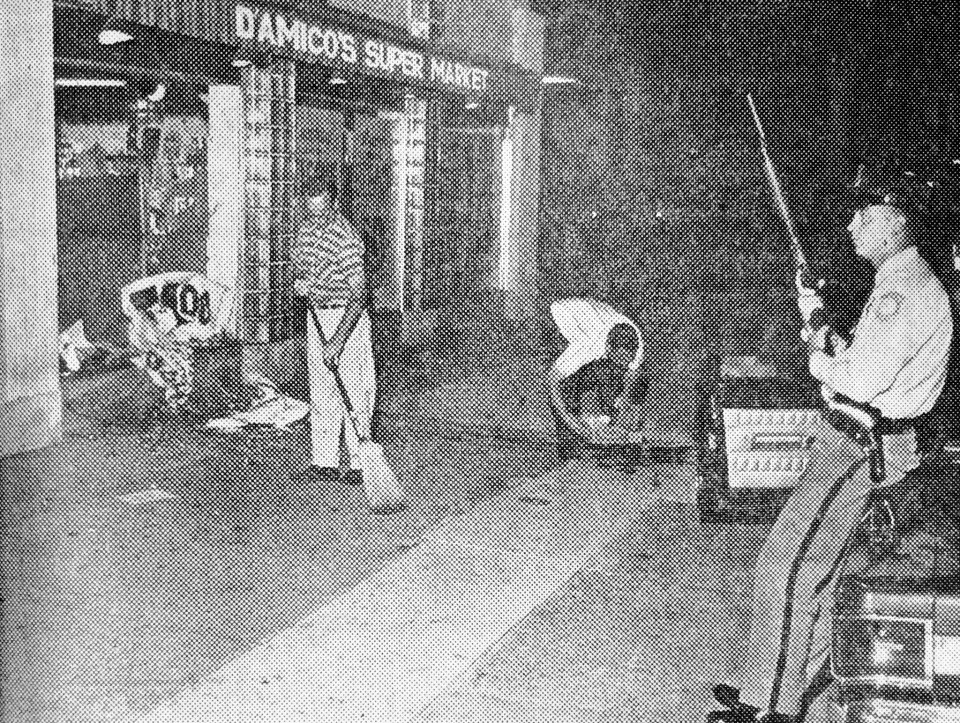
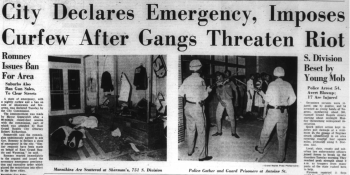
In today’s post, we wanted to share a selection of photos from the Grand Rapids Press that were taken in late July of 1967 during the three days of the Black uprising in Grand Rapids. The photos are instructive, since most of them deal with White owned property, police protection of White owned property or Grand Rapids cops policing the Black community.damicos-store-1967

These photos could collectively be identified as utilizing what some social theorists refer to as the White Gaze. The White Gaze, “is described as looking at the world through the eyes of a white person who has undertones of, or is blatant in, their racism,” as is defined by George Yancy, Professor of Philosophy at Duquesne University.

The photos definitely reflect the White Gaze, not just because they were taken by a white photographer, but because they reflect visually constructed reality as presented through a white lens.

The first photo (seen above) is from S. Division in Grand Rapids, where we see white business owners/workers outside of D”Amico’s Super Market cleaning up after windows had been broken. This image also includes the presence of a white cop with a rifle held in such a way as to make it clear who he is there to protect.

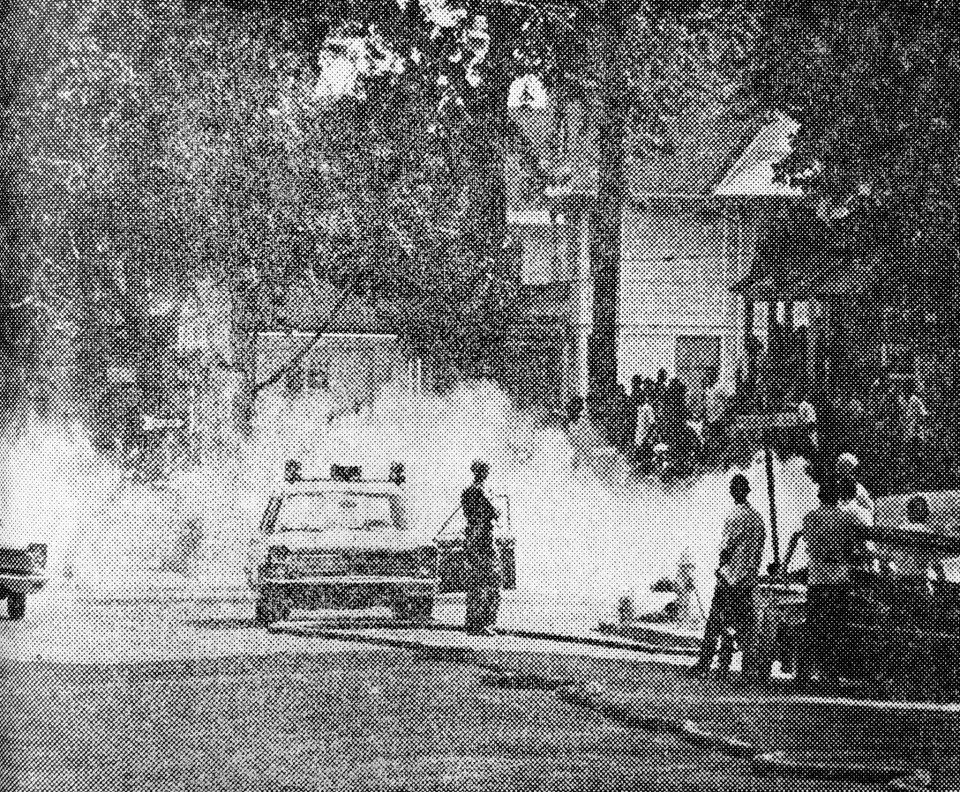
The next photo (seen below) is an image of Grand Rapids cops using tear gas in a predominantly Black neighborhood near the corner of Jefferson and Pleasant SE. The tear gas was used to disperse a crowd of people who had gathered.

police-use-tear-gas-1967

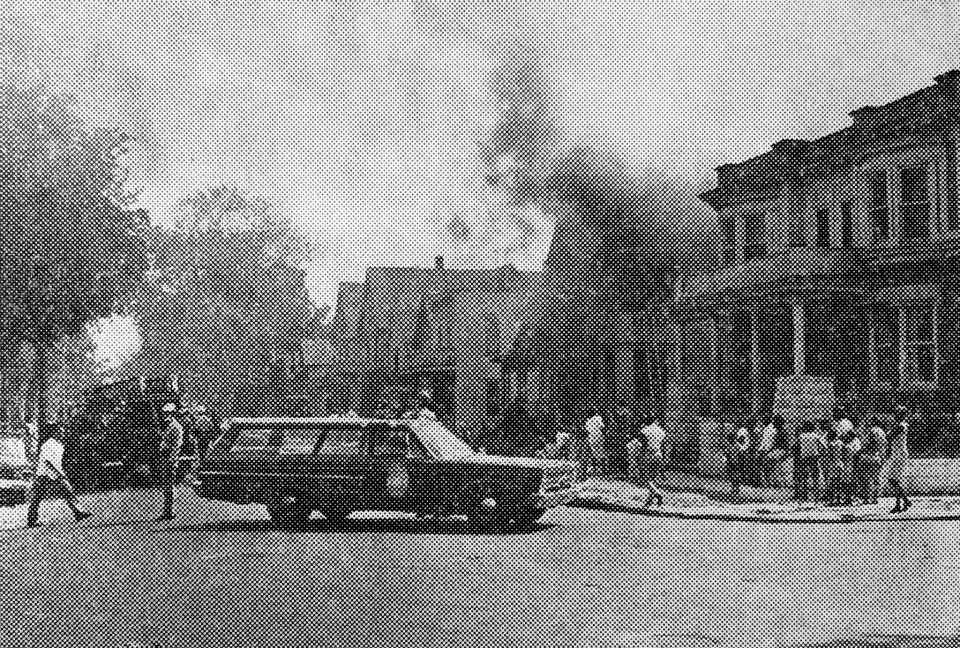
The third photo in this selection (seen below) shows a house on Jefferson near Buckley SE that was on fire. Neighbors who lived in that area during the 1967 uprising told this writer that houses were often targeted, because they belonged to white absentee landlords. The house that is on fire was torn down and that lot on Jefferson is still vacant to this day.

house-fire-on-jefferson-1967

cops-and-rioters-clash-1967

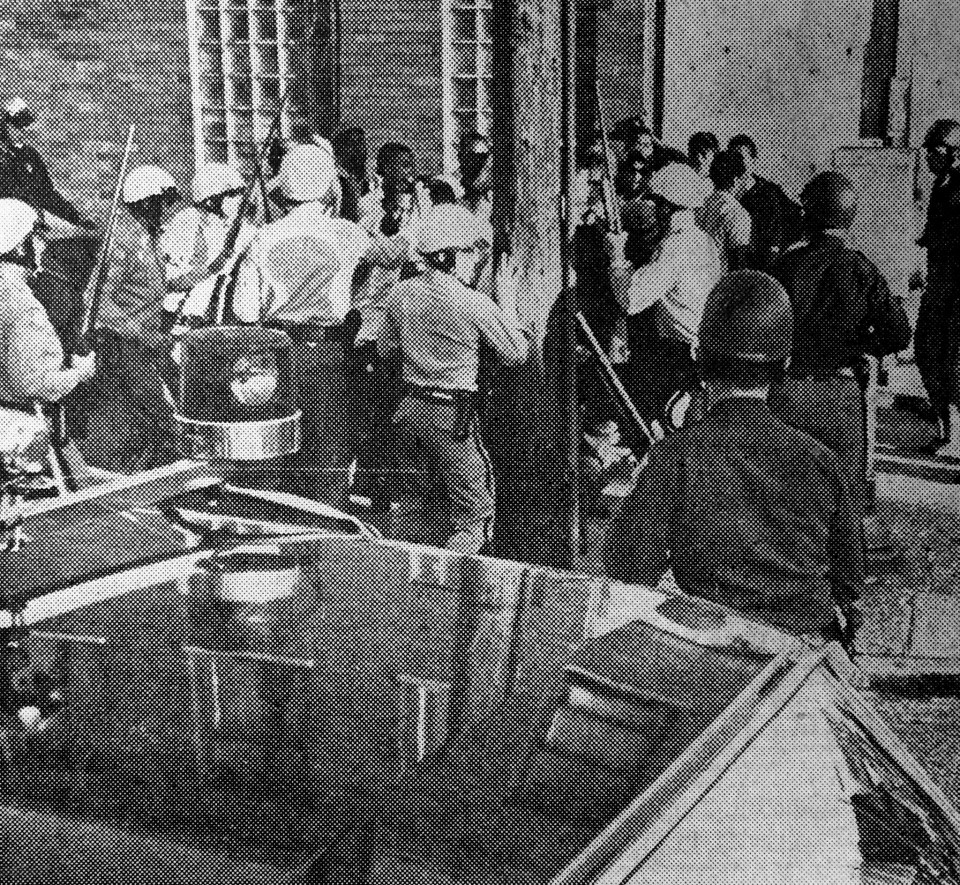
The next photo (to the right) shows Grand Rapids cops cornering Black people near the corner of Wealthy and Division. Despite the fact that this was predominantly a Black neighborhood, Black people were not permitted to freely move about, especially during the three days of rioting in 1967.

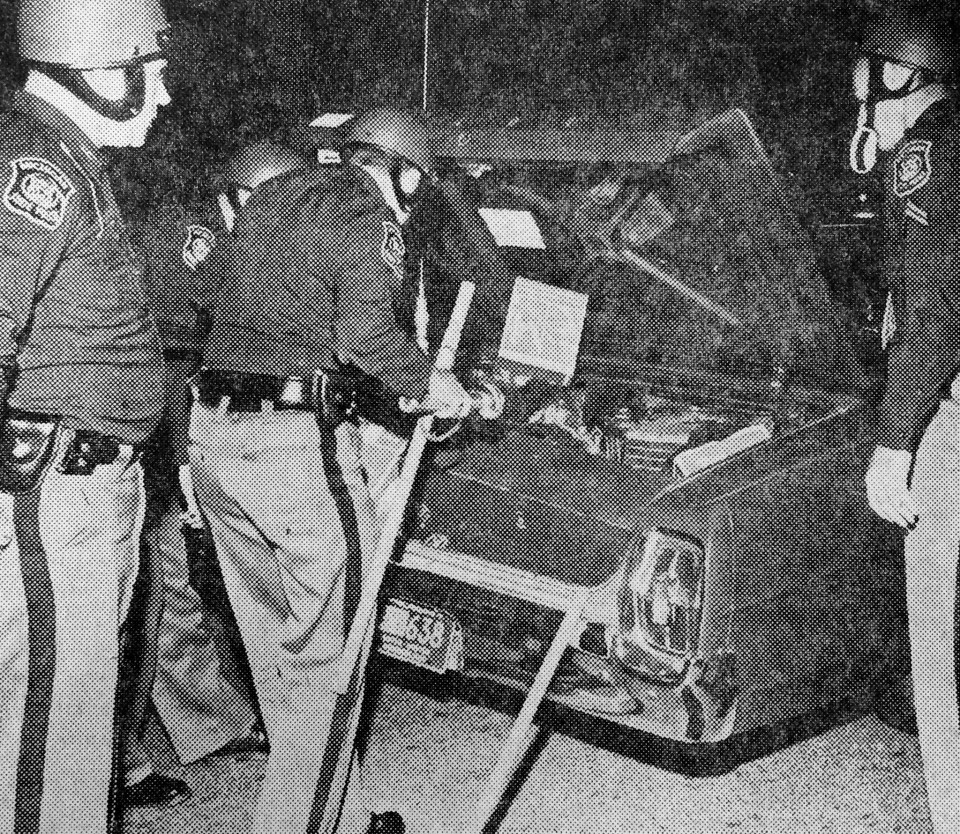
This fifth photo (see below) from the selection shows Grand Rapids cops going through the trunk of someone’s car. People coming in and out of the neighborhood that they lived in during those three days of rebellion in 1967, were subjected to constant surveillance and harassment by the cops.

police-search-car-1967

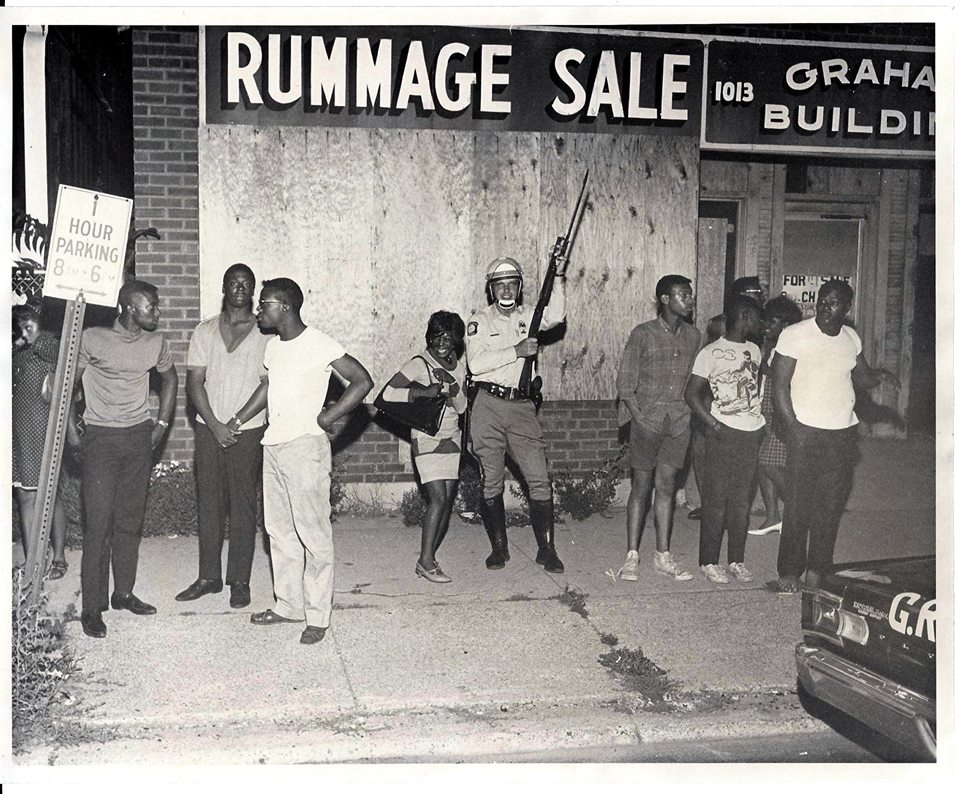
The last photo seen here below is of a Grand Rapids Police Officer, who “poses” with people along Division Avenue during the uprising of 1967. This image is particularly telling as it represents the arrogance of White Supremacy, with a White cop posing amidst Black people who were confronted by the brutality of this system.

grpd-image-from-1967

Posted in Civil Rights/Freedom Movement | Tagged , , | 2 Comments

Centering White Voices: How WOOD TV 8 framed the 1967 riot in Grand Rapids

picture-17

Next summer will mark the 50th anniversary of what is often called the 1967 “race riots” in Grand Rapids.

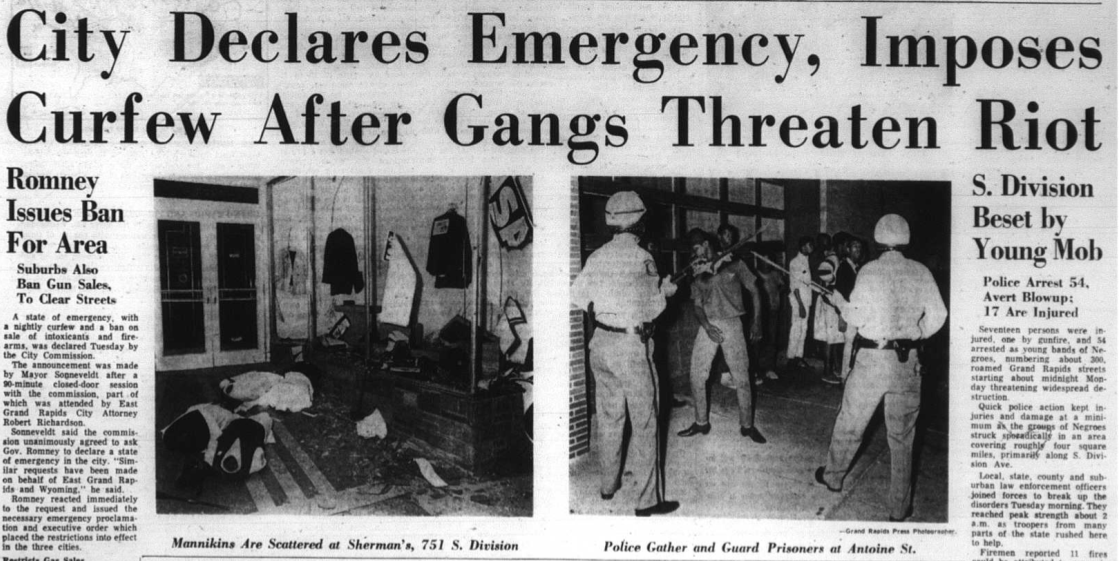
Previously, we have looked at the Grand Rapids Press coverage of this black uprising, which was responding to police brutality and systemic oppression. The Grand Rapids Press coverage does little to look at the root causes and instead focuses disproportionately on property destruction and the opinions of law enforcement and white residents.

Recently, we were looking through the Grand Rapids Public Library Archives and came across a video tape that has a few stories from WOOD TV 8 about the 1967 riot in Detroit and Grand Rapids. It is likely that there were several other TV news stories about the 1967 riot, but the tape we came across only had a few stories specific to the Grand Rapids riot.

We also don’t have the right to post these stories until we can get permission from WOOD TV 8 to post the footage, but in the meantime, here are transcripts of the stories. The transcripts provide an interesting window into how the local TV news framed the 1967 riot, along with which people they chose to interview. These stories are instructive and reflect how white voices are centered even when communities of color are responding to White Supremacy.

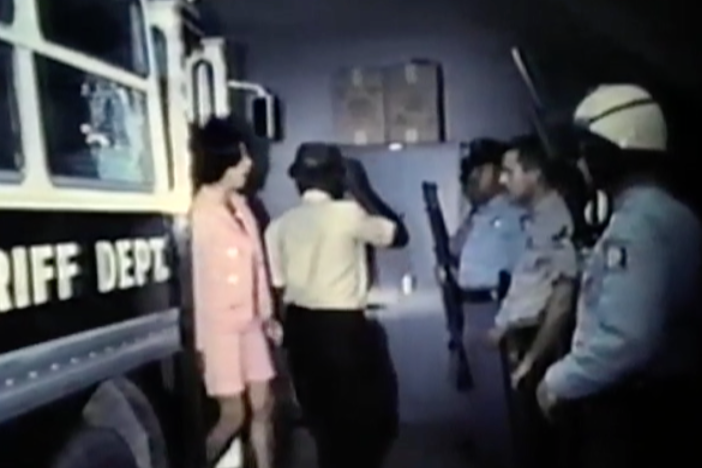
The footage begins with an image of a bus labeled as, Kent County Sheriff Department – Labor Camp. Several black people get off the bus, while armed guards stand outside the bus. The footage continues with three black people being frisked by a white Grand Rapids Police officer. During this footage there is no voiceover or sound of any kind.

screen-shot-2016-11-05-at-11-20-30-am

The first clip with sound is with the Grand Rapids Police Chief in 1967. He reads the following statement:

Chief of Police – Speaking on behalf of Mayor Sonnevelt and City Manager Nabers, we are proposing to establish a prohibited area near the southeast end, in the districted bounded on the east by Madison, on the south by Cottage Grove, on the west by the expressway and on the north by Wealthy.screen-shot-2016-11-05-at-11-54-31-am

We ask all people and we particularly place emphasis on all people, to please refrain from going into the area with the limits I have just described. In addition, we are also closing the exit ramps, I repeat, only the exit ramps on the 131 expressway, Burton St on the south and Pearl St on the north. So, for the benefit of those motorists bound  north or south on 131, do not plan on getting off on any exits from Pearl on the north to Burton on the south.

Reporter – Chief have you heard any word about any National Guards troops coming into town?

Chief of Police – I have just been advised by operations in East Lansing that there is one battalion of National Guardsmen that has been released and will be available in Lansing. However, I was also reminded that in addition to our request, they have similar requests in Pontiac, Flint and from Lansing, so we are going to cut this pie four ways.

Reporter – How long will you keep the particular area sealed off?

Chief of Police – Until such time that we feel that conditions are such that can be opened for general usage.

Reporter – How many officers will you have out there tonight?

Chief of Police – We will have an excessive, we would like to think, an excessive amount of police out there tonight.

Next story, also an interview with the Grand Rapids Chief of Police.

Reporter – But you have requested National Guard Troops?

Chief of Police – Yes, very definitely. The City Manager and I have both talked to the Governor’s office and they are attempted to send to us National Guardsmen to take care of the some of the needs.

screen-shot-2016-11-05-at-12-09-16-pm

This brief interview with Grand Rapids Chief of Police is followed by some brief footage of property destruction in Grand Rapids (image above) and then cuts to an interview with a business owned identified as Mr. Chester.

Reporter – Mr. Chester, what happened here last night?

Business owner – We had all of our windows of our front office broken in, rocks thrown threw them, everyone of them destroyed. And then in the back of our plant they had a fire started, but fortunately there was no damage to speak of.

screen-shot-2016-11-05-at-12-24-10-pm

Reporter – Do you have any estimate as to the damage that was caused?

Business owner – Not yet, but is can be anywhere…..there were 9 panes and each of these panes can cost over a $100.

Reporter – What is your reaction to this whole disturbance last night?

Business owner – Sickening, needless to say and very disappointing.

Reporter – What are your plans now? Will you remain open?

Business owner – We plan on remaining open and doing business as usual.

Reporter – What happens if they come back tonight and do some looting tonight?

Business owner – We’ll do our best to be back in operation tomorrow morning.

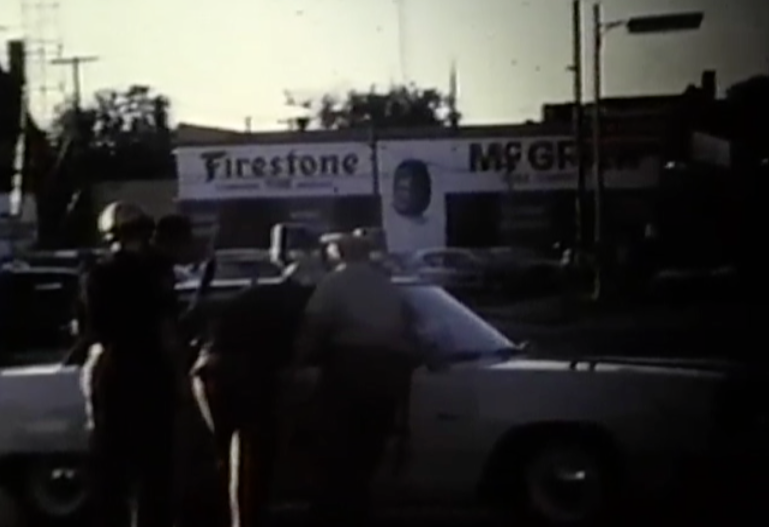
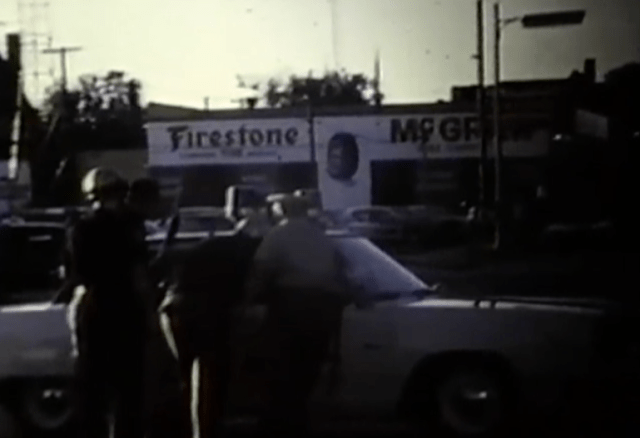
There is about another minute of footage with no sound, footage of property destruction and police presence, like this image of cops in front of the Firestone garage on Wealthy St and LaGrave.
screen-shot-2016-11-05-at-12-19-06-pm

Posted in Civil Rights/Freedom Movement | Tagged , , | 3 Comments

Anti-Nuclear Resistance in Grand Rapids: Part II

Last week we shared Part I, where I had been arrested in an anti-nuclear action in the summer of 1990 at Wurtsmith Air Force Base near Bay City in Michigan. 

no-blood-for-oil-protest

After being arrested, I refused to go to the court date and went underground for several months after Federal Agents came to my house to arrest me.

During this time in 1990, there was the US military build-up against Iraq, because of its invasion of Kuwait. The US military was deploying soldiers and military equipment to Saudi Arabia that would eventually result in a January 1991 US invasion of Iraq. Because of the US military build-up, many of us were organizing against a US military invasion and holding demonstrations once a week in front of the US Federal Building in downtown Grand Rapids.

In late November, I decided to participate in one of the demonstrations and within 10 minutes, I was arrested by Federal Agents working out of the Grand Rapids Federal Building.

I spent the night in the Kent County Jail and went before a Federal Judge, with handcuffs and foot shackles. I was released later that day with a new court date set to appear before the US Federal Judge in Grand Rapids at a later date.

I was eventually found guilty and was sentenced to do 100 hours of community service. At the time I was volunteering for Gleaners and the courts allowed me to use that as my community service, resulting in no real interruption in my life. Ironically, the people who had been arrested with me in August at Wurtsmith Air Force Base and went to their court dates, received 3 months in jail. The lesson learned for me was to not cooperate with the legal system when engaged in acts of resistance against US militarism.

The following video appeared on GRTV, where WenJo Carlton interviewed me for her show, Something Else. We talked about the arrest, the consequences and the eventual invasion/war against Iraq.

Posted in Anti-Nuclear Movement, Anti-War/Anti-Imperialism | Tagged , | Leave a comment

Anti-Nuclear Resistance in Grand Rapids: Part 1

In 1990, several people from West Michigan participated in an action at Wurtsmith Air Force base near Bay City, Michigan. This action was part of a multi-year campaign that targeted the military base because it was a Strategic Air Command base, also known as SAC.

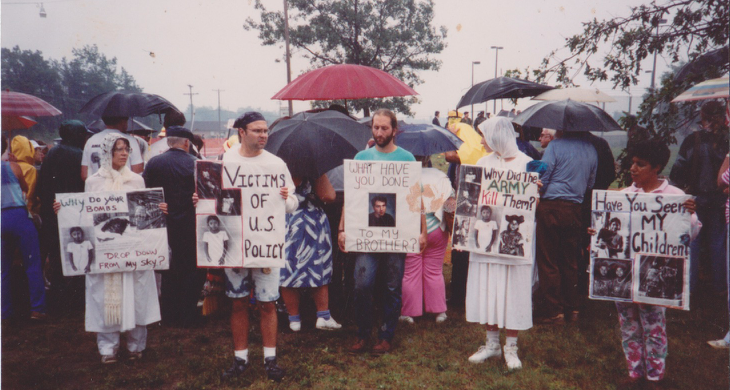
These bases had nuclear weapons at all times and flew B-52 bombers with nuclear weapons on board. Some of these B-52s were in the air constantly, so as to make sure that some nuclear weapons could not be easily targeted while on the ground. The cost of these weapons and to fly them on B-52s was astronomical. screen-shot-2016-10-23-at-10-03-15-pmI was one of those who took part in the action at Wurtsmith Air Force base in August of 1990. The group of people with whom I went with decided to model our action after the Mothers of the Disappeared throughout Latin American, carrying images of loved ones who had been disappeared or murdered by government death squads (pictured here above). However, the picture I was holding was that of my brother Steve, who lived with my parents because of a serious disability from his infancy. The Michigan legislature had made serious budget cuts earlier that year and the program that my brother benefitted had been cut. Therefore, I considered him to have been discarded by the state and amongst the victims of state violence.

I was arrested that day, along with dozens of other protestors at the US military base. We were all released on bond and waited a court date. When I received my court date I sent the court a letter saying I refused to come since I didn’t believe that the court would act justly, especially since we could not use International Law as a defense. The court sent a second letter and I wrote back again saying that I would not come. A week later two federal agents showed up at my front door to arrest me. I was out back and was informed by my housemates that these two men were looking for me. I left and spent the next three months underground, moving from place to place, hoping to avoid arrest.

The video below, is an interview that Wenjo Carlton (who produced a show on GRTV at the time) had conducted with me while I was underground. This is part one of a two part article on the action I took part in against nuclear weapons and US militarism in 1990. Part II deals with the aftermath of me being picked up by federal agents and the outcome of my trial, which includes another interview by Wenjo Carlton.

Posted in Anti-Nuclear Movement, Anti-War/Anti-Imperialism | Tagged , , | 2 Comments

Grand Rapids Furniture Barons lived off the wealth created by furniture workers

screen-shot-2016-10-10-at-1-47-02-am

As we have noted in previous articles related to the 1911 Grand Rapids Furniture Workers Strike, the strike pitted a handful of wealthy robber barons and thousands of furniture workers.

The wealth gap between the Grand Rapids furniture barons was outrageous. According to Jeffrey Kleiman’s book on the 1911 furniture workers strike, the years leading up to the strike saw significant revenues generated by the furniture companies.

The newspaper had calculated that the Grand Rapids furniture industry had jumped from $9.5 million in revenue in 1909 to $11.5 million in 1910 and was clearly in a position to grant higher wages.”

screen-shot-2016-10-10-at-1-00-24-am

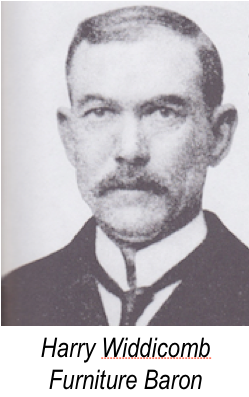
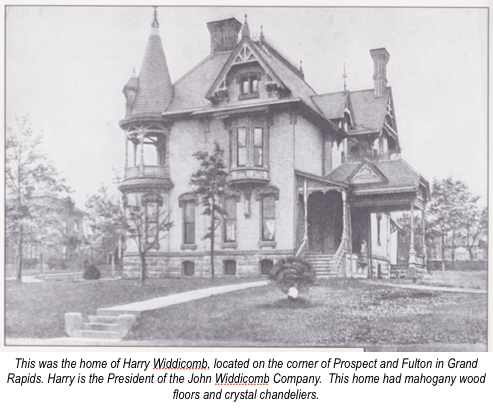
Such wealth was reflected in the way that the furniture factory owners lived. For instance, Harry Widdicomb, president of the John Widdicomb Company lived in this mansion on the corner of Prospect and Fulton, pictured above. During the 1911 furniture workers strike, Harry Widdicomb aggressively sought to break the strike by bringing in scab workers from out of town. In fact, according to Kleiman’s book Strike!, Widdicomb drove scab workers to a from work, driving right through the mass of striking workers. Workers and their spouses regularly threw whatever they could get their hands on at Widdicomb’s car.

screen-shot-2016-10-10-at-1-22-24-am

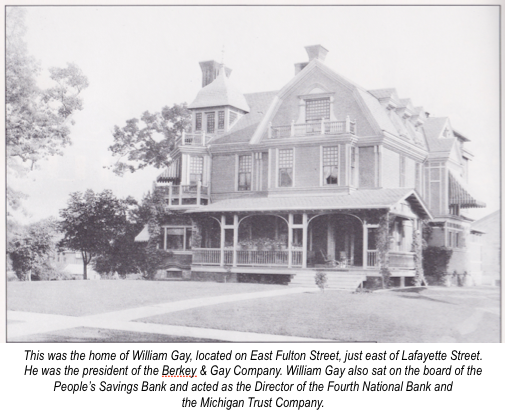
Another one of the Grand Rapids furniture barons was William Gay, who lived in this mansion on East Fulton Street, picture above. As head of the Berkey & Gay furniture company, William Gay was well connected and part of a group of furniture company owners that were interlocked with financial institutions that they were involved with. Again, Kleiman states:

Furniture company owners also created a second tier of financial institutions, assuring themselves of a ready supply of money for loans and credit needed for seasonal expansion. The years between 1905 and 1911 saw the chartering of three local banks – City Trust and Savings in 1905, Kent State Bank, which had ties to the Michigan Trust Company, in 1908 and Grand Rapids National City Bank in 1911 – with furniture executives at their command. The manufacturers sitting on the boards of directors and in the executive offices of these new banks represented major local furniture concerns, each employing more than two hundred workers. Through their banking connections, they were able to play a major role in shaping monetary policy to their advantage.”

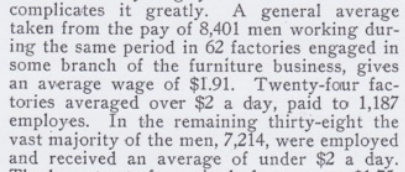
Furniture workers, on the other hand, did not enjoy the same kind of wealth the furniture barons were accustomed to. In Viva Flaherty’s documentation of the Grand Rapids 1911 Furniture Workers Strike, she has the following information in regards to the range of wages being paid to furniture workers at the time. 

screen-shot-2016-10-10-at-1-09-12-am

Many of the 8,000 plus furniture workers did not own their own homes and lived in very modest houses, often with extended members of their families. Hundreds of these houses were torn down when the highway system was built in Grand Rapids between the mid-1950s and mid-1960s. 

While it is clear that the Furniture Barons made their wealth on the backs of thousands of workers, they were not interested in sharing the very same wealth that the workers generated during the decades when the furniture companies flourished.

Posted in Anti-Capitalism/Labor | Tagged , , , | 6 Comments

A.J. Muste: radical pacifist, labor organizer and former Director of the Fellowship of Reconciliation spent his formative years in Grand Rapids

a-j-muste_1-e1438440788677-1

One never knows how our lives evolve and what impact we will have on social issues and the various movements for radical social justice. Abraham Johannes Muste, also known as AJ, was one of those people who had and continues to have a lasting impact on critical social movements within the United States.

AJ Muste was born in the Netherlands, but by age 5 had moved with his family to Grand Rapids, Michigan in 1891. Living on Quimby Street, AJ’s father got a job working for $6 a week for 60 hours of work.

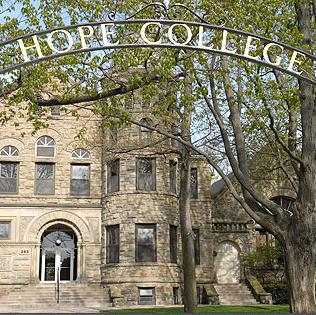
Muste’s family was part of the Reformed Church and AJ attended a parochial school while living in Grand Rapids. At the young age of 13, Muste became a member of Fourth Reformed Church in Grand Rapids and had strong religious convictions. During the time he lived with his family, the other major issue that impacted his life was that of working class values and the struggles of workers in Grand Rapids who were fighting to be part of a union. The labor struggles in Grand Rapids and members of his family had a deep impact on Muste and would later be a major focus of his work.hope_photo_5

AJ then applied to attend Hope College. The online resource digital Holland has this to say about Muste’s time at Hope: 

When he completed preparatory school, Muste enrolled in Hope College. During the eight years Muste spent at Hope, he excelled in the classroom and was involved in numerous extra-curricular activities. He served as the school’s first athletic director, while playing football and baseball, and captained the basketball team as well. Muste wrote for the Anchor, won the Hope College oratorical contest as a sophomore, and placed second in the interstate oratorical competition. In addition to excelling in school, Muste also held several jobs. He led Bible studies, Sunday school classes, and sold Bibles, a job he strongly disliked. He also worked at the Hope College library, wrapped presents during the holidays, worked at the Quimby Furniture Factory, and served as an assistant to Holland’s coroner. Muste graduated from Hope in 1905 at the age of 20. He was valedictorian of his class.

Muste then left the area and took a job teaching at Northwestern Classical Academy in Orange City, Iowa. AJ didn’t stay there long and quickly moved to New York City in the summer of 1908. The living conditions of the working poor activities of labor unions had a significant impact on how Muste viewed his faith. Muste was so impacted by what he saw in New York City, that he shifted his political affiliation from the Republican Party to support for the Socialist Party. In fact, Muste voted for the radical labor organizer Eugene Debs and the Socialist Party in 1912.

By the time that the US became involved in World War I, Muste’s faith was again shaken by the moral conundrum of the violence of war. It was during this time that Muste eventually became a committed pacifist and could not support war and institutionalized violence for any reason. During Muste’s conversion to pacifism, he was the pastor of a Congregational Church in Massachusetts. When members of his congregation had lost sons during WWI, Muste grappled with his own convictions and the needs of the members of his congregation. Muste eventually could not reconcile the conflict and decided to resign from the ministry. Muste did develop a relationship with Quakers at the time and became involved in the newly formed group, the Fellowship of Reconciliation (FOR).

Labor Struggles and Striking Workerslawrence-strike-cartoon

No longer rooted in the church, Muste was then drawn to the struggles of working class people and cut his labor organizing teeth during the 1919 Lawrence Textile Strike. Muste first began by raising funds for the striking workers, but eventually discovered his oratory skills were useful for the strike and the ex-preacher had become the spokesperson for the 30,000 striking workers. Muste also put his pacifism to the test, by being on the picket line and, like his fellow workers, was beaten by cops and other hired thugs working for the textile mill.

This experience with the Lawrence Textile strike led Muste to become a longtime member of the Amalgamated Textile Workers of America and eventually to become a member of the faculty at Brookwood Labor College in New York. Muste was also instrumental in the 1930s in the formation of the American Workers Party. There is a great audio lecture delivered by Muste in the mid-1960s, where Muste talks about his involvement in labor struggles in the 1930s. 

Pacifism and the Civil Rights Movement

However, by 1936, Muste had become disillusioned with party politics and socialism. Muste found his way back to pacifism and particularly Christian pacifism. From 1940 – 1953, Muste had become the executive director of the Fellowship of Reconciliation (FOR).

Many of the people that Muste came into contact through FOR, particularly as a mentor, were students who gone on to form the group, the Congress for Racial Equality (CORE). Muste not only encourage the formation of CORE, he was one of its main fundraiser during its early years.1642161

Another person who became a critical organizer in the Civil Rights movement, was Bayard Rustin. Rustin was one of the main organizers of the Montgomery Bus Boycotts and out of that experience became a close advisor to Dr. Martin Luther King Jr. Rustin would later reflect on the importance of his relationship with Muste. “During all my work with Martin King, I never made a difficult decision without talking the problem over with AJ first.”

King himself, spoke highly of Muste’e influence while he was a theology student in Pennsylvania. “I wasn’t a pacifist then, but the power of AJ’s sincerity and his hardheaded ability to defend his position stayed with me through the years. Later, I got to know him better, and I would say unequivocally that the current emphasis on nonviolent direct action in the race relations field is due more to AJ than to anyone else in the country.”6

AJ Muste continue to participate in and influence movements. In the early years of organized opposition to the Vietnam War, Muste was one of its most vocal critics and was a leader in the lead up to the massive 1967 mobilization to end the war in Vietnam. In 1966, he travel to Vietnam and met with Ho Chi Minh. In February of 1967, at the age of 82, Muste’s life came to an end.

AJ Muste was a person who not only saw how the major issues of his day were inter-related, Muste’s involvement in those movements inspired more than one generation of activists to use the power of nonviolent direct action to work for radical social change,

Posted in Anti-Capitalism/Labor, Anti-War/Anti-Imperialism, Civil Rights/Freedom Movement | Tagged , , , , | Leave a comment