Necessary Radical Thought: Network forum in 1992 demonstrates the importance of constant reflection on where the LGBTQ community is going

When we produced A Grand Rapids People’s History of the LGBTQ Community, we were inspired by all the people who came forward to tell their story and demonstrate the rich history of organizing in West Michigan for collective liberation.Screen Shot 2015-06-10 at 7.57.35 AM

In addition to the stories, we were gifted with lots of archival materials, especially from Bryan Ribbons, who in our estimation made the project truly come alive. From the pictures, to the documents and all the amazing video, Ribbons had so much material that we couldn’t use it all in the film.

However, one of the benefits of living in the digital age is that you can still use all the material, which is why we created an archival site that houses all this rich material.

For example, there is this powerful video of a Network event in 1992 billed as a discussion about the lessons learned from Stonewall. In this video (embedded below), Holly VanScoy and Dennis Komack facilitate this discussion which covers a whole range of topics, such as the Lesbian influence in the local movement, how Grand Rapids responded to the AIDS crisis, dealing with the reaction right in West Michigan and the evolution of Pride events.

At one point in the discussion, one of the participants makes the point about “necessary radical thought.” This comment stands out in many ways, because what the person was saying is that it is absolutely necessary that we not only continue to reflect on where we came from as a community, but that we continue to challenge our understanding of who we are and where we are going. Movements for social change are resilient to the degree that they can embrace the idea of necessary radical thought.

Here is this powerful video from 1992 that should inspire all of us to continue to reflect and challenge what it means to be liberated in a world that either despises us or wants to co-opt us.

Posted in LGBTQ Movement | Tagged , , | 1 Comment

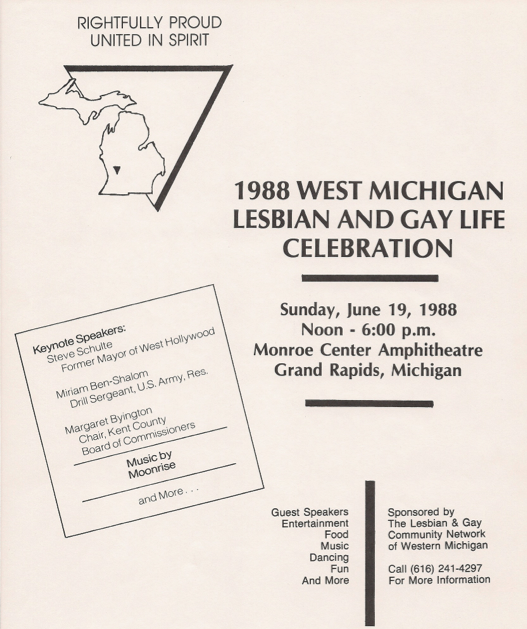
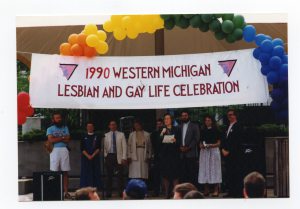
What Grand Rapids Pride looked like in 1988

Screen Shot 2015-06-04 at 9.25.35 AM

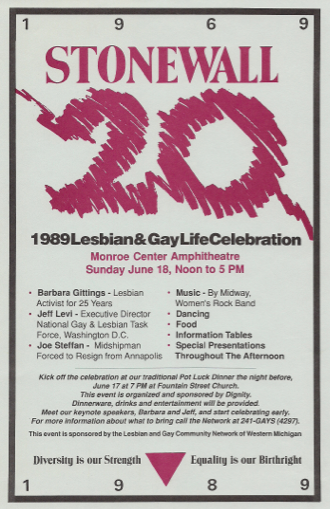
Despite the lack of government support, members of The Lesbian and Gay Community Network of Western Michigan and other area LGBT groups organized the first Pride Celebration in Grand Rapids in 1988.

The video below is 90 minutes of the first ever Pride celebration in Grand Rapids, which includes comments from the stage, interviews with organizations tabling at the event, music and even footage of the spiritual violence that was perpetrated against those in attendance by a group of self-proclaimed Christians who tried to disrupt the event.

Posted in LGBTQ Movement | Tagged , | Leave a comment

Anti-gay businesses and the defeat of the anti-discrimination ordinance in 1991

In Grand Rapids, the campaign to get an LGBT-inclusive ordinance passed took several years and two attempts to get the City Commission to adopt the ordinance. The campaign to pass an ordinance began in 1991 after the Community Relations Commission recommended that the ordinance be updated to include “gender orientation” into the language.

The first time the ordinance was brought before the City Commission it was voted done 4 – 3, with lots of people at the first public hearing expressing their opposition to such an ordinance.

Included here is a 1991 archival news story on the first ordinance hearing that was defeated.

The LGBT community at that time did not call for a boycott of Grand Rapids businesses, nor did they seek out businesses, which supported the ordinance change. Instead, some in the local business community put together a list of those who opposed the ordinance saying it was “contrary to the values of West Michigan.”

However, what is interesting about the businesses that actively opposed the ordinance in Grand Rapids in 1991 was the fact that many of those in the original list actually were NOT opposed to the ordinance. The list that was provided to the Grand Rapids City Commission came from Mike Beckett, a man who worked for a local insurance agency. He submitted a list of 140 businesses he claimed were opposed to the ordinance, which members of the LGBT community at the time believed influenced the Commission’s decision, which resulted in a 4-3 vote against the ordinance.

Members of the LGBT community seemed to think that the list was not accurate and began contacting those listed to verify their stance on this issue. During this process they discovered that many of the businesses on the list did not oppose the ordinance and were never approached by Mr. Beckett about such a campaign against inclusion.

Once Mike Beckett was exposed for his deceit he made a formal apology to the Lesbian and Gay Community Network, which published his apology in their August 1991 newsletter. Once the group had verified the real list of businesses that opposed the ordinance they decided to publish that list in the September issue of the Network newsletter. It is worth noting which businesses and individuals were on that list (included here) from 1991, a list that now included just 59 entities.

nn592

After the accurate list was published there was no real push from the broader business community to oppose the ordinance, but there were some area families with significant wealth that made their opposition to equality for the LGBT community known by spending lots of money on campaigns to defeat such efforts. Some of the more prominent families used money from their foundations to support anti-LGBTQ campaigns in Michigan and abroad. These families include the DeVos family, the Princes and Peter Cook. For more information on these family foundation, click here.

Posted in LGBTQ Movement | Tagged , , , | 1 Comment

Which Local Mayor Supported the early Pride celebrations in Grand Rapids?

One of the benefits of doing a project like the People’s History of the LGBTQ community in West Michigan is that you get an opportunity to see where we have been in order to makes some determinations about where we might be going.lgbt003

The LGBTQ community in Grand Rapids fought hard to get an anti-discrimination ordinance passed in 1994, but before that they had a tough battle to get city support for a Pride Celebration.

At the time, Mayor Gerald Helmholt, would not offer a city proclamation endorsing the Pride Celebration in the late 80s when the first events were held in Grand Rapids. Helmholt was also opposed to the first attempts to get an anti-discrimination ordinance passed in Grand Rapids in 1991 & 1992. Helmholt, a member of Citizens for a United Grand Rapids, was quoted in a June 3, 1992 Press article as saying, “I think it’s the basic belief of the group that a thorough investigation will reveal there is no more discrimination against gays and lesbians than there is against anyone else.”

Here are some local TV news stories from 1988 about the first Pride Celebration in Grand Rapids, along with Mayor Helmholt’s justification for not endorsing Pride in Grand Rapids.

However, not all area mayors were opposed to what the Grand Rapids LBGTQ community was trying to accomplish at the time. In fact, in 1989, the Mayor of Holland, Phil Tanis, wrote a fairly compelling letter in support of Grand Rapids Pride.89-pride-proclamation-support-letter

The struggle for civil rights for all had a good beginning in the 1960s. Today, unfortunately, most people seem to think the fight is over, continue to work against equality, or just don’t care. None of these attitudes is unacceptable.

The fight has only just begun. This sad fact is especially true for members of your organization.

The theme for your rally this year, ‘Diversity is our strength, equality our birthright,’ is one everyone should embrace and fight for.

Please accept my personal endorsement for your Celebration and your fight for civil rights.”

It would seem that the current Mayor of Holland and several of its City Council members are unaware of this history or they are hoping that at least we don’t know about it.

Posted in LGBTQ Movement | Tagged , , , | 1 Comment

What kind of response did a Grand Rapids CRC Pastor get from the Prime Minister of South Africa in 1954 when asking about the system of Apartheid?

Since December of 2014, we have been engaged in research on the movement in Grand Rapids to end the system of Apartheid in South Africa.

Like most of the international anti-Apartheid movement, Grand Rapids engaged in education, confronting government and corporate institutions and ultimately focusing on Divestment as a strategy to break to power that White South Africans held over the majority of Black South Africans.3977893_orig

We have posted stories on the victories won by organizers to get the City of Grand Rapids to divest, the Grand Rapids School Board to divest and even Calvin College to divest. 

However, one thing that made Grand Rapids somewhat unique was the interest of the Dutch South African power structure to how the Dutch Christian Reformed Church community was dealing with the international campaign to end Apartheid. We noted in our interview with Doug Van Doren, that when the South Africa government sent a high ranking official to the US in the 1980s to respond to the growing anti-Apartheid movement, the only place this official visited (outside of DC), was Grand Rapids.

This should not come as a surprise to those who are familiar with the history of the CRC and racial policy. In Todd Robinson’s book, A City Within a City: The Black Freedom Struggle in Grand Rapids, Michigan, the author documents well the resistance from the predominantly White Dutch power structure to efforts by the Black community to gain more rights in West Michigan since the 1930s. Robinson names the system of institutionalized racism in Grand Rapids as “Managerial Racism,” where the White power structure overtly managed what the Black community could do.

When it came to where the Christian Reformed Church in Grand Rapids stood on the issue of South African Apartheid, it is worth reading a letter sent from Dr. D.F. Malan, the Prime Minister of South Africa in 1954, in response to a letter from Rev. John Piersma, a CRC Pastor in Grand Rapids

The letter is divided into essentially three sections. First, the South African official provides a framework for why Apartheid is not only necessary, but should be seen as, “arising from a deep-rooted color consciousness of the White South Africans.”

The difference in color in merely the physical manifestation of the contrast between two irreconcilable ways of life, between barbarism and civilization, between heathenism and Christianity, and finally between overwhelming numerical odds on the one hand and insignificant numbers of the other.

Prime Minister Malan then offers seven points on behalf of the Dutch Reformed Church, points that justify racial Apartheid. Here is point number five:

Screen Shot 2015-05-27 at 9.32.52 PM

The third and final section of the letter was a justification of South African Apartheid on political grounds. Here the White South African writer points out the usual justification for White Supremacy, such as how taxes are used, the creation of “Advisory Boards” and how Black South Africa children are getting a free education from the White ruling class.D1114_inset

The arrogance of White Supremacy is made clear, when the South African Prime Minster refers to Black South Africans as Bantus and goes out of his way to make it clear that White South Africans are saving Black South Africans from themselves. One could argue that this articulation in 1954 was an example of what is referred to now as a White Savior Complex. 

The Grand Rapids Anti-Apartheid movement was able to achieve victories that contributed to the end of Racial Apartheid in South Africa. These victories came about in part by overcoming the religious and political framework of White Supremacy that informed those within the White and Christian community in Grand Rapids. And while White Supremacy is still deeply rooted in Grand Rapids, we must learn from the gains that have been made by those fighting for racial justice.

Posted in Anti-Apartheid Movement | Tagged , , , | Leave a comment

A People’s History of the LGBTQ Community in Grand Rapids film to be shown as part of Pride Weekend

11138511_10153232477679000_7355098558161300150_n

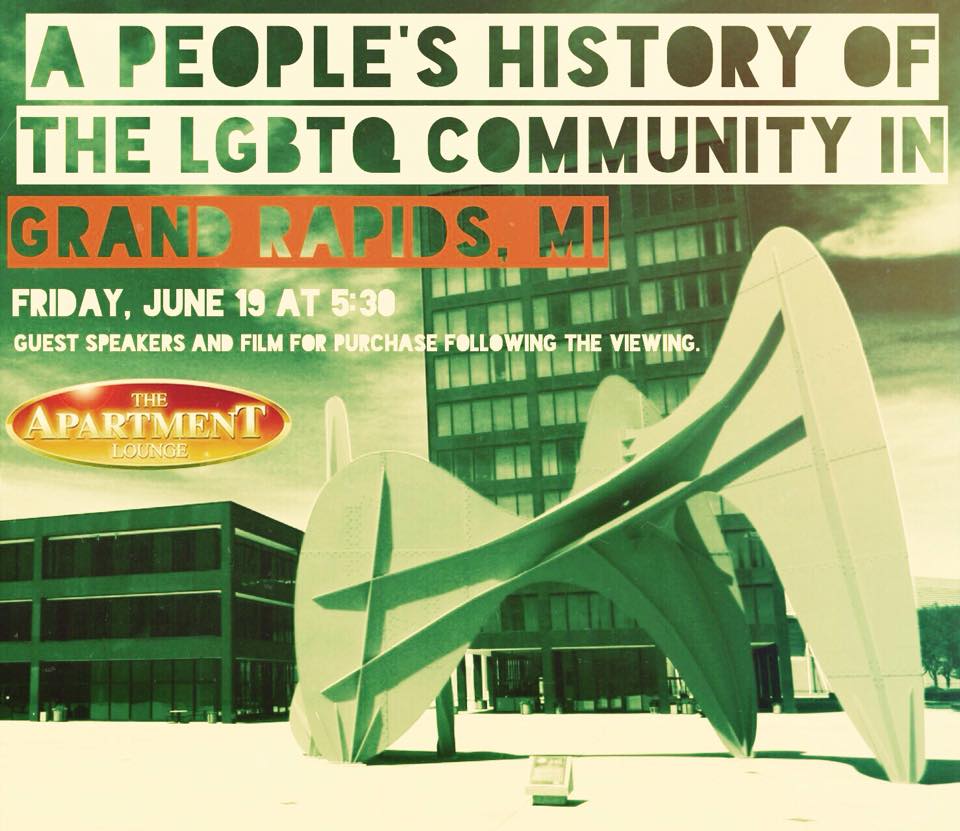
If you haven’t had the opportunity to see A People’s History of the LGBTQ Community in Grand Rapids, you can come to the Apartment Lounge on Friday, June 19 at 5:30pm, as part of the 2015 Pride Weekend.

The film, which was produced by the Grand Rapids Institute for Information Democracy in conjunction with the Milton E. Ford LGBT Resource Center at Grand Valley State University, was produced in 2011.

There is a Facebook event page for this public screening on June 19 and there is an archival site, which includes photos, documents, video clips and the entire film online.

You will also be able to purchase copies of the film, with proceeds going to Grand Rapids Pride and the GVSU Milton E. Ford LGBT Resource Center.

Posted in LGBTQ Movement | Tagged , , | Leave a comment

Interview with Margi Derks Peterson: From Model to Anti-Nuclear Activist

GRPHP – When did you first get involved in the Nuclear Freeze Campaign? and what motivated you to get involved?Screen Shot 2015-05-12 at 12.38.51 PM
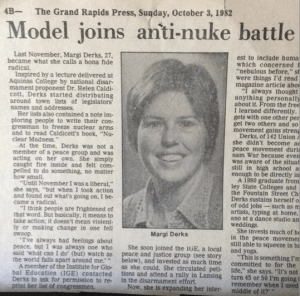
Margi – Let’s see, Chuck and I got married in 1984, and I met my Best Woman, Kathy Connolly through IGE and the campaign, I believe, so I must have started doing that in 1981. It felt like an important thing to do, to do whatever I, personally, could to begin to rid the world of weapons that could cause the total destruction of the world many times over, and to let leaders know that we the people didn’t want to solve our problems that way.

GRPHP – What kinds of activities were you involved in and what kind of training was there to assist to in the work that you were doing?

Margi – My recollection is that IGE and a group of students, mostly from Grand Valley, was at the heart of this and divestment in South Africa, and raising awareness of things that were going on in El Salvador and Nicaragua, as well.

I remember a few protests, one in Lansing that I may have a photo of, but no formal training. I worked on Equity, the IGE newsletter, with Chuck VanderWoude and others. IGE was the main guiding body, in the beginning. Then some local doctors decided to organize a local chapter of Physicians for Social Responsibility (PSR), and they hired me (a paid gig!) to be in charge of Ground Zero Week. This was kind of a coup for me, as I had no formal community organizing experience, and many around me did. I don’t quite remember how I ended up with the job, but I do remember Chet Maternowski being one of the physicians who started PSR, and I remember having an office in the old Medical Arts Building.screen-shot-2014-11-07-at-1-06-18-pm

GRPHP – Was there a central organization working on this campaign or was it a network of groups? If it was the latter, can you name the groups involved?

Margi – The larger PSR organization had designated dates and various types of activities for raising awareness of the realities of nuclear arms build-up. I gathered statistics about our community, learned to write press releases and organize press conferences, and how to draw people’s attention to activities designed to disseminate information. I think there was a big culminating event, but I’m afraid the various demonstrations and rallies of the time get a little mixed in my head. 

Besides IGE and PSR, there were a number of church organizations involved. It was through these activities that I first met Doug VanDoren, then and still Pastor of Plymouth UCC. From what I could tell, as someone who had not been extremely socially involved prior to this point, this was the first grass roots organizing across the country, and it involves a lot of small groups.

GRPHP – What sorts of tactics were you using to inform/engage people about the nuclear freeze campaign?

Margi – I was able to use a lot of what I knew from years of theatre involvement, especially make-up. When a group of us went to a rally in Lansing, we were appropriately decorated with face make-up. And I remember one activity in particular (although it was an El Salvador protest, not nuclear) where I learned how to make someone look as though his throat had been slit.

GRPHP – Did you build any lasting friendships based on your organizing work?

Margi – One person I met back then, who was very active in all of this and with whom I am still close, is Sue Hartman. Our paths have continued similarly, so we still see each other and do things together.
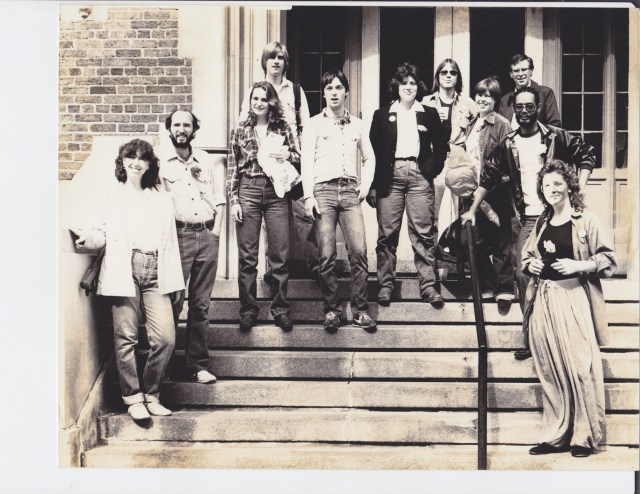
nuclear-freeze-campaign-group

GRPHP – How did your involvement in the nuclear freeze movement impact your life after that campaign was over?

Margi – I realized, after many months of working hard on these activities, that the most important thing I could do to change the world was to change myself, and not be afraid to speak out about injustice. The experience of being part of a grass-roots movement gave me hope that “little people” without a lot of money could really accomplish something. That’s why I was excited when MoveOn got organized and jumped on board.

But the spinoff organizations and inundation of emails asking for money soon (after a couple of years) caused me to lose interest. I have always said, I would far rather be given something to DO than give money or sit through a meeting talking about it.

GRPHP – Why is it important for people to know about this local history?

Margi – Looking back 30 years, I can see this activism in Grand Rapids as the seed of many positive changes that have happened since.
Posted in Anti-Nuclear Movement | Tagged , , , , | Leave a comment

Part II of Interview with Mark Kane on the West Michigan Nuclear Freeze Campaign in the early 1980s

1982-march

This is the second part of a two part interview with former Director of the Institute for Global Education Mark Kane. Part I 

In this second part of our interview with Mark Kane, Mark addresses in more detail the kinds of organizing that was taking place in Grand Rapids around the nuclear freeze campaign and who was involved.

Screen Shot 2015-04-27 at 4.03.27 AM

Mark stresses that there was an intersectional approach to how organizing was taking place in Grand Rapids and how the Nuclear Freeze Movement was making connections to economic issues, hunger and US military intervention around the world.

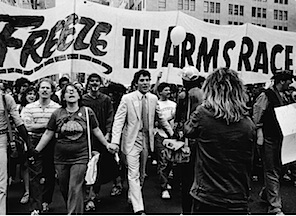
Mark and several other people went to New York for the Freeze rally at the United Nation in 1982. To the right is a picture of Mark at that rally in 1982, a rally that saw 1 million people march for disarmament.

One other issue that Mark addresses in this interview is what the freeze movement gave birth in the 1980s, in terms of other social movements. He also addresses why it is important that we know and learn from this history.

Posted in Anti-Nuclear Movement | Tagged , | 1 Comment

Part I of Interview with Mark Kane on the West Michigan Nuclear Freeze Campaign in the early 1980s

This is Part I of a two part interview with former director of the Institute for Global Education Mark Kane.fallout shelter

In the United States, awareness about nuclear weapons was relatively marginal, until people like Dr. Helen Caldicott and Jonathan Schell began writing, speaking and producing films about the dangers involved in nuclear proliferation.

In many ways the nuclear disarmament/nuclear freeze movements were an outgrowth of the anti-Vietnam War movement. The resistance to the US war in Vietnam involved community-based investigation into weapons production and the growing US nuclear arsenal.

People began to question the very existence of nuclear weapons and the fallacies that came with so-called nuclear fallout shelters. Nuclear Weapons proliferation was spreading across the globe and more and more people were being concerned about the arms race between the US and the Soviet Union.Freeze petition

Various forms of organizing and actions took place around challenging nuclear weapons in West Michigan, as we have noted in a previous posting, The Nuclear Freeze Movement inspired many in Grand Rapids

In Part I of our interview with Mark Kane, he discusses the evolution of the nuclear disarmament/nuclear freeze movement in the US and West Michigan, along with some tactics and strategies used with the freeze campaign. A big part of the freeze campaign, which is also explained in this 1982 IGE article, was putting a freeze on nuclear weapons on the ballot. You can see from the graphic here, an example of what the petition looked like that people were circulating in West Michigan.

Mark also talks a bit about the Grand Rapids contingent that participated in the massive anti-nuclear rally in New York in 1982, where roughly 1 million people from all over the world converged on New York City to so no to nuclear weapons.

Part II of this interview will discuss more details of the anti-nuclear organizing in West Michigan, lessons learned from that campaign and why it is important for people to know this history.

Posted in Anti-Nuclear Movement | Tagged , , | 1 Comment

The Kent County Commission was complicit in South African Apartheid

Last week we posted a piece on the campaign to get the Grand Rapids Public School Board to take a stand against South African Apartheid in 1985.  The School Board, in this instance, voted 7 – 2 in favor of divesting from corporations or financial institutions that were profiting off of the Apartheid system in South Africa.Screen Shot 2015-04-21 at 12.38.43 PM

We have also documented in a previous posting that the City of Grand Rapids passed a resolution in 1982 in favor of divesting from South Africa  and within a few years took action to formally divest.

The Grand Rapids Anti-Apartheid Movement was also attempting to getting the Kent County Commission to take a similar stance, by adopting a resolution and divesting from all corporations and financial institutions economically benefiting from South African Apartheid.

Doug Van Doren, who was a member of the South Africa Working Group of IGE, had sent two letters in July and August of 1985 The letters were a follow up to when members of the South Africa Working Group spoke before the County Commissioners asking them to follow the City Commission and take a stand against the racist Apartheid regime in South Africa.

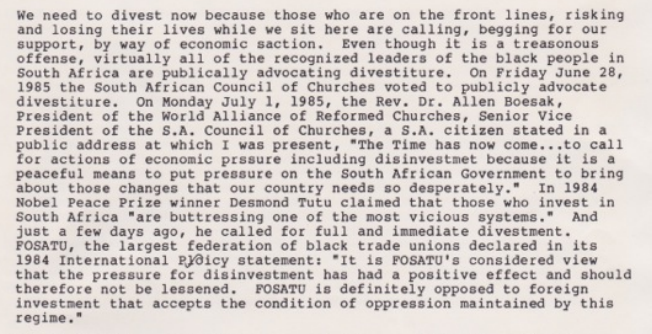
Van Doren provides in his letters insight into how the Grand Rapids Anti-Apartheid Movement was organizing at the time and what arguments and talking points they were using. One of those arguments was to simply list which organizations in South Africa were endorsing the divestiture campaign. Here is a paragraph, which speaks to this point from Van Doren’s August 27, 1985 letter:

Screen Shot 2015-04-21 at 12.06.31 PM

In the letter that Van Doren had sent in August, he also points out the significance of people in Grand Rapids taking action on South Africa:

You need to be aware that action taken in the West Michigan area has an impact out of proportion to our size. This is due to the strong religious and ethnic ties people of this area have to the present South African government. The only city of a smaller size and the only mid-west city visited when the Eloff Commission from South Africa came to the US, to see if they could get away with action against Bishop Tutu, was Grand Rapids. Smash Apartheid button badge c. 1970

Grand Rapids was definitely on the radar for the South African government, mostly because of the strong Dutch and Christian Reformed Church presence in West Michigan. Van Doren was correct in making that point as he urged the county commission to divest. Van Doren further cements the importance of the Kent County Commissioners in taking a stance by stating:

To withdraw support from a racist, violent and repressive regime is the right and moral thing to do. I am certain that you and the citizens of Kent County do not one penny of our money to support, directly or indirectly, physically or psychologically, a regime that discriminately governs the life of its citizens solely by the color of their skin. In addition, divestiture makes a statement that the Kent County Board of Commissioners is against racist behavior wherever it may be found.

The County Commission did not support divestment in South Africa, therefore demonstrating their complicity in the racist Apartheid government in South Africa.

Posted in Anti-Apartheid Movement | Tagged , , | 2 Comments