Members of the American Indian Movement spoke at GVSU in 1973

07 Mar 1973, Wounded Knee, South Dakota, USA --- Two leaders of the American Indian Movement Russell Means and Dennis Banks appear grim after meeting  with all the Indians at Wounded Knee, South Dakota, on the Pine Ridge Reservation.  Government officials proposed that the Indians leave Wounded Knee peaceably and have given the Indians until 6pm March 8th, to do so. --- Image by © Bettmann/Corbis

07 Mar 1973, Wounded Knee, South Dakota, USA — Two leaders of the American Indian Movement Russell Means and Dennis Banks appear grim after meeting with all the Indians at Wounded Knee, South Dakota, on the Pine Ridge Reservation. Government officials proposed that the Indians leave Wounded Knee peaceably and have given the Indians until 6pm March 8th, to do so. — Image by © Bettmann/Corbis

In February of 1973, members of the American Indian Movement (AIM) began a 71-day campaign to defend the sovereign rights of Native Americans in the territories occupied by the State of South Dakota, specifically at the Pine Ridge Reservation.

AIM warriors were fighting against the corruption of the Bureau of Indian Affairs (BIA) leadership and its group of armed thugs known as the Guardians of the Ogala Nation and agents with the FBI.

The campaign at Wounded Knee garnered a great deal of national and even international media attention, since it was one of the most visible platforms for Native people to challenge the settler colonial practices of the US government.

Because of the effectiveness of AIM, the US government, through its FBI Counter Intelligence program, known as CIONTELPRO, targeted AIM members, as has been well documented in the book The COINTELPRO Papers, complete with declassified US government documents on the anti-AIM campaign. 

One of the leaders of the American Indian Movement who was involved with the defense of Native land at Wounded Knee in 1973 was Dennis Banks. Banks, along with a lawyer representing AIM, came to Grand Valley State Colleges in October of 1973 as part of a speaking tour to raise awareness about the resistance that AIM and other Native people were engaged in across the country.

On November 1, 1973, the student newspaper at GVSC, The Lanthorn, ran a front page story about the visit from AIM leader Dennis Banks. The article is short and does not provide any unique insight into the work of AIM, but it does reflect the fact that people in West Michigan were thinking about the courageous actions of the American Indian Movement. 

Screen Shot 2015-12-14 at 12.52.31 AM

AIM did not make many public appearance in Grand Rapids during the height of their organizing efforts in the 1970s, although according to Dee Ann Sherwood, AIM members would stop off in Grand Rapids on their way to and from other cities. Members of the Native community would host AIM members as they traveled across the country to speak, to raise money and to engage in direct action.

In 2009, this writer had an opportunity to interview AIM co-founder Dennis Banks, when he was back at GVSU. 

Posted in Indigenous Resistance | Tagged , , | Leave a comment

Before the GVSU incursion into the Belknap neighborhood, Butterworth/Spectrum Hospital engaged in a hostile takeover in the 1990s

displacement

It has been known for a couple of years now that Grand Valley State University (GVSU) has been making plans to expand into the Belknap neighborhood, specifically north of the 196 freeway.

The GVSU expansion has been met with mixed emotions, with some neighbors supporting, while others have opposed such a drastic transformation of their neighborhood, a transformation that will result in numerous houses being torn down.

The demolition of homes, homes that have been occupied by individuals and families, is a process that has been playing out in numerous neighborhoods all across the city of Grand Rapids. Some refer to this process as gentrification, which often results in the displacement of marginalized communities, particularly poor working class communities and communities of color.

Screen Shot 2015-12-09 at 2.18.42 AM

However, this process does not happen all at once. In many cases there are stages of gentrification, where development companies, large institutions and businesses position themselves to expand into neighborhoods. Most of these neighborhoods have suffered from White Flight, job loss and other forms of structural violence, that is until private capital decides to move in.

The current battle in the Belknap neighborhood is very connected to a previous battle that took place just south of the 196 freeway, when Butterworth Hospital was in the process of becoming Spectrum Health.

In a Nov/Dec 1997 issue of the FUNdamentalist newspaper, there appeared an article about the takeover of the Belknap neighborhood association by operatives of Butterworth hospital. The article begins with a quote by former board member of the Neighbors of Belknap Lookout, Deborah Kales. Screen Shot 2015-12-09 at 2.04.06 AM

We believe that Dorothy Munson through Butterworth Community Interaction has come into the neighborhood and through manipulation and deceit has taken over the Neighborhood Association. Up to this time the only way the neighbors had to be empowered to deal with the city and other big corporations expressing an interest in the neighborhood, was through the Neighborhood Association. Now that the NOBL Board has been taken over by a pro-Butterworth sentiment, where is the residents’ vehicle for voicing their opinion?” – NOBL (Neighbors of Belknap Lookout) board member Deborah Kales, in a letter to Nick Garza of the Grand Rapids Neighborhood Services Dept.

The article written in 1997 sought to speak with all parties involved in the Butterworth/Spectrum expansion and what kind of impact it would have on the neighborhood. 

Long-time community organizer, Frank Lynn, was the executive director in the mid-1190s, until resigning in the Spring of 1997, due to the hostile takeover of the neighborhood by Butterworth/Spectrum. Frank stated recently that what is happening with the GVSU expansion into the Belknap area has its roots in the Butterworth/Spectrum expansion that began nearly 20 years ago today.

We encourage people to read the entire article from 1997 and see how what was happening then in the Belknap neighborhood is happening again. We believe it is important to identify the way private power functions, whether it is Butterworth Hospital or GVSU and how that power impacts individuals, families and neighborhoods. 

Screen Shot 2015-12-09 at 2.11.35 AM

Posted in Indy Media, Neighborhood organizing | Tagged , , , , | 6 Comments

Grand Rapids Participates in National Day of Protest Against Police Brutality – 1996

This article is from a November/December, 1996, issue of the Independent Grand Rapids newspaper, The FUNdamentalist.

With banners that read, “Chief Hegarty, when will the brutality end?” and “fists and guns don’t protect and serve,” over 200 people marched on October 22nd in conjunction with the National Day of Protest Against Police Brutality.10690337_10203914385394584_2785020177277653323_n
The damp weather did not deter the mostly young crowd of people who came to express their rage against an issue that has plagued this community for years, but has recently brought together citizens to fight against this injustice. March organizer Leslie Grossman said, “we hope people will see us and realize that things are out of hand and wake up to see what is going on.”

The march organizers were Leslie, Cole Dorsey and other young people in the area associated with the Anarchist Black Cross movement. The local group formed around the issues of political prisoners, especially Mumia Abu-Jamal, and police brutality in Grand Rapids. Usually referred to as “punkers” by people who don’t know them personally, these young folks organized this event in Grand Rapids not just because of political convictions, but also because they know what it is like to be victims of police abuse.

In September of this year many of them were hanging out on the Monroe Mall, a usual place to meet friends and have fun. Nearly one hundred of them had gathered when suddenly two cop cars appeared. One of them, Phil Holman, was approached about being an under-age smoker. He was asked to accompany the police to their car. He co-operated, but while walking in the direction of one of the police cars and officer grabbed him from behind and forcefully brought him to the car. This got the attention of the other people who were hanging out that day, causing many of them to walk towards the cop cars to have a closed look at what was going on.

Believing that the cops were using unnecessary force against Phil, some of them began to ask the names and badge numbers of the officers. A young man named Crabs was arrested for doing this too close to a cop car. Cole Dorsey said he was thrown into one of the cop cars for telling others to get badge numbers. Kevin was also arrested and suffered the worst abuse. He was thrown up against a cop car so hard it caused him to bleed from the head. In all, six people were arrested and taken downtown.

Screen Shot 2015-12-03 at 9.51.34 AM

While being processed Cole was asked by one of the cops if he was “for Paul Mayhue?” Cole said that he was in support of the petition drive efforts that Mayhue and others were involved in to create a civilian police review board. Cole said that the officer then stated, “He (Mayhue) is just like the rest. As soon as they get a Civilian Review Board it will be as corrupt as all the other cities.” This seemed a bit bit telling about the police department’s contempt for citizen involvement in city affairs. Kevin, who had been bleeding, had his picture taken like the rest. After cleaning up his face the police told him that they needed to take another picture since the first one “didn’t turn out well.” Coincidence?

Another young woman who was at the arrest scene said that the police had a copy of a flyer that the group had been circulating for some time. The officer crumbled it up and threw it on the ground in disgust. Someone pointed out that this was littering and another officer cited him for the violation. It was discovered later that the officer received 3 weeks suspension for this infraction. None of the officers were suspended for excessive force.

I asked Cole if he felt they were using under-age smoking as a pretext to harass them because of their public stand against police abuse. Cole was convinced that this was the case and felt that regardless of whether the officers agreed with them or not, it was a violation of their free speech rights.

The anti-police brutality march wove through the downtown area with most of the participants walking in the streets. This certainly got the attention of motorists and other on-lookers. With high energy the march finally made its way to the Hall of (In)Justice for a short rally.

At the rally many people spoke up and expressed different aspects of the struggle against police brutality. Paul Mayhue and other members of the West Michigan March delegation praised the young crowd for their courage and commitment to work for justice. Paul also encouraged all to contact City Hall and demand that the Civilian Review Board be implemented at once. Other people made reference to the recent police harassment of Heartside residents since the opening of the Van Andel arena. One woman who carried a large picture of Judge Carol Irons, said that the judge was murdered by her husband who was a police officer. he ended up receiving a sentence that was less than a previous charge for his unprofessional behavior as a cop. This underscored the almost untouchable status of police officers.

March organizer Leslie Grossman said, “this was just the beginning. We are going to work to end police violence in this city.” As long as people can maintain the enthusiasm and work to deal with the ongoing abuse as was communicated by numerous march participants, this citizen movement could continue to grow and challenge the present government policies that do not protect the public against police violence.
Posted in Indy Media | Tagged , , , | 2 Comments

Racism and Anti-Immigration has a long history in Grand Rapids

The recent decision by Governor Snyder to not accept refugees from Syria has had mixed reaction across the state. There have also been many editorials and Facebook comments and postings that have sought to put in context the history of other immigrants and refugees that the US government has restricted or denied entry.

In looking at archives on this topic from news media in Grand Rapids, we came across the announcement from the Grand Rapids Evening Leader, dated December 24, 1885 posted here.

Screen Shot 2015-12-02 at 3.44.22 PM

The US government passed the Chinese Exclusion Act in 1882, which denied entry to any new immigrants coming from China. The Chinese Exclusion Act originally was only meant to exclude new Chinese immigrants for 10 years, but the act was renewed in 1892 and then again in 1902, with the 1902 version making the law indefinite. 

There were several hundred thousand Chinese living in the US when the Chinese 1Exclusion Act was passed in 1882, although anti-Chinese sentiment had been building for decades. Thousands of Chinese immigrants had come to California initially during the Gold Rush, with more coming in the 1870s during the peak of railroad construction. Once the TransContinental Railroad was complete, many Chinese starting acquiring land in California for agricultural purposes.

For at least a decade prior to the Chinese Exclusion Act, anti-Chinese sentiments were growing in multiple sectors of society, specifically in news media and labor. In Juan Gonzalez and Joseph Torres book, News For All The People: The Epic Story of Race and the American Media, they demonstrate how newspapers all across the US engaged in fostering anti-Chinese sentiment. One example in an editorial from a San Francisco daily paper says this about the Chinese:

They are idolatrous in their religion, in their disposition cunning and deceitful, and in their habits libidinous and offensive. They do not mix with our people and it is desirable that they should.”

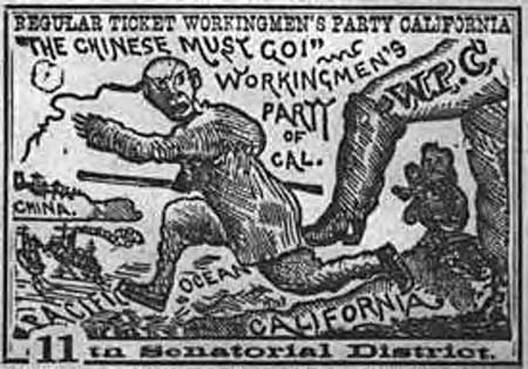
Political cartoons from that period in history also played a significant role in fostering anti-Chinese sentiment. This cartoon from the Working Men’s Party in California uses the same language as the Grand Rapids Evening Leader, “The Chinese Must Go.”

5755390

However, organized labor in the US didn’t just used racist cartoons, they engaged in vigilante actions against the Chinese, both before and after the 1882 Chinese Exclusion Act.

This gets to the main point of the Grand Rapids Evening Leader announcement from 1885, since it was about members of the Cigarmakers Union going to California to “help drive the Chinese out.”

We don’t know if those nine union members from Grand Rapids engaged in acts of violence against the Chinese community in California, but we do have lots of documented examples from the same time. Just one month prior to the Grand Rapids Evening Leader announcement, in the state of Washington where White vigilantes attacked the Chinese community, killing several and rounding up an estimate 600 that they transported to another part of he state. These kind of actions taken against the Chinese community were widespread and was even referred to as the “Driving Out” movement.

This movement, particularly on the west coast, was large enough that it even recruited workers from California to travel across the country and “join the army that is going to California to help drive out the Chinese.”

As ugly as this racist history is, it is vital that those of us who identify as White know this history and own it, if we are to take a stand against any contemporary forms of racism directed at immigrant communities.

Posted in Anti-Capitalism/Labor | Tagged , , | Leave a comment

Early HIV/AIDS organizing in Grand Rapids

In honor of World AIDS Day, we are posting a section from the film, A People’s History of the LGBTQ Community in Grand Rapidssilence

This section of the film provides some history on the early organizing around HIV/AIDS. Most of the organizing was done by those in the LGBTQ community, since members of that community were disproportionately impacted by AIDS.

The video is 13 minutes in length and includes comments from Larry Abbott, one of the founding members of the local AIDS Task Force. Larry talks about how this was truly a grassroots effort, but he also talks about the social stigma that was place on those who were HIV positive.

The video also includes commentary from Rev. Bruce Roller who talked about doing pastoral care work with those who were dying of AIDS in the 1980s and Jan Koopman who was the Director of the AIDS Resource Center when it first got off the ground.

We often forget how devastating the impact of AIDS was in the US in the 1980s and how politically charged it was. This section of the film was done to honor the amazing work done by people in Grand Rapids around AIDS, as well as all the beautiful people we lost to the disease.


Posted in LGBTQ Movement | Tagged , , | Leave a comment

Working Class Families were simply forced to move: Consequences of highway Construction in Grand Rapids from the late 1950s through early 1960s

Like many things we assume are the norm, highways are a relatively new phenomenon in human history. Highway construction through Grand Rapids was first proposed after WWII as part of the Eisenhower administration’s interstate highway construction program, know as the National System of Interstate and Defense Highways.

Screen Shot 2015-11-24 at 8.28.14 AM

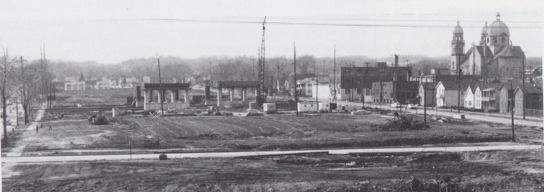
US 131 construction began first, which meant that an estimated 1,000 homes on the west side of Grand Rapids would be demolished to make room for the new highway. Most of the families displaced were working class families of varying Euro-American heritage – Polish, German, Lithuanian and Italian. You can see from the picture here the early stages of construction, where houses once stood. St. Adalbert’s Catholic Church is pictured in the far right corner of the picture. (photo is from the Grand Rapids Public Library, William Drueke Collection)

State Highway Commission at the time, John Mackie said, “The new system will enable Grand Rapids to realize its full economic and industrial potential.” Mackie’s comment is instructive, since it makes clear that the intention of the highway through Grand Rapids was not about realizing human potential, but that of industry and capital. As with all modern capitalist projects, there are some who benefit tremendously, while others are left out or even punished in the process.

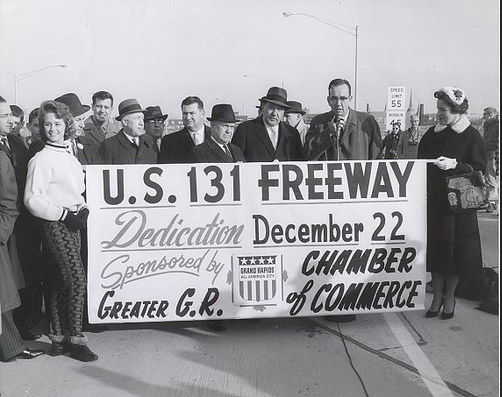
The “who benefits” notion is demonstrated in the photo here, with State Highway Commissioner Mackie, pictured with members of the Grand Rapids Chamber of Commerce and Miss Michigan (on the far left), for the ribbon cutting ceremony for the completion of US 131 through Grand Rapids on December 22, 1961. The Capitalists were present, but not working class families.

Screen Shot 2015-11-23 at 4.19.37 PM

Posted in Anti-Capitalism/Labor | Tagged , , , | Leave a comment

1990 Flyer makes the link between US militarism and Housing Justice in the US

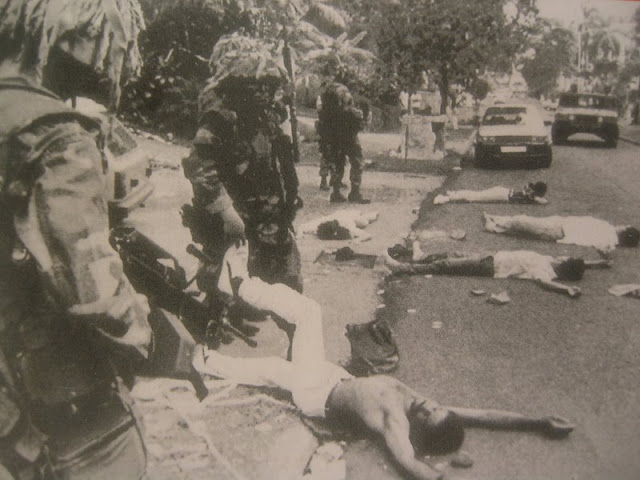
Over the past week we have posted some archival flyers that were used by Central American Solidarity activists in Grand Rapids, during the late 1980s and early 1990s. One flyer dealt with the connection between the Columbia legacy and the ongoing Guatemalan genocide, while the other flyer dealt with the 1989 US invasion of Panama6a2257f9d18050fbd055f01193fea388

We have come across a third flyer from that same time period, a flyer which links US militarism in Central America with the housing crisis in the United States.

When this flyer was created (1990) the United States was still deeply involved in supporting counter-insurgency wars in El Salvador and Guatemala, isolating the government of Nicaragua and militarily occupying Panama after the December 1989 invasion.

The 1990 flyer is really divided into three sections. First, it provides a summary of US policy towards Central America at the top, with data on how many refugees there were as a result of the US wars in central America (on the left of the flyer), and a section that linked homelessness and military spending in El Salvador and the US.

homes-not-bombsThe flyer is important for several reasons. The obvious reason the flyer was important is that it provided some solid data on what the US wars in Central America looked like. More importantly, the flyer provides important intersectional analysis, since it not only links the Central American refugee crisis to militarism, it makes the link between US militarism and immigration, and it shows how US funding priorities directed toward militarism were causing a housing crisis in El Salvador and in the US.

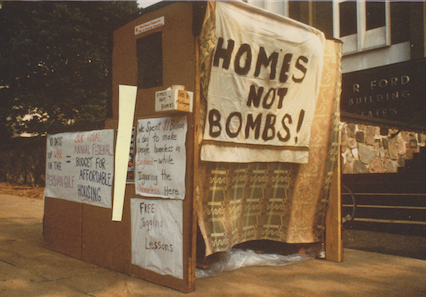
We have highlighted this intersectional work in Grand Rapids in a previous posting where the Homes Not Bombs Campaign had camped out in front of the federal building to draw attention to the link between US military spending and the growing housing crisis in the US just before the massive US build up to the Persian Gulf War. 

Screen Shot 2015-10-22 at 12.06.05 PM

Posted in Anti-War/Anti-Imperialism, Central American Solidarity Movement | Tagged , , , , | Leave a comment

1989 Flyer on the US Invasion of Panama that was distributed in Grand Rapids

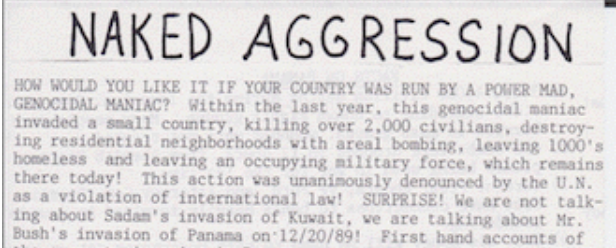
Last week we posted a flyer that was created by the Latin America Working group at the Institute for Global Education on the Guatemalan Genocide and the Columbian Legacy. We discovered another flyer that was developed in response to the US invasion of Panama at the end of 1989. wJEQ2Kg

Just months before Saddam Hussein invaded Kuwait, the US military invaded the tiny Central American nation of Panama. The Bush administration was becoming frustrated with the lack of cooperation from Panamanian leader Manuel Noriega, especially with the US attempt to further marginalize the Sandinista-led Nicaragua government.

To justify the invasion, the US government claimed that Noriega was involved in drug trafficking and needed to be removed from power. The US media  bought this justification and acted as cheerleader for the US military, as is well documented in a report from Fairness and Accuracy in Reporting and the award winning documentary, The Panama Deception.

The flyer created by people involved with the Institute for Global Education cites the hypocrisy of the US and provided some sobering statistics on the human cost of the US invasion of Panama, which is supported by numerous independent investigations, like the one from Human Rights Watch.

This flyer is just one more indication that the Central American Solidarity Movement in Grand Rapids was active for over a decade and not limited to just one or two countries. Click here to read the two-page informational flyer.
Screen Shot 2015-10-19 at 1.12.37 AM


Posted in Central American Solidarity Movement | Tagged , , | 1 Comment

GR Central American Solidarity flyer connects Guatemalan Genocide to Columbus Legacy

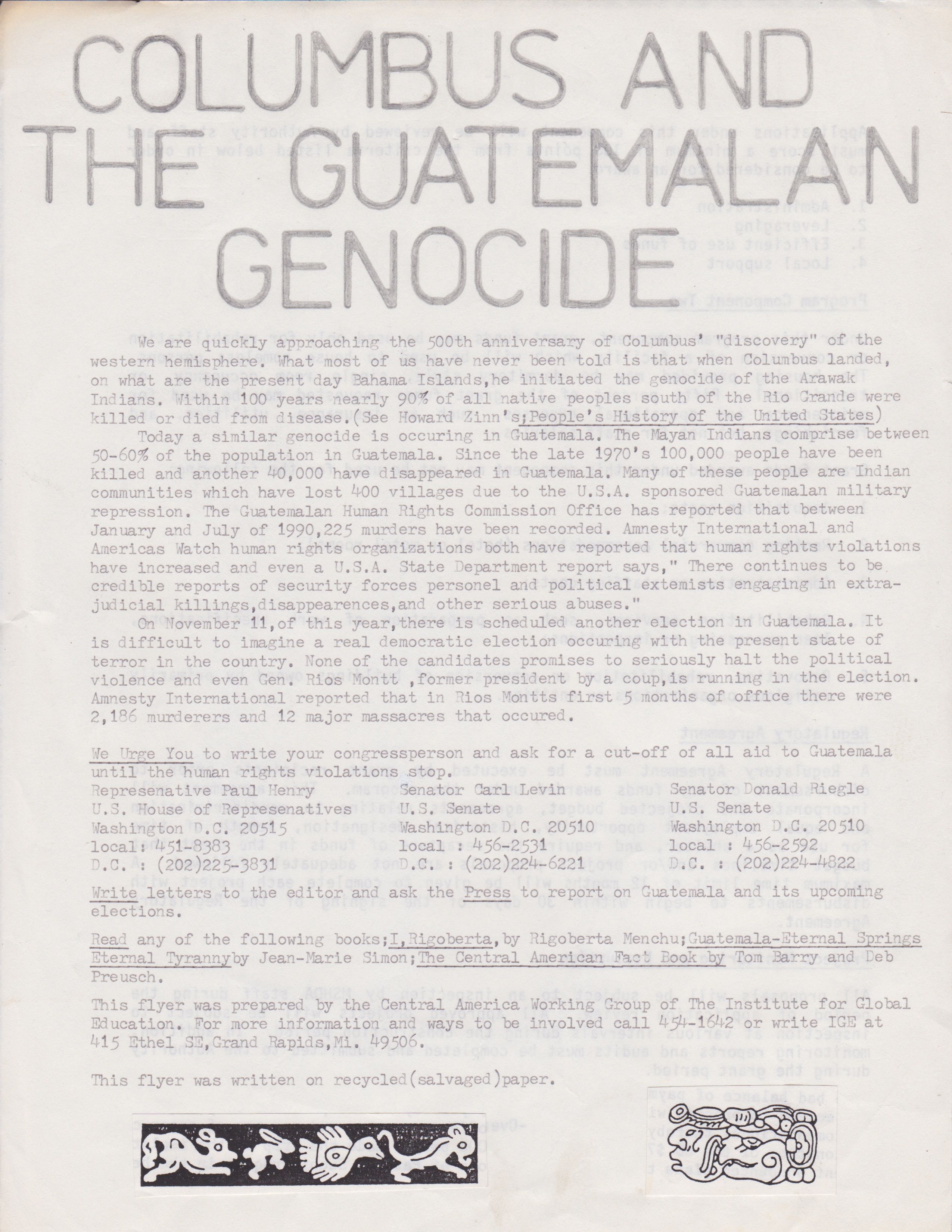
We came across a flyer the other day that was produced in 1990 by the Latin American Working Group from the Institute for Global Education. 500

The flyer talks about the Columbian legacy and the genocidal policies in Guatemala during the 1980s. The flyer urges those who read it to become more informed and provided some resources to build awareness. In addition, there was a plea to contact members of Congress demanding they cut off all military aid to Guatemala, military aid that was essential to the Guatemalan counter-insurgency war that cost the lives of an estimated 200,000 civilians.

This connection between the legacy of the European Conquest initiated by Columbus was the subject of an inter-continental gathering in Guatemala in 1991 in preparation for the 500 Years of Resistance Campaign. http://articles.baltimoresun.com/1991-10-13/news/1991286031_1_christopher-columbus-guatemala-indians The 1991 gathering in Guatemala gain so much attention that the Nobel Peace Committee chose Guatemalan Mayan activist Rigoberta Menchu Tum as the 1992 Peace Prize winner.

Here is a digital copy of the flyer from 1990.

Columbus and the Guatemalan Genocide


Posted in Central American Solidarity Movement, Indigenous Resistance | Tagged , , | 2 Comments