Voltairine De Cleyre: Feminist and Anarchist writer lived in Grand Rapids in the 1880s

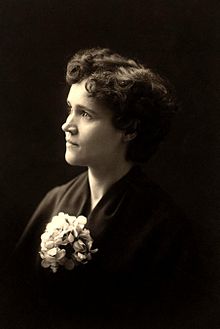
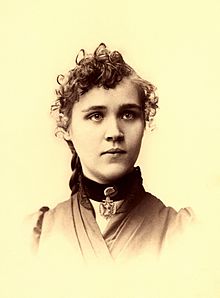
Emma Goldman once referred to Voltairine De Cleyre as, “The most gifted and brilliant anarchist woman America ever produced.”voltairine_de_cleyre_age_35

Voltairine De Cleyre was born in Michigan in 1866 and was named after the French Enlightenment writer Voltaire. She grew up experiencing poverty and then was forced to live in a Catholic convent by her father, who thought it would provide a better education for her. Life at the convent did have a positive effect, but not the one that her father had hoped for. What Voltairine developed was not only a critical understanding of the world, she would also eventually identify as an atheist because of the oppressive nature of the Catholic education.

By the early 1880s she moved to the Grand Rapids area and eventually to Grand Rapids and was active in the anti-clerical, Free Thought Movement. Voltairine soon began writing for various publications and exploring other political disciplines. However, it was the Haymarket uprising in Chicago in 1886 that finally brought her to embrace anarchism. More specifically, it was the hanging of the Haymarket Martyrs in 1887, that solidified her belief and commitment in political anarchism.

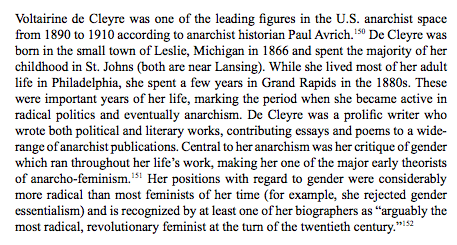
There is an excellent zine produced by Sprout Distro in Grand Rapids on the history of Anarchism in Grand Rapids, with a section on De Cleyre that is worth citing:

screen-shot-2016-09-26-at-12-56-12-am

In addition to De Cleyre’s deep feminist thought, she began devoting a great deal of time to the memory and legacy of the Haymarket Martyrs. In fact, between 1895 and 1910, she began to give speeches throughout the midwest and east coast on the anniversary of Haymarket, on May 1. Paul Avrich, the anarchist historian, eventually put together a collection of these Haymarket speeches by De Cleyre, in a small book entitled, The First Mayday: the Haymarket speeches 1895 – 1910.

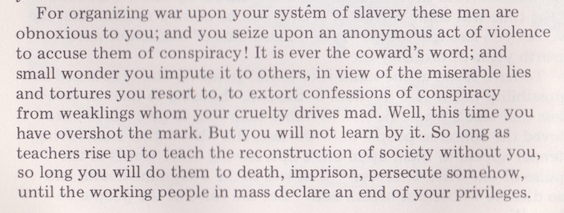
In the speech she delivered in 1906 in Chicago, De Cleyre shared these eloquent words:

screen-shot-2016-09-26-at-1-36-32-am

For the text of that entire 1906 speech, go to this link

However, De Cleyre did not limit herself to writing just about the Haymarket Martyrs. She was a prolific writer of poetry and essays. In her poem entitled, The Burial of My Past, the anarchist wrote:

And now, Humanity, I turn to you;

I consecrate my service to the world!

Perish the old love, welcome the new –

Broad as the space-aisles where the stars are whirled!

Voltairine De Cleyre was an astute observer of the world. She wrote about anarchism and the particularly anarchism in America. She wrote about Direct Action, Crime & Punishment and the Paris Commune. In 1911, the year before she died, she wrote about the Mexican Revolution.

De Cleyre stated, “The Mexican revolution is one of the prominent manifestations of the world-wide economic revolt. It possibly holds as important a place in the present disruption and reconstruction of economic institutions, as the great revolution of France held in the eighteenth century movement.”

De Cleyre was an admirer of the Mexican anarchist, Rigardo Flores Magon and her last poem was dedicated to the Mexican Revolution.

Gods of the World! Their mouths are dumb!

Your guns have spoken and they are dust.voltairinedecleyre

But the shrouded Living, whose hearts were numb,

Have felt the beat of a wakening drum

Within them sounding – Dead Men’s tongue –

Calling: “Smite off the ancient rust!”

Have beheld “Resurrexit,” the word of the Dead,

Written – in – red.

                             from the poem, Written in Red

Voltairine De Cleyre died in 1912, at the young age of 46. However, despite her short life, she not only impacted those who heard her speeches, she continues to inspire generations of people who will consecrate their service to the world!

Posted in Anti-Capitalism/Labor, Feminist Movement | Tagged , , | 3 Comments

Malcolm X Spoke in Grand Rapids in 1962

malcolm-x-civil-rights

On February 12, 1962, Malcolm X spoke at Fountain Street Church in Grand Rapids to an estimated crowd of 350 people. His lecture was part of the Great Speakers Lecture Series that Fountain Street has hosted for decades.

Before we look at the talk that Malcolm X gave at Fountain Street Church in February of 1962, it is important to put into context where Malcolm was in his own journey as a participant in the Black Freedom struggle.

Malcolm X was already beginning his evolution to a broader understanding of religion and politics. His impact on the Nation of Islam meant a significant growth in the number of temples being created across the country and a pronounced increase in membership.

Just days after speaking in Grand Rapids, Malcolm debated Bayard Rustin in Chicago on the topic, “Integration or Separation for the Negro?” So, one can see that Malcolm was still advocating against an integration into White society and pushing for more Black autonomy and independence.

In late 1962, the first rumors of Elijah Muhammad’s adultery began circulating, which was a devastating blow to how Malcolm viewed his leader.

However, he continued to speak at rallies and became more and more involved in demonstrations against police brutality and other forms of state violence. Malcolm also continued to be critical of the mainstream civil rights movement and the 1963 March on Washington.

In November of 1963, President Kennedy was assassinated and Malcolm made his famous statement about “Chickens coming home to roost,” which essentially meant that the violence that the US has perpetrated around the world and at home resulted in violence being done to them. This statement enraged Elijah Muhammad and he prohibited him from speaking in public from engaging in his ministry. Within three weeks of his being silenced by the Nation of Islam, Malcolm formed his own entities, the Organization of Afro-American Unity (OAAU) and Muslim Mosque Inc.

From that point on Malcolm’s evolution accelerated and he spoke at even more rallies and forums across the country and around the world. Malcolm became much more interested in international affairs and particularly in the anti-colonial movements throughout African, Asia and Latin America.

On February 21st, of 1965 Malcolm X was assassinated at an OAAU rally in the Audubon Ballroom in Manhattan, almost 3 years after he spoke in Grand Rapids.

Malcolm’s Fountain Street Church Lecture

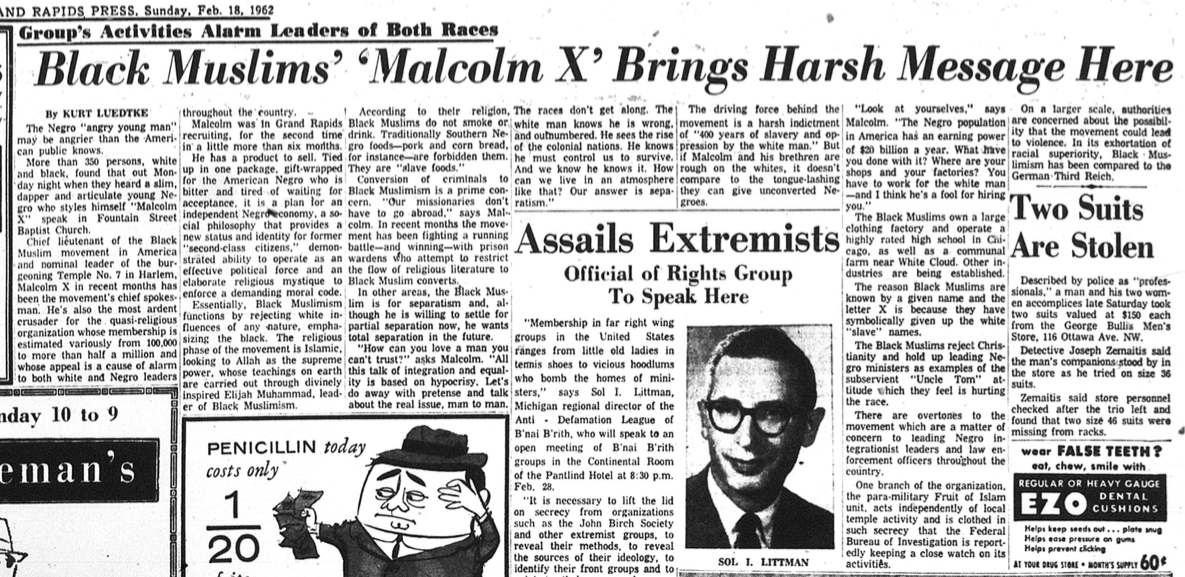
The title of his talk at Fountain Street Church was “Segregation, Separation and Integration.” Fountain Street Church has an audio recording of the lecture, but we have been unable to allow them to let us listen to the lecture or share it with our readers. The  only record we have is from a February 18 article written about the lecture by a reporter named Kurt Luedtke, writing for the Grand Rapids Press.
screen-shot-2016-09-18-at-11-26-01-pm

The article is not very long and the headline reads, “Black Muslims’ ‘Malcolm X’ Brings Harsh Message Here.” Luedtke refers to the Nation of Islam as a “quasi-religious organization” in the early part of the article and continues throughout to engage in hostile language towards Minister Malcolm.

The reporter does note that this was the second time in six months that Malcolm had been in Grand Rapids to recruit in the Black community. The sub-heading of the article says,”Activities Alarm Leaders of Both Races.” However, nowhere in the article are any Black or White leaders cited, so the claim seems to be unfounded or at least unsubstantiated.

At the very end of the article, the reporter states, “In its exhortation of racial superiority, Black Muslimism has been compared to the German Third Reich.” Such a conclusion only further demonstrates the lack of understand of the reporter and it exposes the contempt he had with what Malcolm X had to say and what the Nation of Islam represented at the time.

We plan to continue to look for any evidence of the recruiting visits to Grand Rapids by Malcolm X in 1962 and if we are ever able to gain access to the audio recording of his lecture we intent to post it on this site.

Posted in Civil Rights/Freedom Movement | Tagged , | 1 Comment

Several Arrested in Grand Rapids in 1917 for passing out anti-draft information

Viva

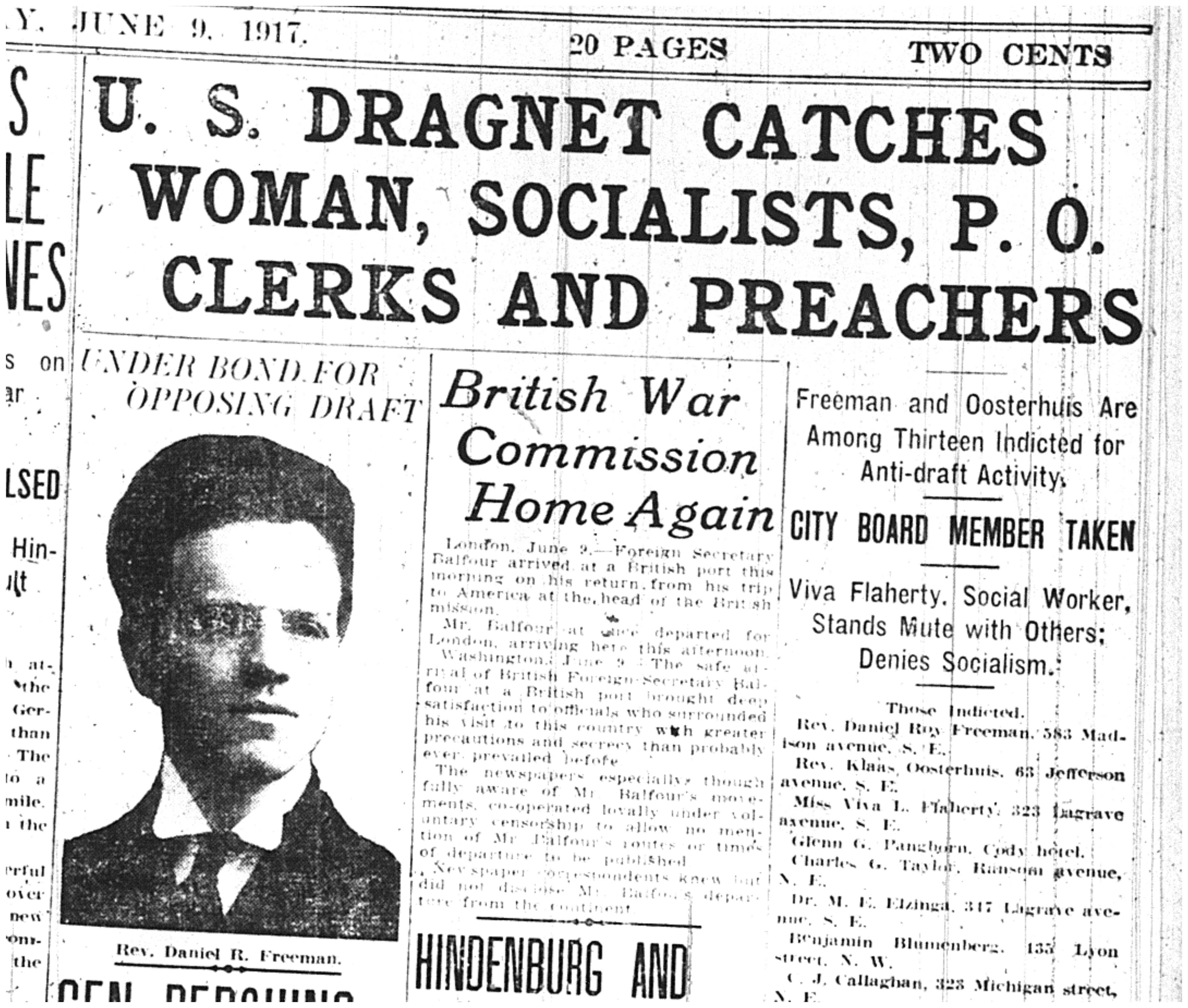
In May of 1917, several members of the Socialist Party, two clergymen and Feminist/Labor supporter Viva Flaherty were arrested in Grand Rapids for distributing anti-conscription pamphlets near downtown Grand Rapids.

This seemingly mild act of informing people about their rights and about the imperialist nature of World War I was seen as a form of treason. There had been numerous laws passed since the beginning of the United States government, such as the Alien and Sedition Acts passed in 1798, which meant to silence and punish those considered to be, those “dangerous to the peace and safety of the United States.”

The Espionage Act was passed in 1917, as a means to silence and punish those who spoke out against the US entry into World War I. However, as radical historian Howard Zinn points out, these laws were not applied equally and were meant to target dissidents during WWI, particularly radical labor organizers, socialists and anarchists. Some of those arrested for opposing the US entry into WWI were arrested and jailed, while others were arrested and deported.

The level of contempt that the US government held against radicals involved in labor organizing and anti-WWI activities eventually led to the Palmer Raids (1919-1920) as a justification for “cleansing” the US of radical leftists, socialists and anarchists.117200166_138016672849

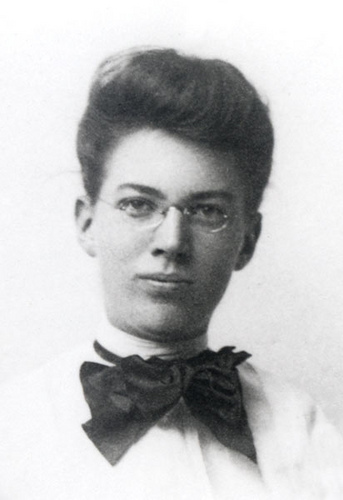
Those arrest in May of 1917 in Grand Rapids fell under the category of dissidents and radicals. There were several who identified as Socialists and then there was Viva Flaherty. Flaherty was the only woman arrested in May of 1917, but she was possibly the most well known of the group, particularly in Grand Rapids.

Viva Flaherty was some who gave us one of the best accounts of the 1911 Grand Rapids Furniture Workers Strike, when she published, History of the Grand Rapids Furniture Strike: With Facts Hitherto Unpublished.   

Flaherty, along with those she was arrested with, were passing out anti-conscription pamphlets on Division Avenue near downtown Grand Rapids and on Bridge Street. They had 15,000 copies printed from the Furniture City Printing Company of Grand Rapids.

The International Socialist Review, published in Chicago, makes mention of the action taken by the state against Viva Flaherty and her fellow dissidents. Published in the July 17 edition of the ISR, this is what they had to say about the anti-conscription action: 

Almost all active members of the Socialist Party have been arrested and indicted by a Federal Grand Jury. Principal charge is that the accused, by the circulation of literature and “thru demonstrations, mass petitions and by other means,” conspired to “prevent, hinder and delay” the execution of the conscription law. There were six counts in the indictment.

National Secretary Adolph Germer, of the Socialist Party, was also indicted by the same jury and charged with conspiracy. On learning the “news,” Comrade Germer went to Grand Rapids, submitted to arrest, plead “not guilty” and was liberated on bonds. If necessary, these cases will be carried to the highest courts.Screen Shot 2016-08-29 at 12.53.44 AM

Grand Rapids has a population around 130,000—mostly wage slaves. Scab labor runs its factories. It is a typical American Billy Sunday burg. Therefore all the fury of the pulpit and the press was directed against the socialists.

Among the indicted comrades are Ben A. Falkner, financial secretary of the Local. For years he has been employed in the city water works department. He has been fired and blacklisted by the political patriots. Comrade G. G. Fleser, corresponding secretary of the Local, who had worked eight years for the Grand Rapids and Indiana Railroad as a stenographer, was discharged by the patriotic rail-plutes. Viva L. Flaherty, social worker and writer; Charles G. Taylor, member of Board of Education; James W. Clement, manufacturer; Charles J. Callaghan, postal clerk (discharged); Dr. Martin E. Elzinga; G. H. Pangborn; Vernon Kilpatrick; Rev. Klaas Osterhuis, and our wellknown, active old-time Comrade, Ben Blumenberg.

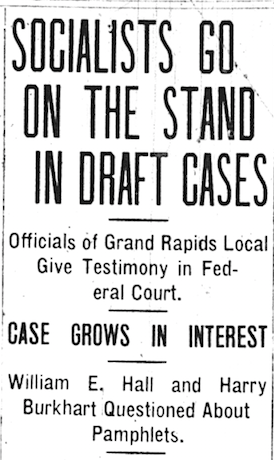
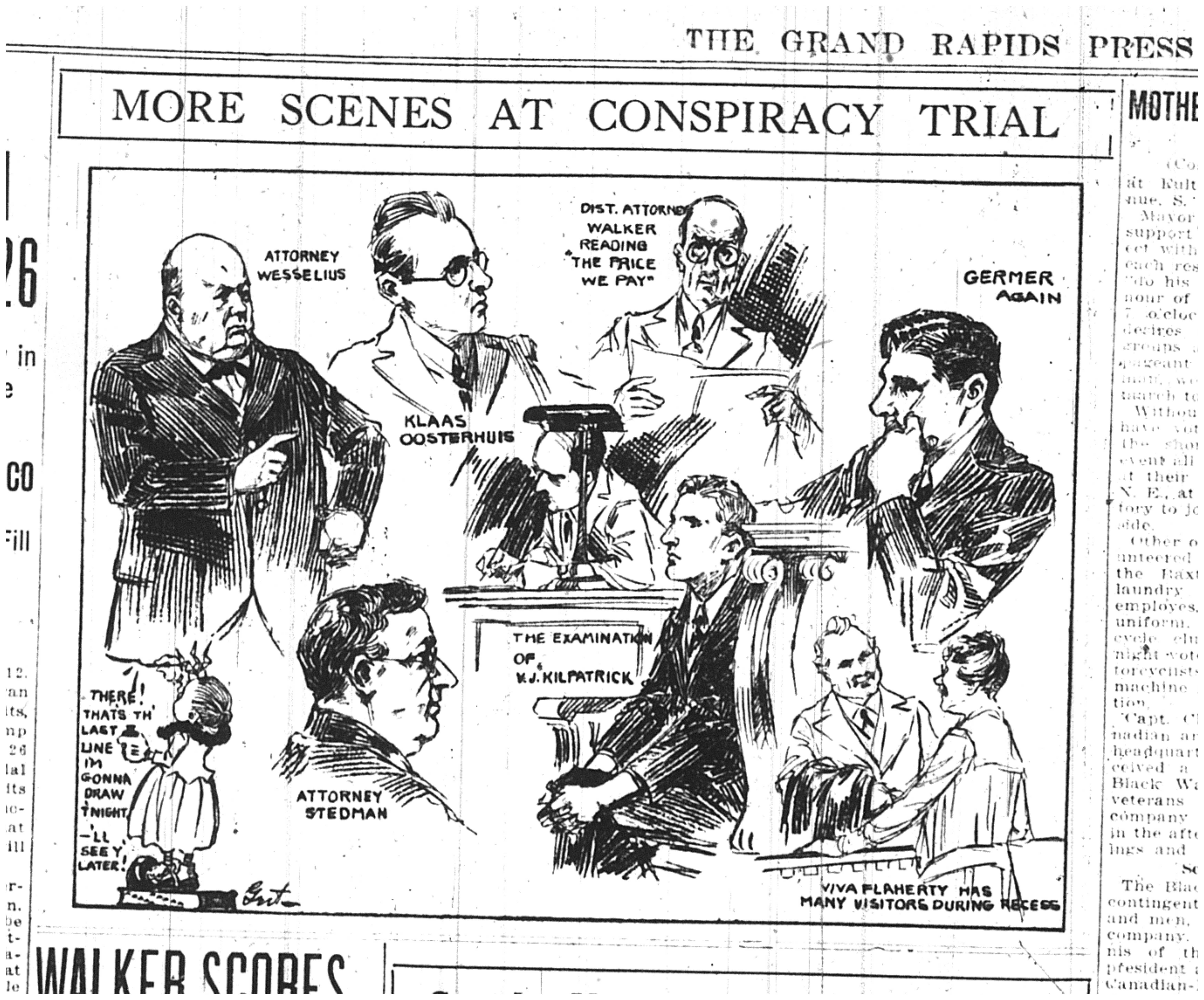
The Grand Rapids Press wrote about the arrests, the selection of the jury and the trial itself. Much of the their reporting reflected a bias in favor of prosecution of those arrested for distributing anti-conscription material. There were a few interesting cartoons that ran during the trial in October of 1917, one with the note below Viva Flaherty’s image which says, “Viva Flaherty has many visitors during recess.”

Viva18

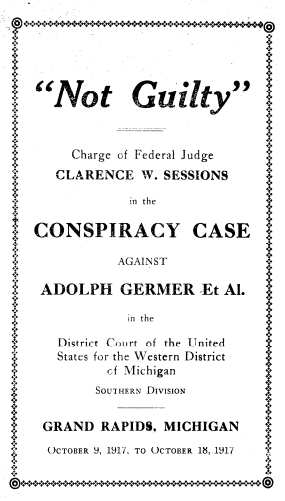
Ultimately, Viva Flaherty and her co-conspirators were not found guilty for the charges Screen Shot 2016-08-29 at 12.06.11 AMbrought against them from May of 1917. The trial ended on October 18, 1917, and it well documented by the National Socialist Party in the publication entitled, “Not Guilty.” 

Viva Flaherty may not be well know, especially for her opposition to the US entry to WWI and the military draft, but future generations should look to her for inspiration as someone who challenged political and economic power structures in Grand Rapids. Flaherty lived to be 84, eventually dying in 1968.

Posted in Anti-War/Anti-Imperialism | Tagged , , , , | 3 Comments

10,000 March in Labor Day Parade in 1911

Screen Shot 2016-08-22 at 12.24.01 AM

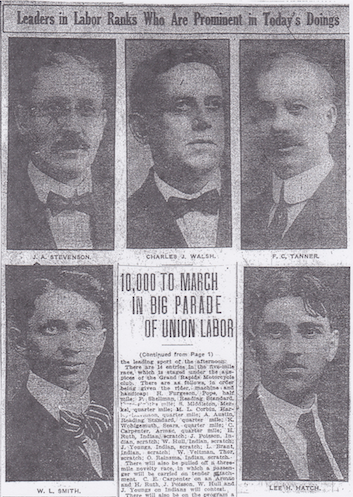
According to the September 4 issue of the Grand Rapids Herald, 10,000 people planned on marching in the 1911 Labor Day Parade.

According to the Herald, fifty-two unions participated in the march, which began at 10:00am on Bridge street, making it’s way on Canal, Monroe, Division, to Wealthy and back down Bridge street.

There were eight divisions participating in the parade, with a band at the front of each division. Unions from all over the state came to the Labor Day Parade in Grand Rapids, including Lansing, Benton Harbor, Ludington and Muskegon.

The activities of the day also included a bicycle race, a motorcycle race, a boxing match and a baseball game.

Coming off of the longest labor strike in Grand Rapids history, a strike that lasted 17 weeks and involved an estimated 7,000 workers, lots of support and solidarity permeated the air on that early September day in 1911.

The furniture workers led the labor day march of course, just after voting to go back to work in August, thus ending the labor strike. The unions had run out of funds to cover the striking workers and out of desperation and the need to take care of thousands of families, the strike came to an end.

However, such a massive outpouring of support just weeks after the strike came to an end, was a further demonstration of the popular support shown by the larger community. Besides the 10,000 marchers, thousands more lined the streets to cheer the workers who had fought for the dignity of a city and its working class community. Even though the workers did not win any of their demands, they demonstrated the potential of working class people to organize the workplace.

Putting the 1911 Labor Day Parade march in perspective, 10,000 marchers may not seem like an impressive number on labor day, but consider the fact that there were only 112,000 people living in Grand Rapids at the time. This means that more than 10 percent of the population had participated in the Labor Day parade. Further evidence that the community was deeply supportive of unions and working class issues. Grand Rapids was indeed a union town.

Posted in Anti-Capitalism/Labor | Tagged , , | 6 Comments

A Working Class and Capitalist perspective: Revisiting the 1911 Grand Rapids Furniture Workers Strike – Part Two

( A special thanks to the Grand Rapids Public Library and its support for accessing the source documents used for this article.)MIGRAstrike_rymill1_480x640

In Part One, we looked at the role of Catholic Bishop Schrembs, whom the furniture workers on strike referred to as, Angel of the Workers.

In Part Two of our revisiting of the 1911 Grand Rapids Furniture Workers strike, we will take a look at two source documents, written just after the end of the 1911 Furniture Workers Strike.

From April of 1911 through August an estimated 7,000 furniture workers went on strike in Grand Rapids, in what was to be the city’s largest labor dispute to this day. After 19 weeks of walking off the job, most workers voted to go back to their factories, despite not winning their demands. Two people, writing from fundamentally different perspectives, documented what took place during the strike and its outcome.

The two people who reflected on the outcome of the 1911 Grand Rapids Furniture Workers Strike, were Viva Flaherty and R. W. Irwin. Irwin, a furniture factory owner, was part of the National Association of Furniture Manufacturers and Flaherty worked at Fountain Street Church. Irwin’s documentation of the 1911 Grand Rapids Furniture workers strike is entitled, Story of the Grand Rapids Strike, while Flaherty names her document as History of the Grand Rapids Furniture Strike: With Facts Hitherto Unpublished Screen Shot 2016-08-15 at 1.19.38 AM

Viva Flaherty documented the 1911 strike because she believed that the “people of Grand Rapids are awakened and enlightened and they can be trusted with the whole truth.” Flaherty went on to say, in her introduction to the History of the Grand Rapids Furniture Strike:

“A strike is a public matter, and if the people are to know how another is to be avoided they should know all the inside facts of this one, so that they may know whom to distrust and on whose shoulders rests blame for a nineteen weeks strike.”

Flaherty makes it clear in her version of the story that the strike was able to endure as long as it did because of the seven unions that were involved, with membership of over 4,000 workers in thirty-five shops in Grand Rapids. She also made it clear in the opening observations of her historical account that the Christian Reformed Church would not grant their members the right to be part of the union, since it was not “founded on divine right.”

On page 8 of the booklet written by Flaherty, she documents the kind of wages earned by those in the furniture industry, stating that of the eight thousand furniture workers employed in Grand Rapids, most made less than $2 a day. Flaherty also mentions that as early as 1909, after furniture workers found out that the price of what they produced had increased by 10%, they demanded that their wages increase. Some of the workers who had made such demands in 1909 were fired shortly thereafter as being agitators.

As we mentioned in Part One, a commission was established to investigate the grievances of the workers, which included a final report. However, according to Flaherty, the Brotherhood of Carpenters and Joiners had designated the commission as, “the hired servant of that powerful union, the Furniture Manufacturers Employers’ Association.”

Such suspicions were affirmed by the furniture industry’s claims that they needed to honor any of the demands from the striking workers around wages, hours, piece work, etc. Flaherty notes that the furniture barons, “repudiated any social responsibility to regulate wages to suit the cost of living.

On page 17, Flaherty affirms the workers admiration of Bishop Schrembs when she writes:

Screen Shot 2016-08-15 at 2.02.26 AM

Such commentary not only reflects that Schrembs was practicing the social gospel, but it also reflects the sophistication of Flaherty and her keen theological observations. What a powerful indictment she makes of the church that endorsed the furniture barons, by stating that they worship the Almighty God of the Pocketbook.

Flaherty then goes on to talk more about the specifics of the strike, beginning on page 18, where she discusses the “riot” on May 15. The “riot” Flaherty was speaking of is when workers and their wives confronted strikebreakers & scabs who were brought in to continue with production after the walkout of 7,000 furniture workers.

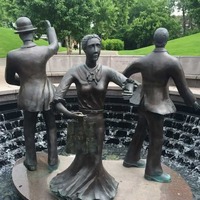
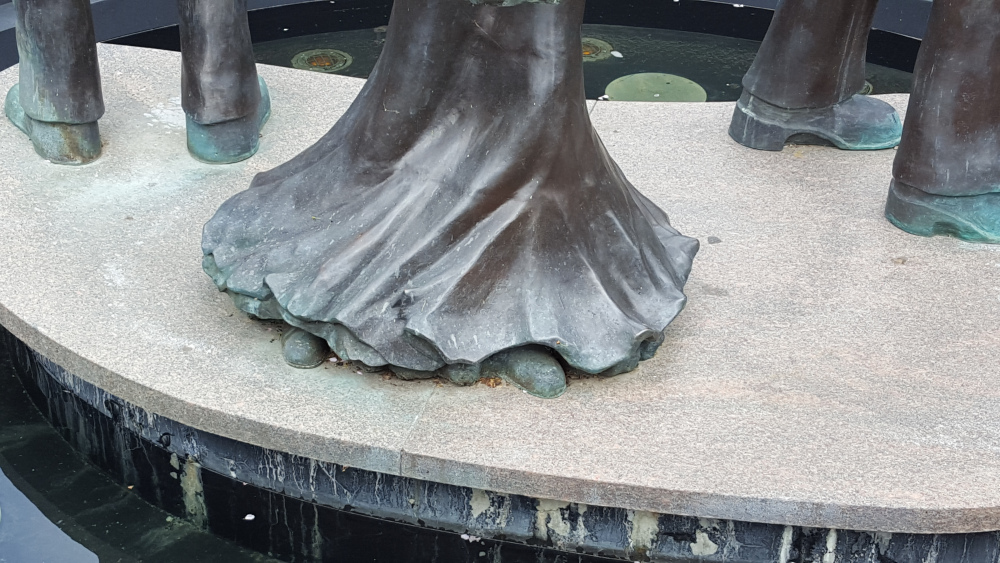
It is worth noting here that during the confrontation against the scab workers, many of the women in the crowd, who had been hiding rocks and bricks under their dresses began to throw them at the scab workers and cops who attempted to escort them into the factories. Such disgust at the attempt to break the strike by the furniture barons is captured in the statue dedicated to the 1911 furniture workers strike. At the feet of the woman depicted in the statue, you can see rocks underneath her dress.

20160515_152322

The City of Grand Rapids, for its part, not only called for arbitration during the strike, but adopted this resolution on July 24, 1911:

Screen Shot 2016-08-15 at 2.37.04 AM

Towards the end of the booklet, Flaherty provides more forceful observations about the furniture industry and reflects a high level of class consciousness that workers had developed in the early part of the 20th century. Flaherty states:

Capital knows that when the people realize that capital is organized in this country today for the conscious and deliberate purpose of crushing labor in its efforts to become free, the people will make common cause with labor and send the divine right of capital to join the divine right of kings. Industrial freedom is a state which the world as yet has not experienced.”

Flaherty then follows up with a clear indictment against the captains of industry, particularly the National Association of Manufacturers and the Furniture Manufacturers Employers’ Association. These entities were producing their own propaganda that blamed workers for being “class conscious” and for “stirring up trouble.”Screen Shot 2016-08-15 at 1.19.10 AM

Viva Flaherty’s documentation of the 1911 Grand Rapids Furniture Workers strike is in stark contrast to the observations of R. W. Irwin. Whereas, Flaherty’s booklet was distributed in public, Irwin’s booklet was a transcription of a talk he gave to the National Association of Furniture Manufacturers in December of 1911.

Irwin begins his observations by making the claim that, “nor do I believe there is any other place in this country where the rank and file of the laboring men are better housed and better cared for than in Grand Rapids.”

Irwin continues with his arrogant tone by talking about the businessmen in Grand Rapids as “having unusual strength and ability.” He mentions several of the furniture barons on page 5 and states, “that Grand Rapids owes its supremacy in the furniture world” to these men.

To his credit, Irwin does acknowledge the union organizing efforts in Grand Rapids, particularly those of the Brotherhood of Carpenters and Joiners. (pages 8 – 9) However, shortly after this acknowledgement, he dismisses the claims made by the unions before and during the strike, by saying the following on page 10:

Screen Shot 2016-08-15 at 3.13.18 AM

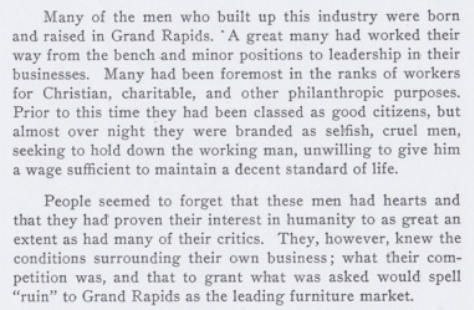
Near the end of Irwin’s talk to the National Association of Furniture Manufacturers, he grants near sainthood status to his fellow industrialists.

Screen Shot 2016-08-15 at 3.21.47 AM

The “ruin” that Irwin mentions was nothing more than to pay people a livable wage and grant the other demands presented by the strike. If such demands had been met, it would not have meant the ruin of the furniture barons, but it would have meant that the furniture workers would have enjoyed a better life.

It is critically important that both a worker and a capitalist perspective are preserved on the 1911 Grand Rapids Furniture Workers strike in these documents. They represent the strong class divide that existed in Grand Rapids at the time, a divide which still permeates the city today.

Posted in Anti-Capitalism/Labor | Tagged , , | 9 Comments

Revisiting the 1911 Grand Rapids Furniture Workers Strike – Part One

Screen Shot 2016-08-04 at 3.44.39 AM

It was 105 years ago this month that workers voted to end the strike against the furniture industry in Grand Rapids.

Over 6,000 workers went on strike in April of 1911 against poor wages, long hours and exploitative working conditions. The furniture barons responded by bringing in scab workers from out of town and to engage in a strategy of attrition, by wearing down the workers and holding out against their demands.

In the next several postings on the Grand Rapids People’s History Project, we will look at various players in the 1911 furniture workers strike. Today, we will be looking at Bishop Joseph Schrembs, the catholic bishop, whom the labor movement referred to as “Angel of the Workers.”

Bishop Schrembs role is significant on many levels. First, the bishop was invited to be part of a negotiating committee, along with Rev. Alfred Wishart, from Fountain Street Church. Workers had clear demands ast the time, but the furniture barons were unwilling to compromise and diminish their profits.220px-Bischof_Josepg_Schrembs_Cleveland2JS

The committee that included Schrembs and Wishart, was created for the following reason:

“To obtain from any employee or group of employees, either individually or through their representatives, a statement of their grievances and proposals together with their reasons therefore.” (Lydens, The Story of Grand Rapids)

The workers were demanding a 9 hour work day, a 10% increase in wages, the elimination of piecework and the establishment of a minimum wage. Workers also demanded the right to form unions and engage in collective bargaining.

At the time, the furniture barons were blacklisting workers who had any sort of union affiliation, which often resulted in their termination from the company. Schrembs himself pushed for the 9 hour work day and also, “asked whether it was fair for employers acting in an association, to deny the right of union to their men.” Schrembs was referring to the Manufacturers Association, which was the dominant business association the furniture barons belonged to.

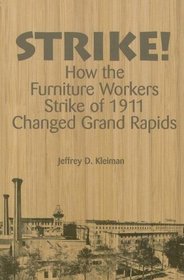
The committee heard testimony from workers in the lobby of the old Livingston Hotel on the corner of Fulton and Division. After hearing testimony from workers over several days the committee then met amongst themselves with the intent of publishing their findings. However, the Furniture Manufacturers Association stated on April 18 of 1911, that it would “not deal with workers in any form of collective bargaining.” (Kleiman, Strike: How the Furniture Workers Strike of 1911 Changed Grand Rapids) The workers called for a massive strike the very next day.

After several weeks and growing tensions between the industrialists and workers, Bishop Schrembs began to speak out against the injustice being done to the workers.

I consider the present labor situation in our city as a most deplorable one from every point of view. I would welcome and hasten the day when compulsory arbitration will force men dealing with their fellow men to let fairness and justice come to their own through reasonable methods rather than through the cowering of men’s hearts through the cruel pangs of hunger of their wives and children.

Bishop Schrembs would also invited to speak at several rallies held by the workers over the 17 weeks of the strike. At one rally in early May at the Ramona Theater in Grand Rapids, where the bishop addressed some 2,500 striking workers, he “praised the workers’ moderation and and restraint, noting that had it not been for the labor unions, we would still have the conditions which shamed men and women one or two generations ago.” (Kleiman, Strike)9780977904303

Such pronouncements by Schrembs did come at a price. The furniture barons and wealthy sectors of Grand Rapids began to question the bishop and make accusations against him. In an open letter in one of the industry’s publications, Francis Campau:

“asserted that Schrembs promoted discord by encouraging a sense of ingratitude among the working class for all the benefits that they had reaped through the factory owners’ efforts. The men who are the owners and the managers of the furniture factories in this city……lived here all their lives. They and their ancestors are to be credited with making Grand Rapids the name it has in the world today as a furniture center. It was unjust, he claimed, to insinuate they are conducting slave-driving institutions and standing as the oppressors of labor.” (Kleiman, Strike)

Eventually the mutual aid provided by the unions to striking workers and their families took its tool. On August 19, after 17 weeks of striking, most workers voted to go back to work and thus the strike ended.

On August 9, the Christian Reformed Church came out with an official decree that no worker who belonged to the church would be allowed to join a union.

Shortly after the strike ended, Bishop Joseph Schrembs was reassigned to the Toledo, Ohio diocese. There is no hard evidence that Schrembs departure was due to his role in supporting striking workers, but the timing of such a decision suggests otherwise.

Posted in Anti-Capitalism/Labor | Tagged , , , | 15 Comments

Anna Bissell Statue in Grand Rapids: Honoring another Capitalist

20782522-standard

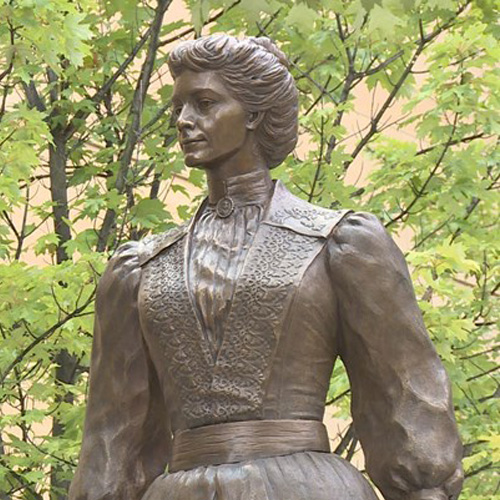
Last week, a new statue was unveiled in Grand Rapids, in front of the DeVos Convention Center, honoring former CEO of Bissell Corporation, Anna Bissell.

The unveiling drew a small crowd consisting mostly of the business community, some descendants of the Bissell family and a few local politicians. The statue is part of the Legends series that has been spearheaded by businessman Peter Seechia, who is part of the Grand Rapids power structure.

Anna, who was married to Melville Bissell, started as a sales person for the company, but took over in 1889 when her husband died. Anna Bissell ran the company until 1919 and remained chairman of the board until 1934.

One of the claims that is part of the statue and is promoted on the Bissell Corporation website states:

Anna was known as a progressive executive who showed concern for her employees, introducing innovative labor relations policies, including employee compensation, insurance, paid sick leave and pension plans, long before these practices were widespread.

20782527-standard

Even the Greater Grand Rapids Women’s History Council repeats the same mantra about Anna Bissell. In fact, Bissell is one of seven women that the Grand Rapids Women’s History Council features as women who Made a Difference. 

So what does it mean that Bissell introduced innovative labor relations policies? There is no evidence that a labor union was allowed to organize or attempted to organize at the company. The notion that paid sick leave and pensions plans were implemented “long before these practices were widespread, does not mean that the company engaged in such practices out of some benevolence. These policies were adopted at a time in the early years of the 20th Century, when organized labor was more radical and militant than at any other point in US history. The fact that the Bissell Corporation adopted such labor practices could also very well suggest that they by adopting such policies was a way to prevent workers from organizing.anna bissell

In looking at labor history sources in Grand Rapids, there is no mention of any attempts to unionize the Bissell Corporation. In fact, the only major history book on Grand Rapids that mentions anything about the Bissell Corporation is the book edited by Z. Z. Lydens, The Story of Grand Rapids: A Narrative of Grand Rapids, Michigan.

On page 294, there is only reference to the company buying up other companies, thus expanding it capacity in business portfolio. However, there is another reference in Lydens book near the end, on page 637, which makes the claim that in 1900 Mrs. Bissell may have hosted the very first office part on New Year’s Day at her home on College Avenue. Bissell factory employees and their family were said to have attended.

So, what can we make of the latest statue in Grand Rapids and the woman that it honors? Some will no doubt argue that Anna Bissell was breaking a glass ceiling, by becoming the head of a major company at a time when men ruled that arena. However, what could also be said is that Anna Bissell, the owner of a multi-million dollar company with global reach, made her wealth from the labor of those who worked in the factories. Lastly, the latest statue in the Legends series only proves that women can be good capitalists as well.

Posted in Anti-Capitalism/Labor, Lies Across Grand Rapids | Tagged , , , | 3 Comments

Revisiting the 1967 Race Riot in Grand Rapids

“It is not enough for me to stand before you tonight and condemn riots. It would be morally irresponsible for me to do that without, at the same time, condemning the contingent, intolerable conditions that exist in our society. These conditions are the things that cause individuals to feel that they have no other alternative than to engage in violent rebellions to get attention. And I must say tonight that a riot is the language of the unheard.”    Dr. Martin Luther King Jr.

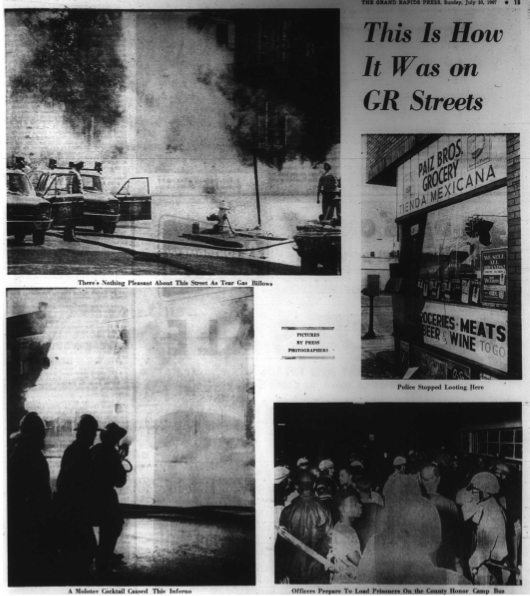
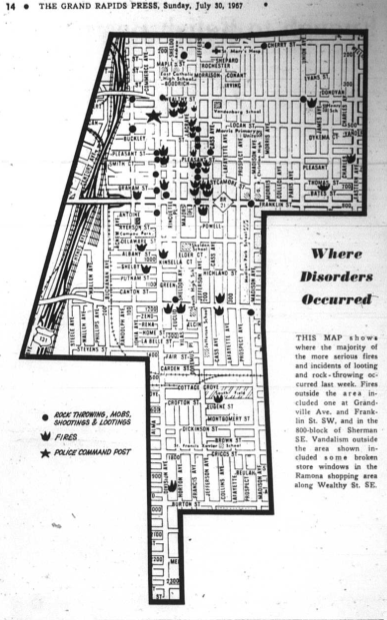
It’s been almost a half a century since hundreds from the black community rose up in a three day riot against racial injustice.
picture-17

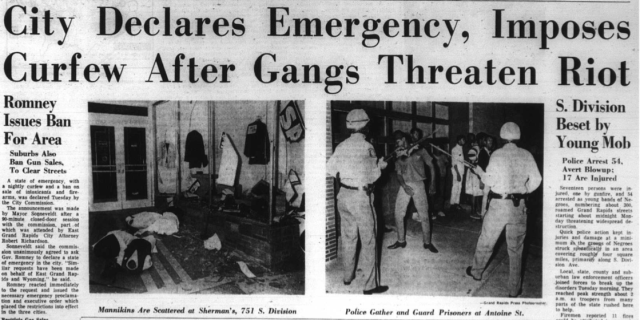
In 1967, there were 44 cities that experienced a racial uprising, including Grand Rapids. Like all across the country, the black community in Grand Rapids suffered from high levels of poverty, unemployment, limited educational opportunities, poor housing and little political power. On July 25th, Grand Rapids police pulled over a car with several black youth, and in front of several witnesses, used “excessive” force against those same black youth.

This was the spark that ignited an entire community’s rage over decades of institutional racism and exploitation. Some in the black community smashed windows of white owned businesses, while others set fire to abandoned or rundown buildings owned by white absentee landlords. An estimated 320 arrests were made during the three days that rioting took place, with most of the arrests involving members of the black community.picture-33
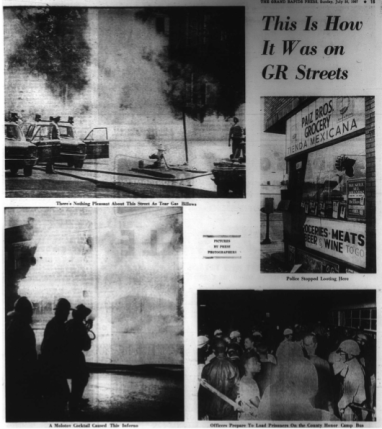
However, there were several white people who were arrested, according to a report published just months after the 1967 riot, entitled, Anatomy of a Race Riot. According to the report, published by the Grand Rapids Planning Department, most of the white people that were arrested, was because of weapons charges. Apparently, there were several white residents who wanted to use the riot as an opportunity to shoot black people. The report notes that some of the white people arrested were armed because they “wanted to protect their property.”

There were even a few groups (the report refers to them as gangs) of white people who roamed the streets on foot and in cars, particularly from the west side of Grand Rapids. The Grand Rapids Police Department even received calls from white people wanting to “volunteer as vigilantes.”

Media Reflects White Supremacist Valuespicture-5

Most of the local news coverage of the three day riot in 1967 was sensationalized and tended to rely heavily of the police department and other city officials as sources. On the second day of the riot, a Grand Rapids Press editorial stated, “The great majority in the Negro Community is law-abiding.” Such a statement sends the message that those involved in the riot acted outside of officially sanctioned behavior.

The editorial goes on to say that, “the lawless behavior of a few Negro citizens has made a mockery of civil rights and that everything that has been done up to this point to improve the Negro’s social and economic standing has been a waste of time, money and effort.” Here we can see strong White Supremacist values in the editorial. Writing for a majority white population in Grand Rapids, the GR Press editorialist is suggesting that white society has invested all of these resources – time, money and effort – to save the black community, but it has all been wasted. This is a clear reflection of what some call the white savior complex, as if white society has made every effort to treat the black community better, despite themselves.

Lastly, the editorial says, “there must be no compromising with the forces of disorder.” The Press editorial writer makes his bias known by saying that anyone arrested should be treated as a criminal and nothing else.

In addition, to the editorials, the Grand Rapids Press ran an interesting story, one that reflected the dominant culture’s fear about urban Blacks. The July 27 story was based on calls the Press writer made to people in communities near Grand Rapids, communities that were almost exclusively White.

A woman from Ionia said, “We heard they were coming here on Tuesday. We all had our guns ready if we had to.” Another White woman in Lowell was quoted as saying, “I think it is terrible. They are destroying their own property – hurting their own cause.” A resident of Saranac stated, “It is a terrible thing to say, too, but authorities should open fire on them, do something drastic to wake them up.” A man from Holland agreed with serious force being used against those rioting. He stated, “The troops should have orders to stop them anyway necessary.

It’s Their Behavior, not the System

In the last section of the Anatomy of a Riot report they make some recommendations about what could be done to prevent future responses like the 1967 riot.

Income – The report states that there is a need to provide full employment to people in the black community, so they they can take care of themselves. The report doesn’t say anything about wages, just employment, as if any job will suffice. The report also acknowledges that there are few black owned businesses and no black run financial institutions. Looking at the economic reality for blacks in Grand Rapids today, not much has changed, based on a report acknowledging that Grand Rapids is one of the worst cities for blacks to live inScreen Shot 2016-07-20 at 1.48.36 AM

Housing – The report acknowledges that more black people should be provided the opportunity to own their own homes. However, the report also states, “At the same time, to stop deterioration, the prices of ghetto property have to be determined by the supply and demand of the open market.” Ironically, the same mentality exists today, which is why a disproportionate number of African Americans are being priced out of the housing market in Grand Rapids.

However, the report does suggest that local government needs to better serve the black community. The report states:

“The residents of the inner city must feel that the local government is their government. This is best shown when their problems and suggestions are considered as seriously as those of others in the community. A reputation for being concerned and doing everything possible for the inner city will go a long way toward the opinion that, unlike most American cities, the government of Grand Rapids considers these people first class citizens.”

In this whole section of the report, the section on recommendations, is completely devoid of any systemic analysis. In addition, institutionalized racism and White Supremacy are completely omitted from this part of the report, which is to say that those that prepared the report believe that while society can do better, the problems facing the black community comes down to its behavior.

So it has been nearly a half a century since the 1967 riot in Grand Rapids. So, what lessons can we learn from how the dominant culture responded to this racial uprising that took place nearly 50 years ago?

First, not much has changed in terms of the quality of life for the black community in Grand Rapids. Almost every indicator in terms of quality of life has not changes much. Whether it is income levels, employment, housing, health care or incarceration rates, the black community continues to be disproportionately impacted in a negative way in each of these areas.

Second, the news media and public opinion continue to reflect White Supremacist values. The problems in the black community, we are told, are the fault of the black community. Things like institutionalized racism don’t really exist, we just need more diverse representation in our organizations, in government and corporate board rooms. However, the real lesson to be learned is that white people and white dominated power structures are resistant to change. The 1967 Riot says more about white people and our unwillingness to come to terms with White Supremacy.

Lastly, black anger and black rage are not allowed. As in the 1967 riot, black people today are constantly being told to be patient and to work to change things through proper channels. Join a non-profit, vote or start your own business, but stop blaming it all on racism are the mantras of today. Black people are not allowed to be heard, as Dr. King put it 50 years ago, by engaging in riots that challenge the “intolerable conditions that exist in our society.

Posted in Civil Rights/Freedom Movement, Uncategorized | Tagged , , , , | 9 Comments

Senator Arthur Vandenberg: The Grand Rapids Bi-Partisan Statesman for US Imperialism

As part of our series that looks at statues, monuments and other historic markers in Grand Rapids, we look at Senator Arthur Vandenberg, who’s statue sits across from the Rosa Parks statue near the entrance to Rosa Parks circle. 

Arthur Vandenberg, who grew up in Grand Rapids, was the editor of the Grand Rapids Herald from 1906 – 1928. Like his boss at the newspaper, William Alden Smith, Vandenberg got involved in politics and was elected Senator in 1928.

DSC00015

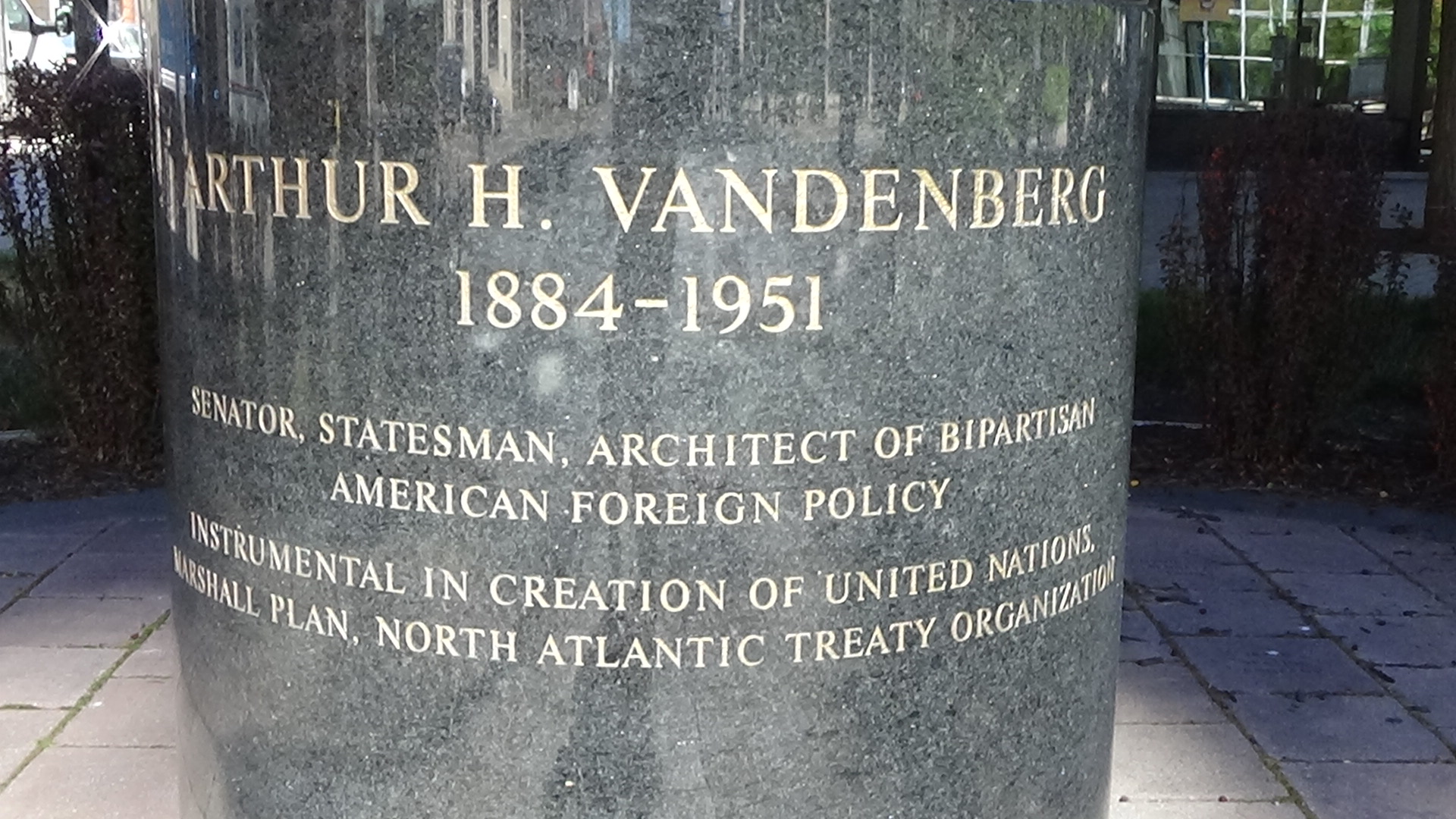
The statue near Rosa Parks Circle in Grand Rapids is inscribed with these words under Vandenberg’s name, Architect of Bi-Partisan American Foreign Policy. Such words are not only instructive, they are reflective of the dominant narrative about US foreign policy that students learn about in civics class, a narrative that is generally mimicked in commercial media.

Often referred to as an isolationist in the early part of his political career, Vandenberg was one of the few members of Congress to ask questions about the role of US weapons manufacturing and sales. Beginning in 1934, the Nye Committee, headed by Senator Gerald Nye, was calling for more accountability for US companies profiting from war, particularly Du Pont. A Washington Post headline from December of 1934 reflected the work of Senator Nye and Senator Vandenberg by stating, “800% War Profit Total at Inquiry: Du Pont Deal Up.”

The Nye Committee published several reports, like this one released in February of 1936.  Senator Nye, along with other members of the committee were calling for government ownership of weapons manufacturing, while Senator Vandenberg was calling for more oversight of the war industry. The following month a Gallup Poll was conducted asking Americans, “Should the manufacture and sale of war munitions for private profit be prohibited?” 83% of those polled said yes. Ironically, days later Eleanor Roosevelt was in Grand Rapids and called for, “taking all profits out of the munitions industry.” (The Untold History of the US, Stone & Kuznick)

However, once the US declared war on Japan after the bombing of Pearl Harbor, Vandenberg’s isolationist views began to dissipate.

As a member of the US Foreign Relations Committee, one of the most influential committees in Congress, Vandenberg began to call for the US to take an assertive role in the matters of foreign policy. Vandenberg did not live that many years after World War II (succumbing to cancer in 1951, but long enough to be part of three policy decisions that continue to dominate US foreign policy ever since.united-nation-security-council-unsc-22867436

The three major policy decisions are also inscribed on the statue of Senator Vandenberg in downtown Grand Rapids. Those policy decisions were: to support the creation of the United Nations, the Marshall Plan and the North Atlantic Treaty Organization (NATO).

The United Nations as an extension of US Foreign Policy

Senator Vandenberg became a champion of the creation of the United Nations and submitted the UN charter for Senate approval in June of 1945. Earlier that year, Senator Vandenberg was a US delegate at a conference in San Francisco to discuss the formation of the United Nations. In Phyllis Bennis’s book, Calling the Shots: How Washington Dominates Today’s UN, the author makes clear that the US was not going to be part of a process that created a level playing field at the international level. US policy makers saw the creation of the United Nations as a mechanism to insert US dominance at the international level after WWII. This was exactly why the UN Charter included a Security Council, with the US being one of the permanent members and giving the country veto power. The UN Security Council was not only decided upon by the US, but other powerful nations, which also had a stake in global politics after WWII. However, the US came out as the dominant power after WWII, both economically and from a geo-political stance. Thus the notion that Senator Vandenberg was in support of global peace is a bit of a stretch, since the creation of the United Nations was fundamentally a mechanism for US hegemony.

The Marshall Plan – Subsidizing US corporate power in Europe

The Marshall Plan in generally communicated in popular culture as the United States commitment to helping rebuild Europe after WWII, sort of a form of US benevolence. However, what was really behind the Marshall Plan was not some great humanitarian endeavor, rather a way to solidify US economic dominance at the beginning of the Cold War.

The $13 billion price tag attached to the Marshall Plan was essentially US taxpayers funding US based corporation who would “re-build” Europe, thus further solidifying US corporate control by opening up new markets throughout Europe. One example that Noam Chomsky discusses is that the Marshall Plan got Europe and Japan to shift from a coal-based energy system to an oil-based energy system. What this means is that roughly $2 billion from the Marshall Plan went straight to US-based oil companies after WWII. 

Another major motivating factor in the Marshall Plan was to suppress any left political movements in Europe. This is an important point since many of the anti-fascist forces organizing in Europe during WWII were either communist, socialist or anarchist. The US did not want to see any of these left political movements take root in Europe and used the Marshall Plan to help finance projects that would undermine such movements. Noted scholar of US foreign policy, William Blum, also notes that the CIA was involved early on in using Marshall Plan funds for its own Cold War propaganda purposesVandenberg

The CIA also skimmed large amounts of Marshall Plan funds to covertly maintain cultural institutions, journalists, and publishers, at home and abroad, for the heated and omnipresent propaganda of the Cold War; the selling of the Marshall Plan to the American public and elsewhere was entwined with fighting “the red menace”. Moreover, in its covert operations, CIA personnel at times used the Marshall Plan as cover, and one of the Plan’s chief architects, Richard Bissell, then moved to the CIA, stopping off briefly at the Ford Foundation, a long time conduit for CIA covert funds.

NATO as a military tool of US Imperialism

The third major post-WWII policy that Senator Vandenberg is credited with passing was the creation of the North Atlantic Treaty Organization, also known as NATO. NATO has generally been viewed as a means to counter Soviet military influence after WWII, particularly in regards to Europe. However, as Noam Chomsky and others have observed, NATO is a US-run intervention force. 

Now, it must be made clear that Senator Vandenberg, like many politicians, may not have know all the details about policy decisions they make. However, let us make no mistake about the fact that the major policy decisions for which Senator Vandenberg is revered, are the ones that gave rise to US global hegemony and US Imperialism.

Posted in Lies Across Grand Rapids | Tagged , , | 3 Comments

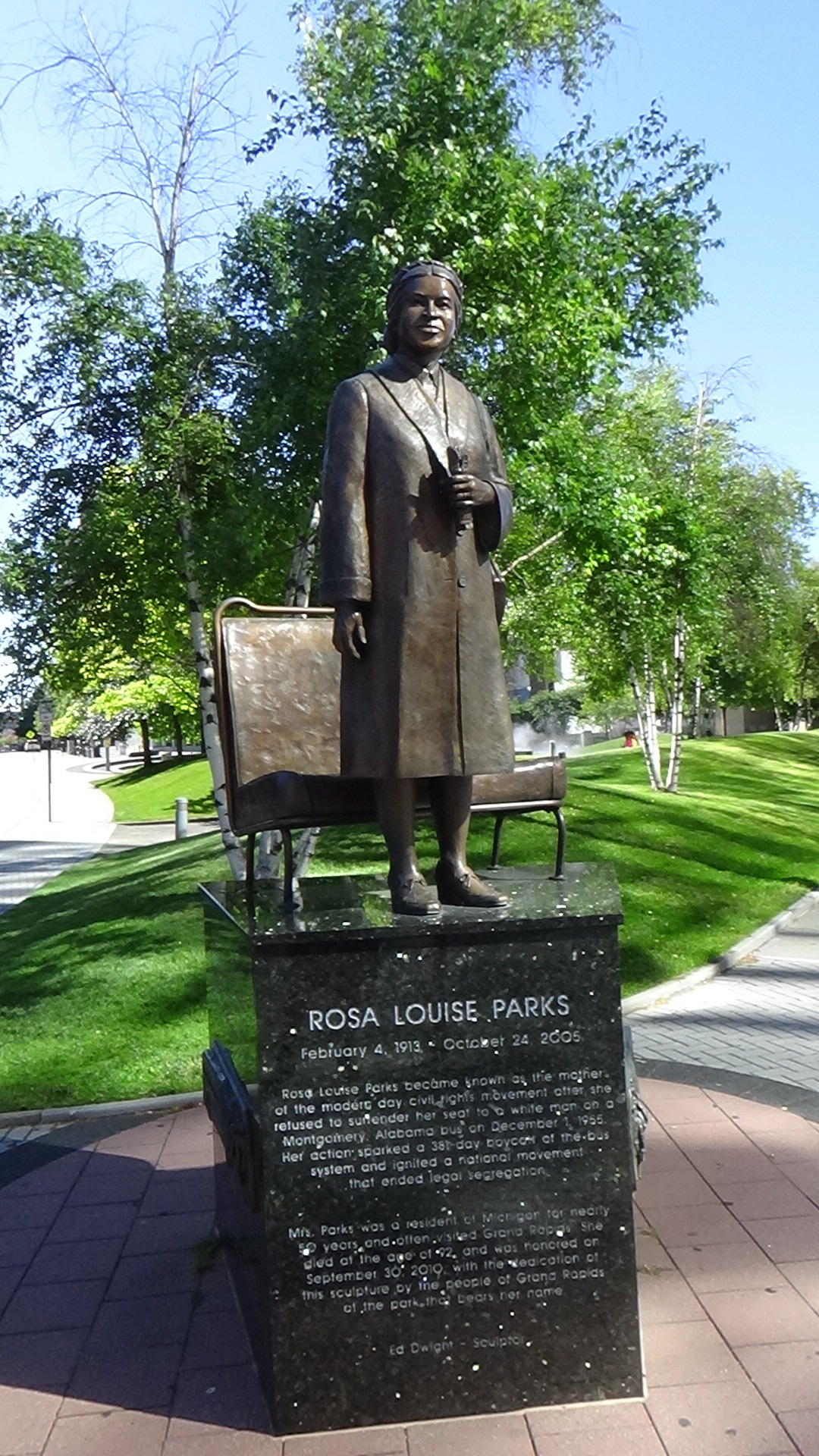
A Legacy of Organized Resistance: the Rosa Parks statue in Grand Rapids

Parks Statue

The only statue in Grand Rapids that doesn’t feature someone who spent part of their life in this city, is that of Rosa Parks.

The statue is located at the west entrance to a downtown community gathering space, also known as Rosa Parks Circle. The statue of the late civil rights organizer was dedicated in September of 2010 and includes text on three different sides.

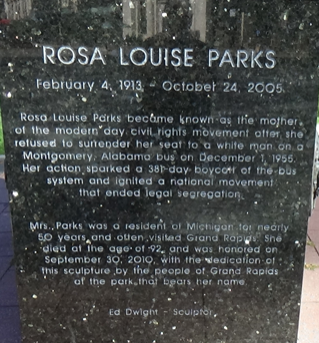
Screen Shot 2016-07-05 at 2.41.06 AMThe front side includes the following text pictured here on the left. Although the text on the front of the statue is accurate, it doesn’t capture all of what Rosa Parks was about, nor does it provide a more honest historic context of what brought her to Montgomery, Alabama.

According to the groundbreaking research in  Danielle McGuire’s book, At the Dark End of the Street: Black Women, Rape & Resistance – a New History of the Civil Rights Movement from Rosa Parks to the Rise of Black Power, racial segregation was not the only thing that brought Rosa Parks to Alabama.  

A 24 year old black woman named Recy Taylor was raped by a carload of white men in Abbeville, Alabama in 1944. The NAACP got wind of the incident and sent their best investigator, Rosa Parks, to Alabama to interview Recy. What Rosa Parks discovered was that a decade before the Montgomery Bus Boycott, the Black community was already organized and resisting White Supremacy. The difference was Black people were not just fighting for an end to racial segregation, they were fighting against the sexual violence of White men against Black women.51Rn6cw4JCL._SX334_BO1,204,203,200_

At the Dark End of the Street makes it clear that in addition to organizing against racial segregation, the black community was responding to the ongoing violence by white men against black women. The police and courts in Alabama did virtually nothing to hold white men accountable for these assaults against black women. Black women were being targeted by white men on the streets in grocery stores and on the buses.

Black people in Montgomery were organizing around these assaults and used a variety of tactics to draw attention to the sexual assault of black women. One action was to hang a banner that read, “The Rapist was White.” It happened to be that the church where the banner was hung was the same church that Dr. King would later be pastor of. A local committee was also formed in response to the rape and this group was so effective in their organizing that they got a Grand Jury hearing and the local Black ministers together for the very first time.

In addition, there were organized campaigns against the bus system, even boycotts, because of the ongoing sexual harassment on the buses in Montgomery. The bulk of the riders were Black women who worked as maids in White homes and could only use bus transportation to get to work.

So when Rosa Parks refused to move to the back of the bus, it was no surprise that thousands participated, especially women who had been fighting racism and sexism on the buses for over a decade.

During Reconstruction White Supremacists used Sexualized violence as a tool against freed slaves. It was during this time that the White Supremacists used the myth of Black male sexual predators as a way to demonize Black men and maintain power. McGuire states in At the Dark End of the Street, there is an old saying that grew out of the Jim Crow era which said, “The closer a Black man got to the Voting box, the more he looked like a rapist.

So while it is important that we recognize and honor the role that Rosa Parks played in the Montgomery Bus Boycott, it is equally important that we understand that she was part of the larger Black Freedom struggle that resisted the various ways in which White Supremacy was, and continues to be, manifested throughout the US.

Lastly, there is a statement by Rosa Parks etched on the side of the base of the statue that reads:

Screen Shot 2016-07-05 at 3.43.48 AM

We must not merely hear these words as coming from a deeply committed member of the Black Freedom struggle. We must take them seriously and continue to fight for the same kinds of things that Rosa Parks fought for. When she says she wants freedom, equality, justice and prosperity for all people, then we need to simply look around and realize that this vision has yet to be fulfilled in Grand Rapids. The fight for racial justice, economic justice, affordable housing, food justice, environmental justice and gender justice (just to name a few) continues. Let us honor the legacy of Rosa Parks by continuing to be involved in organized resistance.

Posted in Civil Rights/Freedom Movement | Tagged , , | Leave a comment