News Coverage of the Grand Rapids Center American Sanctuary Movement in the 1980s

Screen Shot 2014-09-22 at 2.58.42 PM

This is the second story dealing with the Central American Sanctuary Movement that existed in Grand Rapids. The first story provided an overview of the Grand Rapids Movement.

There was limited news coverage of the Grand Rapids Sanctuary house, which was part of the Central American Sanctuary Movement in the 1980s.

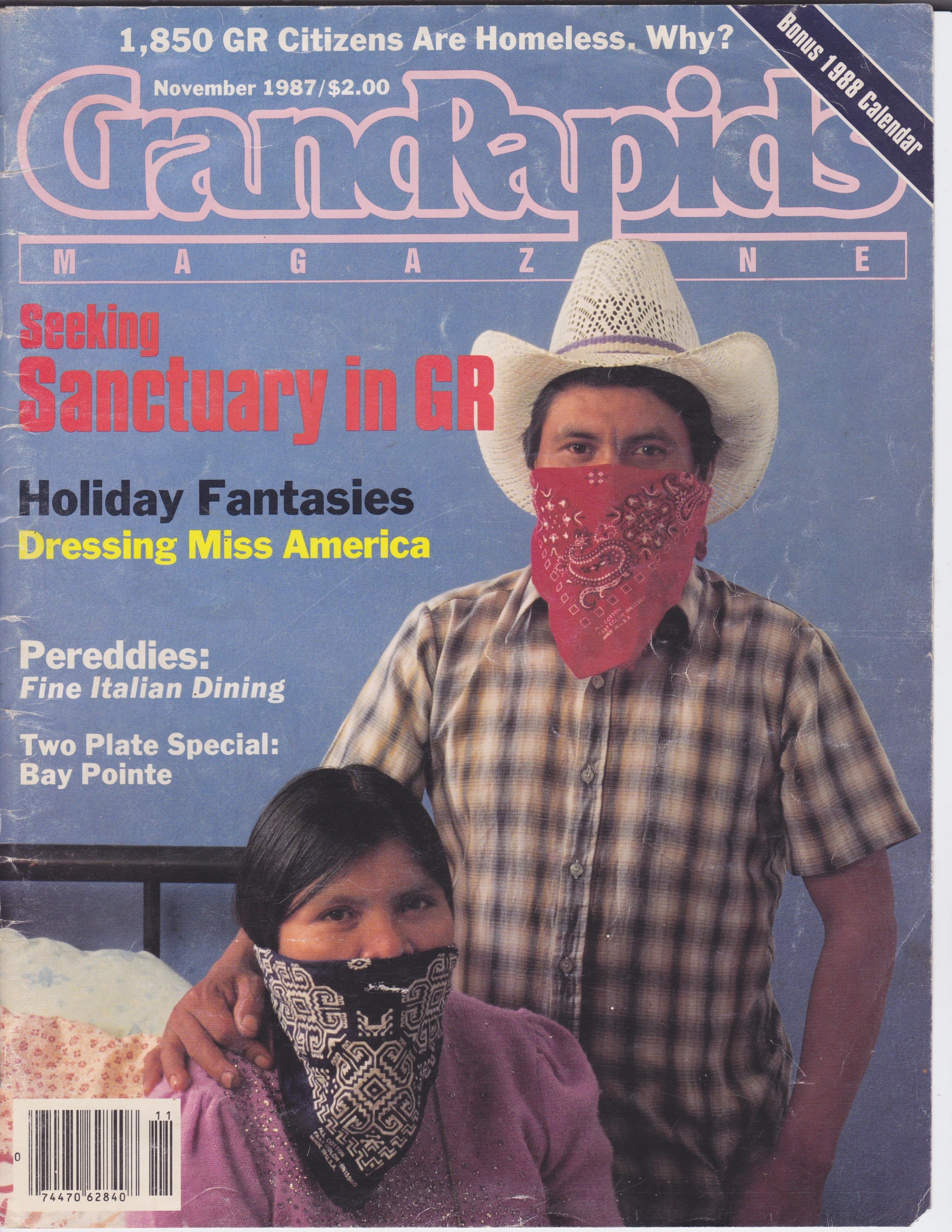
We were able to identify three separate news stories (archived here), one from the fall of 1986, just prior to the public declaration by Koinionia House that it was declaring itself a Sanctuary and two stories in late 1987, months after the first political refugees had arrived seeking sanctuary.

The Grand Rapids Press article in the fall of 1986, was brief, but did provide some contextual information about the US Government’s crack down on the Sanctuary Movement in the Southwest part of the country. Religious workers in Arizona had been arrested and sentenced to more than a year in prison for providing sanctuary to undocumented political refugees fleeing El Salvador and Guatemala in the 1980s.

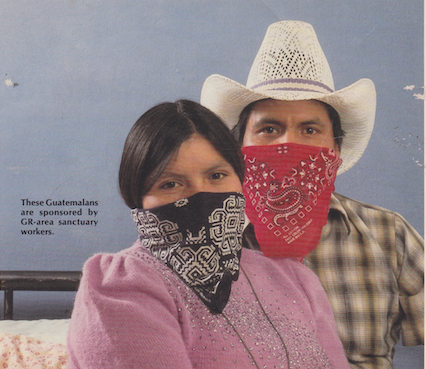
Koinonia House had declared itself a sanctuary in the fall of 1986 and welcomed the first political refugees in the spring of 1987. Initially housed at the Koinonia House, the group was able to secure a second house in Grand Rapids, which was then turned over to the families that had fled the violence in their home country of Guatemala.

The two stories from the fall of 1987 appeared in the now defunct West Michigan Catholic Reporter and the Grand Rapids Magazine.

Both stories provided some insight into the concrete kind of work involved in being a sanctuary, but the Grand Rapids Magazine actually ran 2 separate pieces, one about the larger Sanctuary Movement and the other one about what was happening at the Koinonia House in Grand Rapids. In both the Catholic newspaper and the GR Magazine, those involved in the Sanctuary Movement were given a significant amount of space for commentary.GRBJ Sanctuary Cover

The coverage in these stories also helped to put a human face on those involved as well as provide solid political context for the work. This last point is important, since one of the goals of the Central American Sanctuary Movement was to get the stories of the political refugees out in order to change US policy towards countries like El Salvador and Guatemala.

Unfortunately, there was no further coverage of the Sanctuary Movement in Grand Rapids, even those it lasted until the mid-1990s. The lack of coverage was not a surprise, especially if it questioned US foreign policy, a point we will explore in the next article.

Posted in Central American Sanctuary Movement | Tagged , , | Leave a comment

Womyn’s Action Network: Practicing Feminism in Grand Rapids in the 90s

WAN LogoThis article is part of a larger project that will look at the various feminist movements in Grand Rapids. We are grateful for the following information that came to us by the late Karen Henry, a co-founder of the Womyn’s Action Network)

In recent years there has been a variety of activities and actions around the rallying cry of fighting “The War on Women.”

The cause for this effort has primarily been the recent national and state efforts to diminish legal protects for women around reproductive rights and rape. The organizing has mostly been inside the electoral framework of fighting legislation and supporting or opposing political candidates. While electoral politics is one strategic approach to fighting for women’s rights, it is certainly not the only one.

Organizing and movements for women’s rights and gender equality have existed in Grand Rapids for over 100 years, with women participating in the Suffrage Movement, the Civil Rights Movement, Sexual Assault/Anti-Rape Movements and other manifestations of feminism.

In the early 1990s, one such effort was the creation of the Womyn’s Action Network (WAN). WAN’s stated purpose from the organizational brochure was, “The Womyn’s Action Network works to eliminate violence against women and oppression of women through self-empowerment and the resurrection of womyn’s voices.

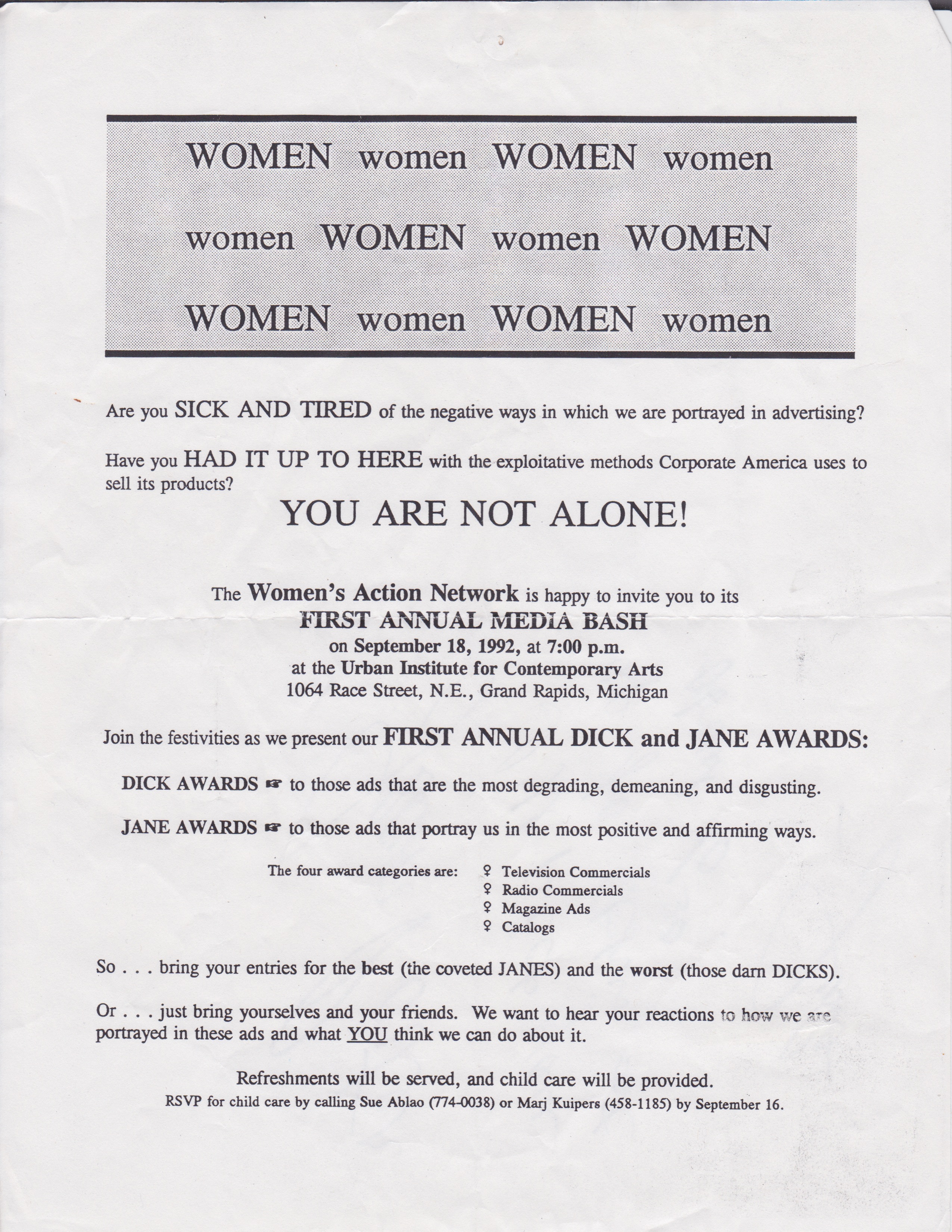
WAN came together in 1992 and began their feminist work with a satirical event that took on media representation of women. The First Annual Media Bash was an awards ceremony, where those in attendance would look at misogynistic and empowering images of women and then give out what they called Dick and Jane awards. The Dick awards were given out to the ads that “are the most degrading, demeaning and disgusting,” while the Jane awards were given to “those ads that portray us in the most positive and affirming ways.”First Annual Media Bash

In addition to the Media Bash, WAN organized or participated in Take Back the Night marches, challenged sexist local radio billboards (WKLQ), spoke on campuses, facilitated forums and created a Women Now Forever Scholarship. The scholarship was for women attending or wanting to attend college and gave preference to women of color and Lesbian or Bisexual women.

The Womyn’s Action Network also understood how social justice issues intersected and participated in the annual Pride event in Grand Rapids, World AIDS Day, anti-war activities and community wide anti-violence campaigns.

The organization’s literature states that it was committed to looking at issues through a race/class/gender lens; challenging corporate defined beauty; fighting femicide, rape, battering and harassment; and looking at women’s health issues, like breast cancer, menopause and menstruation.

WAN only survived for three years (1992 – 1995), but accomplished an amazing amount of work in that brief time and inspired many women in Grand Rapids to find their voices and fight back against patriarchal systems of oppression.

Posted in Feminist Movement | Tagged , , | 1 Comment

Grand Rapids was part of the Central American Sanctuary Movement in the 80s

(This article is part of a larger project about the Grand Rapids Central American Sanctuary Project. As a matter of full disclosure, this writer was part of that effort.)

In the late 1970s and 1980s, US funded counter-insurgency wars were being waged in El Salvador and Guatemala, activists along the US/Mexican border began to see a sharp rise in the number of political refugees entering the country.Screen Shot 2014-09-10 at 2.56.38 PM

As communities began to offer safety to these refugees, they realized that all of them had a similar narrative. Each of the refugees told them that they fled their country because they either witnessed the torture and murder of family members or they themselves were torture survivors.

The US financed death squads in El Salvador and Guatemala was the primary source of the displacement of hundreds of thousands of people coming from Central America in the 1980s. US activists began to hear these stories in greater numbers and since the Reagan administration did not acknowledge Salvadoran or Guatemalan refugees as being political refugees, the US Sanctuary Movement was born.

The US Sanctuary Movement was begun by US faith-based communities that believed that they should offer sanitary for their fellow humans who were fleeing violence, even if it meant violating US laws.

Beginning in the Southwestern part of the country, Sanctuaries began popping up, where faith-based groups began to house people fleeing violence and to provide them with a forum to tell their stories.

Soon there were hundreds of places declaring themselves a sanctuary for Central American refugee, with three places declaring in Michigan alone – Detroit, Lansing and Grand Rapids.

The Grand Rapids Sanctuary was run by members of the Koinonia House, a housing collective that had begun in 1984 and did much of their organizing around resisting US Policy in Central America.

The seven members of the Koinonia House decided in the fall of 1985 to be part of the Central American Sanctuary Movement and traveled to Chicago to meet with the national coordinator of the project, the Chicago Religious Task Force on Central America.

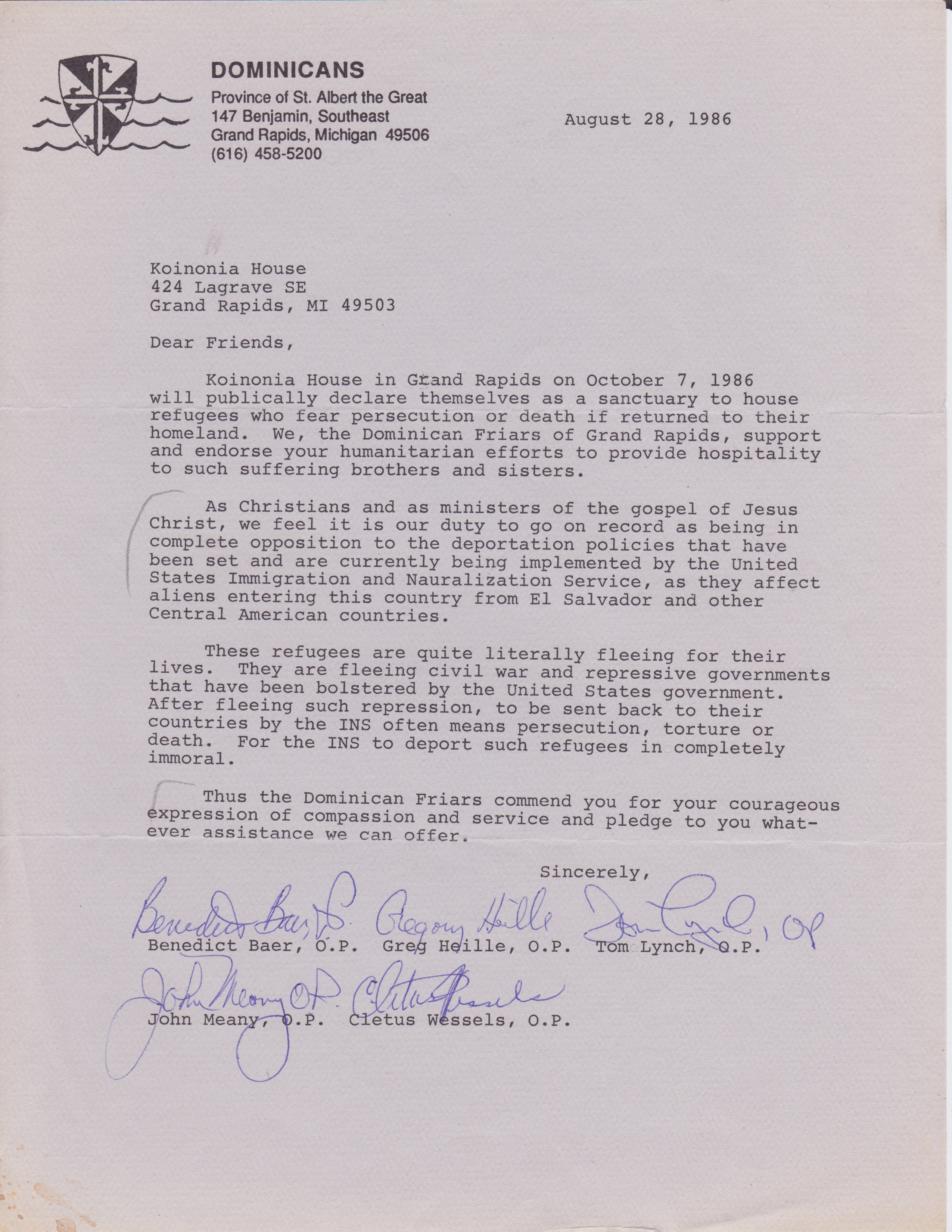
One major aspect of becoming a sanctuary was the need for those seeking to declare to obtain as much support from the community, especially in the form of letters. Such letters were a sign that Koinonia House would indeed be trusted with doing the work and it signaled to the federal authorities that those who signed the letters stood with the members of the Grand Rapids Sanctuary. Koinonia House received dozens of letters of endorsement, from churches, community and university organizations, individuals and parents. Here is a copy of the letter sent by the Dominican Priests of Grand Rapids.

Domincan Letter of Sanctuary Endorsement

Once the Koinonia House had significant community support for becoming a Sanctuary, they set a date in to declare themselves a place that would defy the federal government and provide sanctuary to Central American Refugees.

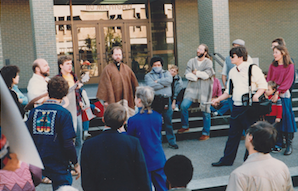
Koinonia House declared themselves a Sanctuary in the fall of 1986 on the steps of the Gerald Ford Federal building in downtown Grand Rapids, as it was custom to make this declaration public. Members of the Detroit and Lansing Sanctuaries were present, with Fr. Dick Preston (pictured here wearing the dark brown poncho) leading a ceremony to honor the public commitment being taken on by Koinonia House.

GR Sanctuary Declaration

Several months later, the Chicago Religious Task Force on Central America contacted members of the Koinonia House and told them they had 2 Indigenous families from Guatemala in need of Sanctuary.

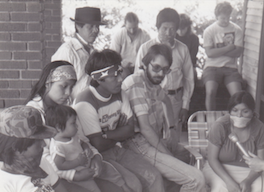
In April of 1987, six adults and one child arrived in Grand Rapids at the Koinonia House. A few days later a press conference was held on the front porch of the Koinonia House (pictured below) and this marked the beginning of several years that the Grand Rapids Sanctuary offered a safe haven for those who were fleeing violence in Central America. 

Sanctuary Members on K House porch

Posted in Central American Sanctuary Movement | Tagged , , | 13 Comments

Anti-Vietnam War Resistance was widespread in Grand Rapids

This article is part of a larger research project on local organizing against the US war in Vietnam.Screen Shot 2014-09-04 at 8.52.17 AM

Like in most US cities, Grand Rapids was active in the larger movement agains the US war in Vietnam throughout the later half of the 1960s and early 1970s.

The anti-war movement in Grand Rapids was not as militant as in cities like Chicago, New York or Washington, but there were a significant number of people opposing the war in a variety of ways.

The local chapter of the Women’s International League for Peace & Freedom, along with the Grand Rapids Quakers organized an ongoing vigil in downtown between the City and County buildings.Screen Shot 2014-09-04 at 8.48.08 AM

Numerous churches took a stand against the US firebombing of villages in South Vietnam, with Fountain Street Church and Park Congregational leading the way. Both Fountain Street and Park hosted forums, provided information on how to resist the draft and brought in national speakers and musicians against the war such as Tom Hayden, Joan Baez, Holly Near and Jane Fonda.

Many people were involved in the anti-draft movement in Grand Rapids as well. We interviewed Jashu Milanowski recently who was one of the anti-draft organizers that was living in an alternative community house on Charles St. Milanowski told us they were training people on how to file as conscientious objectors, draft resister and were part of the network assisting young men who chose to engage in self-exile and move to Canada.

Many people from the Grand Rapids area also traveled to Washington, DC for the massive anti-war rallies. Many of those who went and organized buses were from colleges and high schools in the area, with Calvin College and Grand Valley State College being the most active.

Grand Valley had a lively student anti-war contingent, holding Teach-Ins, rallies and anti-draft actions. Here is a picture of some students protesting the war just before a march on campus took place.

Screen Shot 2014-09-04 at 8.49.41 AM

In addition to student activism, Grand Valley had numerous faculty actively opposed to the war, but the highest profile on campus was that of Arend Lubbers, President at Grand Valley State College at the time. Lubbers was often a speaker at the student anti-war rallies on the Allendale campus.

Anti-Vietnam War organizing was also substantial on the campus of Calvin College. Despite the conservative nature of the Christian Reformed college, Calvin students and faculty organized numerous activities for several years during the US war in Southeast Asia.Screen Shot 2014-09-04 at 8.56.09 AM

According to archives of the student paper, The Chimes, Calvin students and faculty hosted numerous lectures, debates and forums on the war, with an emphasis on Christian moral responsibility. In March of 1968, forty seven Calvin Professors ran an anti-war ad in the Grand Rapids Press.

Screen Shot 2014-09-04 at 8.48.34 AM

Students organizing against the war were involved in organizing Teach-Ins, rallies and informational resources for students on the draft, as is seen in the picture.

In addition, students at Calvin participated in the national Moratorium Campaign against the Vietnam War, with rallies on campus and organizing buses to DC.

Lastly, it is worth mentioning that while there was no active GI-led anti-war movement in Grand Rapids, there were several veterans who have told us of their involvement in the anti-war GI newspaper movement.

This is just a snapshot of the kind of anti-war organizing that was taking place in Grand Rapids during the late 1960s and early 1970s. We hope to bring you a more detailed investigation as we begin to research this issue for the Grand Rapids People’s History Project.

Screen Shot 2014-09-04 at 8.47.32 AM

Posted in Vietnam War Resistance | 2 Comments

Calling out Congressman Paul Henry was one tactic in the resistance to US Policy in Central America in the 1980s.

This article is just one piece of a larger project that will explore the movement in Grand Rapids to resist US foreign policy in Central America in the 1980s.Paul Henry Poster

During the 1980s, Central America became of central part of US foreign policy as liberation movements sought to rid themselves of governments that were mostly under the influence of Washington.

Hundreds of people from Grand Rapids went to Central America as part of a larger solidarity movement to stand with people fighting for freedom, some participated in changing public opinion, others joined the Sanctuary Movement and many more participated in various forms of direct action against government policy or corporations profiting from the repression in Central America.

One target of direct action was Congressman Paul Henry, who represented the 3rd District in Michigan from 1985 – 1993. Henry’s name can be seen on university buildings in Grand Rapids and his name was chosen for the new highway built just south of Grand Rapids, highway 6, also known as the South-belt.

Henry is highly regarded in mainstream circles, both as a man of principle and high morals. However, Paul Henry’s voting record reflected a totally different reality.

In the 1980s one of the most contentious issues during the Reagan/Bush years was US policy towards Central America. The US was providing military aid, weaponry and military advisors to fight insurgent wars in El Salvador and Guatemala, while at the same time was supporting the Contra forces, which were attempting to overthrow the Sandinista-led government in Nicaragua.

On the matter of the US support for the Contras, Paul Henry consistently voted for military funding that allowed the Contras to attack Nicaragua from both Honduras and Costa Rica, the countries which border that Central American nation. The Reagan administration (and Paul Henry) was claiming that the Contra forces were “freedom fighters,” despite the record of massive human rights violations. The Contras were known for attacking farming cooperatives, literacy workers and other social programs, which were at the forefront of the Sandinista revolution.

There was a lively campaign in Grand Rapids to challenge Paul Henry’s position on Nicaragua and his support for the Contras beginning in 1984, with the Stop The Invasion Campaign (STIC). There were weekly demonstrations outside his office in the federal building for years and several acts of civil disobedience, where people occupied his office until they were arrested. On one occasion, a group of people put 100 crosses in the lawn of the federal building with the names of Nicaragua civilians that the Contras had killed. Despite these efforts and many more Paul Henry never changed his position on Nicaragua, even after the Iran Contra affair and the allegations that the CIA was working with the Contras to traffic cocaine to buy weapons.

Contra death crosses

In the 1980s the US was also providing massive amount of military aid to the country of El Salvador to fight the FMLN guerilla forces. Throughout that period human rights groups and many US-based church groups were claiming that the Salvadoran military and the death squads were responsible for the bulk of the human right abuses, but Congressman Henry (who support military aid to El Salvador) was staunch in his conviction that the human rights abuses were equally committed by the FMLN.

Again, people in Grand Rapids organized to oppose the US support of the Salvadoran military and Paul Henry’s office was the target of people’s rage. The largest action against Henry’s support for the death squad terror in El Salvador was right after several priests, their cook and her daughter were assassinated on November of 1989.

About 100 people blocked traffic on Michigan Avenue in front of the Federal building in Grand Rapids. After the police came, another contingent of people went into Paul Henry’s office and attempted to make a citizen’s arrest against the Congressman and his staff. Eventually, the people who were in Paul Henry’s office were dragged out and the doors to the federal building were locked so no one could get in.

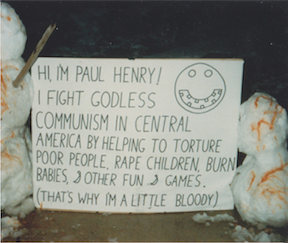
Congressman Henry was a member of LaGrave Avenue Christian Reformed Church, near downtown Grand Rapids. On numerous occasions people would protest outside his church on Sunday mornings with signs that read, “Paul Henry support, rape, torture and murder in Central America.” In the winter other activist built snowmen and squirted ketchup over them to simulate blood to draw attention to the harsh realties of Congressman Henry’s support for the Death Squad government in El Salvador.

Paul Henry Protest

In 1992, there was a ceasefire in El Salvador and a UN Truth Commission was established to investigate the crimes committed in El Salvador between 1980 and 1992. In March of 1993, the UN Truth Commission published their findings, which stated that the Salvadoran military was guilty of 85% of the human rights abuses during that 12-year period and that the FMLN was only responsible for 5%. Congressman Henry never admitted he was wrong or that he was mislead by the Reagan/Bush administrations.

Again, this was only one way in which people mobilized against US Policy in Central America in the 1980s. We will investigate other tactics used by people through interviews, documents and other archival material that is obtained through this project.

Posted in Central American Solidarity Movement | Tagged , , , | 4 Comments

Why it is important that we learn from our history of resistance and liberation

During the interview process for the People’s History of the LGBTQ Community in Grand Rapids, we asked participants what the value is of being aware of and learning from the rich history of resistance and liberation, no matter what struggle people have been apart of.

Here is what they had to say, comments which inspire us to continue to document and reclaim the people’s history in Grand Rapids.

Posted in Uncategorized | Tagged , | Leave a comment

Grand Rapids People’s History Project Kickoff Event – September 5

Join us for a public event to kick off the newest chapter of the Grand Rapids People’s History Project.

Grand Rapids has such a rich history of resistance, whether it is small acts of resistance or social movements for collective liberation. Join us in exploring this history, reviving this history and celebrating this history.

Screen Shot 2014-08-20 at 1.03.49 PM

At this event we will look at the new direction of this project, talk about the many ways people can participate in the work and help us generate some funds to make the work sustainable.

There is a Facebook page for this event that you can invite people to and a general Facebook page for the Grand Rapids People’s History Project that you can like and share with people you know.

Bring a friend and make a donation! There will be light refreshments. Parking is available on the east end of the Masonic Temple building or on the upper level entrance off of Lafayette.

Posted in Uncategorized | Tagged , | Leave a comment

Ferguson and the System of White Supremacy: What we can learn from the 1967 Riot in Grand Rapids

While attending a symbolic action in Grand Rapids, an action in support of what is happening in the aftermath of the police shooting of a young Black man in Ferguson, MO, I heard someone say, “we need to be vigilant and make sure this kind of thing doesn’t happen here.”ferguson

The fact is, that police killing or brutalizing people of color does happen here and has a long history of happening here. Whether it was the brutalization of Indigenous people by White colonizers, the decades of Black people being the target of police brutality, or the harassment of other communities of color, what is happening in Ferguson is a microcosm of what has taken place in Grand Rapids and all across the country since the beginning of European colonization of this hemisphere.

It is not only important that we come to terms with this history, but do the work of learning from it. One way to learn from history is to examine specific incidents, which not only tells us a great deal about what has happened, but how oppressed communities responded to the violence and how systems of power and oppression responded. It is particularly important for those of us who benefit from systems of oppression, those of us with privilege, understand these dynamics if we are going to play any serious role in challenging and dismantling these systems of oppression, which in this case is the system of White Supremacy.

The race riot, or as some refer to it as, the racial uprising that took place in Grand Rapids, in July of 1967, is a useful example to learn from.

Like all across the country, the Black community in Grand Rapids suffered from high levels of poverty, unemployment, limited educational opportunities, poor housing and little political power. On July 24th, Grand Rapids police pulled over a car with several Black youth, and in front of several witnesses, used “excessive” force against the Black youth.

This was the spark that ignited an entire community’s rage over decades of institutional racism and exploitation. Some in the Black community smashed windows of White owned businesses, while others set fire to abandoned or rundown buildings owned by absentee landlords. An estimated 320 arrests were made during the three days that rioting took place, with most of the arrests involving members of the Black community.

There is nothing exceptional about how the Black community responded to police brutality in Grand Rapids during those summer days in 1967. They rose up and they resisted. Much can be learned from how oppressed communities respond to systemic oppression, lessons that are well documented in Charles Cobb’s recent book, This Nonviolent Stuff’ll Get You Killed: How Guns Made the Civil Rights Movement Possible. However, it is equally important for our purpose to learn from how the systems of oppression and those in power responded.picture-17
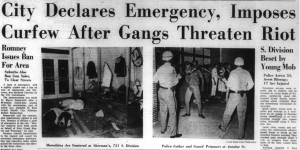
The responses highlighted are those that promote and perpetuate the system of White Supremacy. White Supremacy is an historically based, institutionally perpetuated system of exploitation and oppression of continents, nations and peoples of color by white peoples and the European continent, for the purpose of maintaining and defending a system of wealth, power and privilege. This definition comes from Latina activist Elizabeth Martinez and it is the framework used here to assess the various White Supremacist responses to the 1967 uprising in Grand Rapids

  • The local media, typified by the first editorial from the Grand Rapids Press, used harsh words to condemn those who participated in the uprising.
  • At the first meeting of the Grand Rapids City Commission, the political body that ruled the city, passed a resolution, which praised the police department and any business or individual that “cooperated” with the cops. An interesting assessment, especially since the police initiated the violence and turned the southeast part of the city into a militarized zone that they controlled.
  • White residents of surrounding communities, when asked about their response to the uprising, stated the following:

A woman from Ionia said, “We heard they were coming here on Tuesday. We all had our guns ready if we had to.” Another White woman in Lowell was quoted as saying, “I think it is terrible. They are destroying their own property – hurting their own cause.” A resident of Saranac stated, “It is a terrible thing to say, too, but authorities should open fire on them, do something drastic to wake them up.” A man from Holland agreed with serious force being used against those rioting. He stated, “The troops should have orders to stop them anyway necessary.”

  • In addition to the racist comments from surrounding communities, several White Grand Rapidians contacted the GRPD to volunteer to assist in putting down the uprising and several White residents were arrested near the area of the riot because they had concealed weapons.
  • Lastly, those in power commissioned a study that was issued months later, entitled, Anatomy of a Riot. The report not only documents what took place from the perspective of those in power, it offers “solutions” to prevent future uprisings from taking place. On page 34 of the report, there is a list of problems that need to be addressed. Everyone of these problems that are listed focus on behavior or are framed in such a way as to ignore any systemic forms of racism and White Supremacy. In other words, the report was just another attempt to offer just enough of a reformist response without ever having to challenge or dismantle the system of White Supremacy.

All of these responses are important if we are to understand how entrenched the system of White Supremacy really is. However, it is the last point we need to pay extra attention to today.

We can not afford to see the police brutality in Ferguson as bad behavior by a few bad cops. We have to see it for what it is, a manifestation of White Supremacy. More importantly, we can not be seduced by the notion that we just need more programs for Black youth or more social services in order to prevent more people of color from being murdered by the police. We need to dismantle White Supremacy.

Granted, dismantling White Supremacy is not a single act or an easy problem to overcome, but anything we do that does not have that goal in mind will only result in this kind of violence being played out over and over again. Again, this is especially important for those of us with multipole privileges, especially White Privilege. We can not engage in activity that just makes us feel better and we cannot do things that will “help” people of color. We must struggle against and ultimately dismantle the system of White Supremacy. If we don’t, then we are complicit in the systematic oppression of communities of color.
Posted in Civil Rights/Freedom Movement | Tagged , , | Leave a comment

One of the earliest critiques of Amway and American Imperialism – 1971

Those of us living in West Michigan are not used to any substantive critique of the most powerful company in the area, Amway. Indeed, the only real critiques have been found in alternative news source or Indy Media.

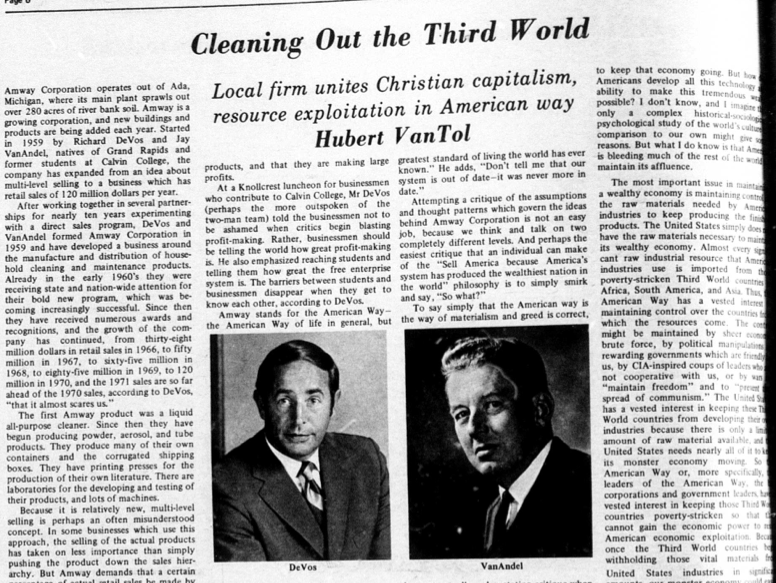
While working on a project to look at anti-Vietnam War organizing in Grand Rapids, we came across this article in a January, 1971 issue of the Calvin College Student newspaper, The Chimes, entitled, Cleaning Out the Third World.

Screen Shot 2014-08-12 at 7.40.21 AM

The student who wrote the article, Hubert VanTol, attended a business luncheon on Calvin’s campus and heard both Richard DeVos and Jay Van Andel speak. VanTol provides a summary of the Amway philosophy early on in the article, but in the last third states the following:

The most important issue in maintaining a wealthy economy is maintaining the control of the raw materials needed by American industries to keep producing the finished products. The United States simply does not have the raw materials to maintain its wealthy economy. Almost every significant raw industrial resource that American industries use is imported from poverty-stricken Third World countries in African, South America and Asia. Thus, the American Way has a vested interest in maintaining control over the countries from which the resources come. The continuation might be maintained by sheer economic brute force, by political manipulation or rewarding governments which are friendly to us, by CIA-inspired coups who are not cooperative with us or by wars to “maintain freedom” and to “prevent the spread of communism.” The United States has a vested interest in keeping these Third World countries in developing their own industries because their is only a limited amount of raw materials available and the United States needs nearly all of it to keep its monster economy moving. So, the American Way, or more specifically the leaders of the American Way, the large corporations and the government leaders have vested interests in keeping those Third World countries poverty-stricken so they cannot gain economic power to resist American economic exploitation.

The student writer then connects this larger critique of capitalism and US Imperialism to Amway by stating:

….because of its name and because of what the purpose of the company seems to be – to sell and promote the excellence of the American Way – the company has become an adequate symbol for every United States business. And Amway stands for those same ideals which have made world-wide exploitation of the poor possible. A fantastic belief in free enterprise without governmental or “socialistic” controls is logically consistent with the outlook that the United States has the right to use the world’s resources indiscriminately. A belief in scientific progress is logically consistent with the belief that solutions will always be found for the world’s problems before a crisis explodes. A belief that economic strength is the ultimate test of the “rightness” of a system is logically consistent with producing suicidal weaponry at tremendous cost to protect the system, with polluting the world to a slow death, with maintaining slaveholder control over much of the rest of the world in order to maintain the strong economy.

Hubert VanTol may not have envisioned the ongoing growth and political influence that Amway and its founding families would wield in West Michigan or in US domestic and foreign policy, but he certainly had a fairly accurate understanding of the power dynamics that have allowed the Ada-based company to grow. The past is the present.

Posted in Anti-Capitalism/Labor | Tagged , , , | 3 Comments

Nuclear Resistance in Grand Rapids – 1985

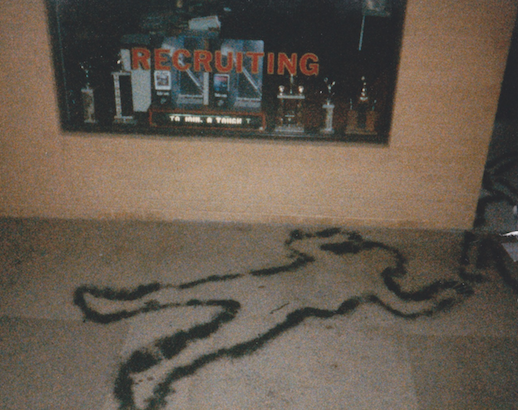
People have engaged in all sorts of opposition to nuclear weaponry and militarism in West Michigan since nuclear weaponry was used against the civilian populations of Hiroshima and Nagasaki, Japan.Screen Shot 2014-08-11 at 6.57.20 AM

We found the picture included here from an action that numerous people took in 1985 on the anniversary of Hiroshima and Nagasaki. The street theater action took place in the middle of the night and included people laying down at various places and having the outline of their bodies made with ground up rubber.

In the morning of August 6th, 1985, people in the downtown area discovered these human outlines that also had a stack of flyers next to them stating:

What you see here are the outlines of human bodies, just like what was discovered in Hiroshima and Nagasaki, Japan in 1945, after the US military dropped nuclear bombs on those two cities. The bodies of residents of many at Hiroshima and Nagasaki were completely incinerated, with only an ash outline of where their bodies where.

We oppose the US production, testing and global build up of nuclear weapons and believe that the very idea of a nuclear deterrent is absurd.

You can see in this picture that the location of the outlines of these human bodies was in front of a US military recruiting center, which used to be on the east end of the old Monroe Mall, exactly on the spot in front of what is now Monument Park.

Posted in Anti-Nuclear Movement | Tagged , , | 1 Comment